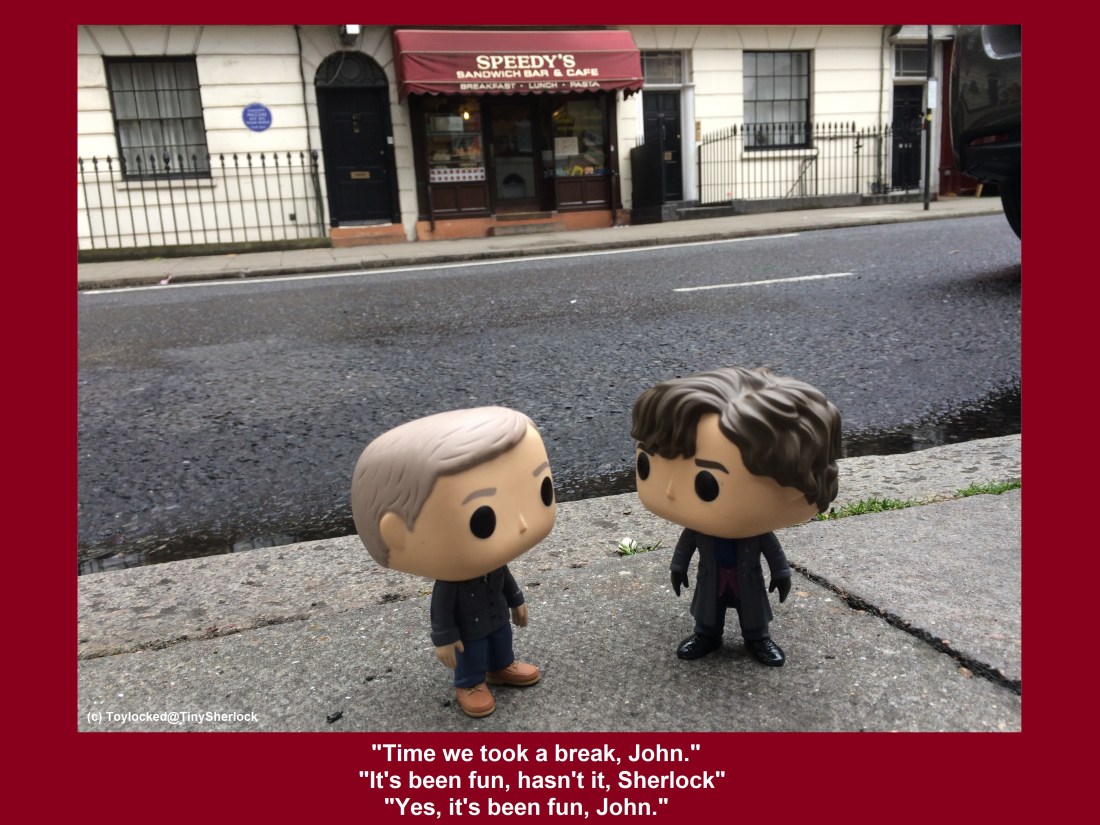
To the best of times…

farewellI’ve decided to take a break. After 147 images, published and in some cases re-published over 18 months, I’m wary of spreading the ideas too thinly. I’ve loved running the Toylocked accounts on Facebook and Instagram, and I’ve loved creating all these pictures, but I need the time to do other things for now. I may be back – never say never!

I have now assembled all the pictures in episode order here and there are some very important acknowledgements and thank-yous to makers of various toys and props and the great transcriber, Ariane de Vere, here.

Thank you to everyone who has commented, followed and liked over this time. I hope the blog has answered questions about how the pictures were made, and I will be checking all accounts for more questions, which I will be happy to answer. In the meantime, thank you for all the TinySherlock love.

Alison

vow 007

A Day Trip to Sherrinford

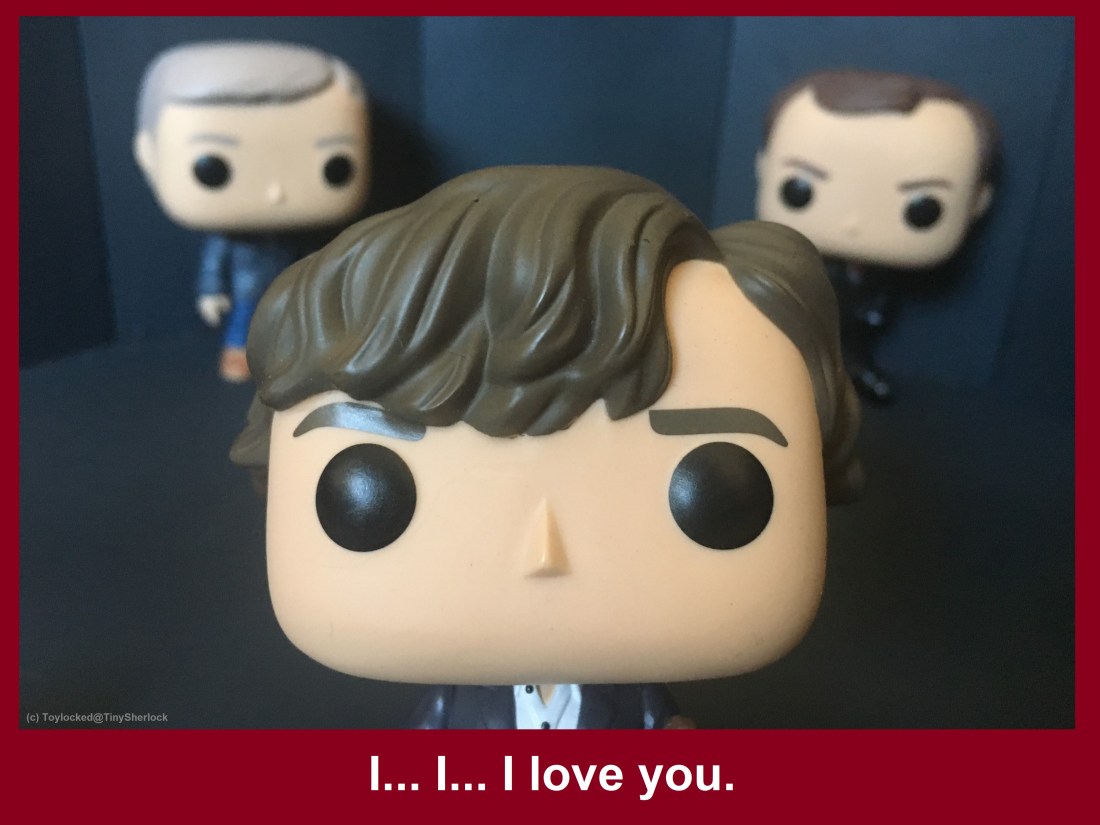
Opinions are somewhat divided on the merits of the last series, and especially the last episode, The Final Problem. I chose not to judge, but simply to portray scenes from the series as well as possible, and there were quite a few scenes in that episode which were worth recreating. A trip to East Sussex last year helped… the beautiful beaches at Camber Sands were crying out for an invasion of toys.

IMG_4048

A flat piece of sand, a couple of Playmobil people tied together with string and some writing in the sand made this one very easy:

arriving at sherrinford

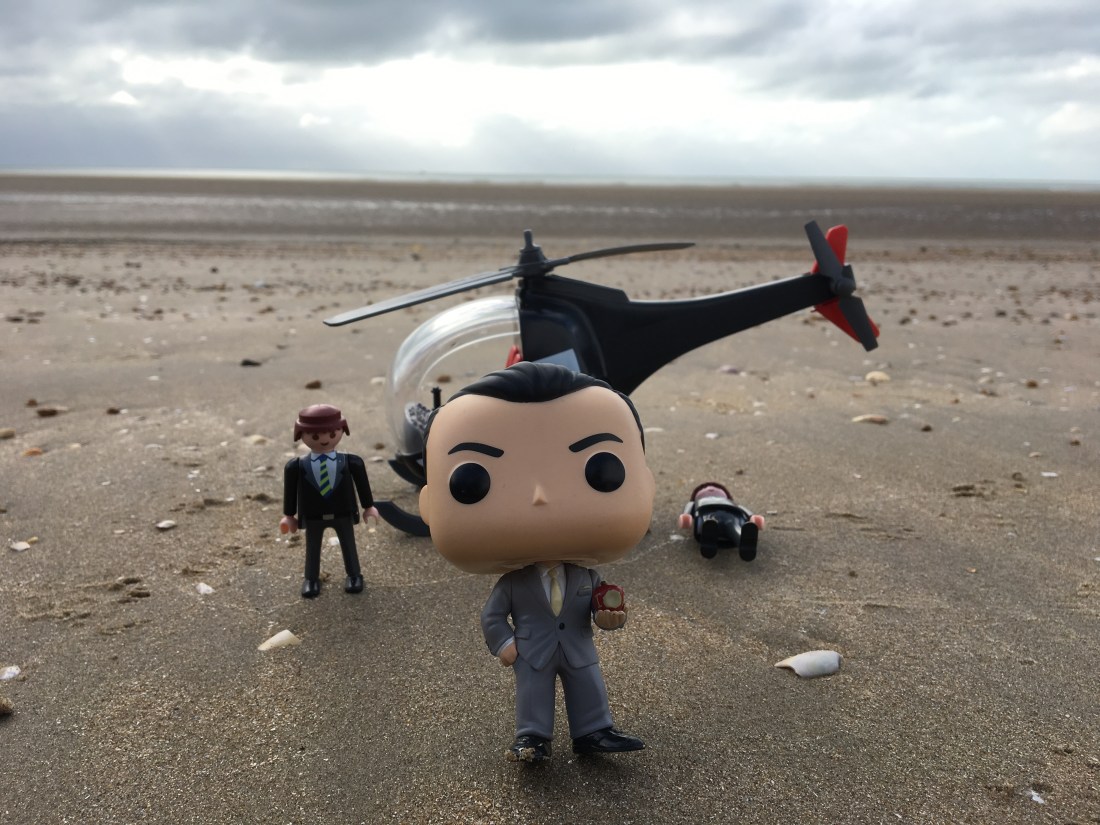
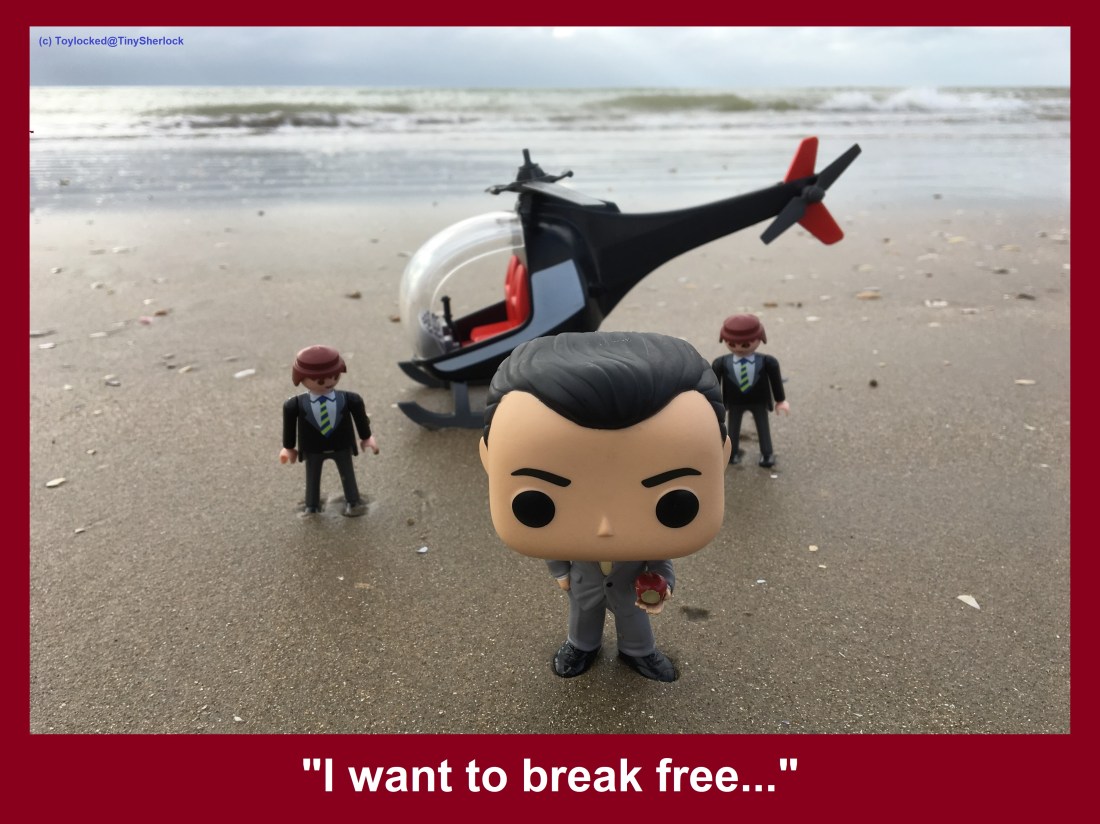
Moriarty’s arrival at Sherrinford was slightly more complicated. It was a breezy day, the Playmobil helicopter rotors kept moving, the Playmobil “minders” kept falling over, and Jim, in the way of Funko Pops, had a very big head which made him hard to keep stable in the wind: in this shot, one of the minders is down and Jim is in the act of falling.

IMG_3991

Because I had to move the toys several times, the sand became disturbed and I had to try different parts of the beach. In the end, I went nearer to the sea so the waves could be seen in the background. As often, it wasn’t until afterwards, when I went through my photographs on my laptop, that I was sure I had one good enough to use:

final 006

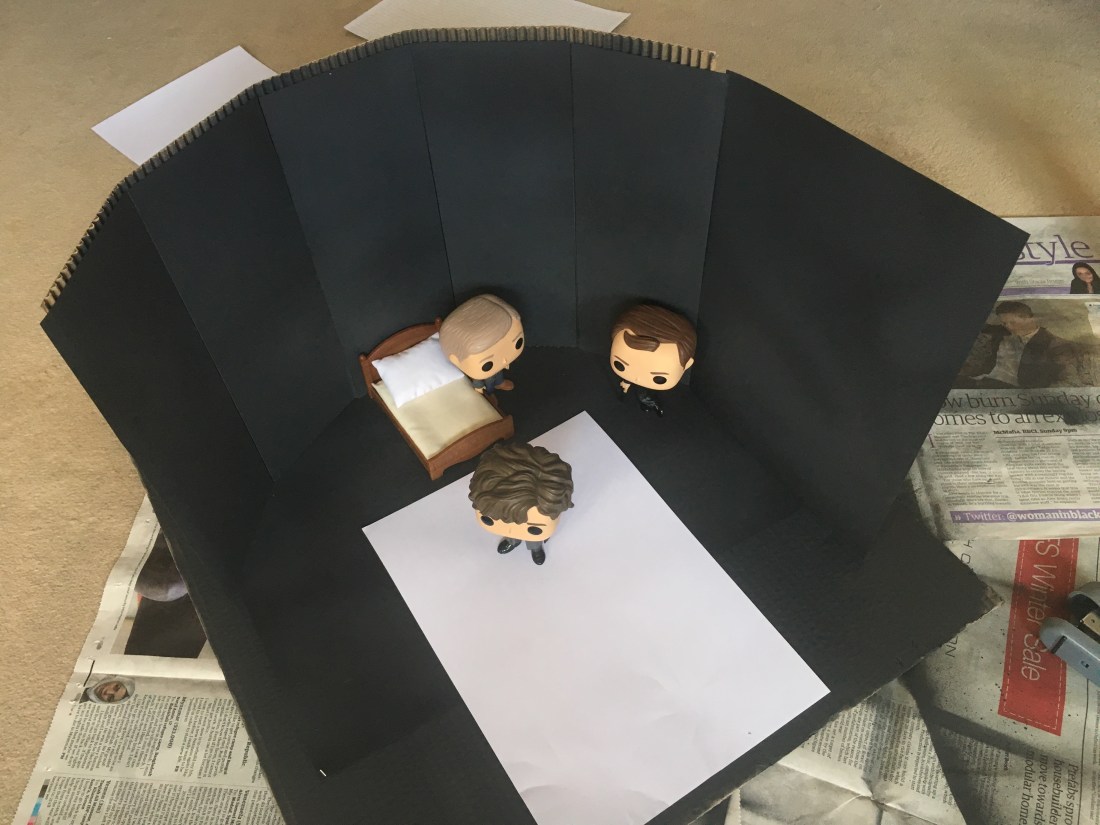
To create the gloomy atmosphere inside Sherrinford, I wanted to replicate the dark and slightly mottled walls seen on the set. I took advice from an artist friend on experimenting with spray paints, and eventually sprayed black card with dark grey car paint. This was just enough to reflect the light slightly differently as compared with plain paper.  As with previous scenes, I simply took a photograph of my tv screen to check the layout:

IMG_0530(1)

The walls of Eurus’s cell are straight panels arranged around a curve. I pinned my painted panels to a large sheet of corrugated card, curved to create slight angles between the panels. The bed is actually from a “Sylvanian Families” set, about as far from the world of Sherrinford as I can imagine!

IMG_0541(1)

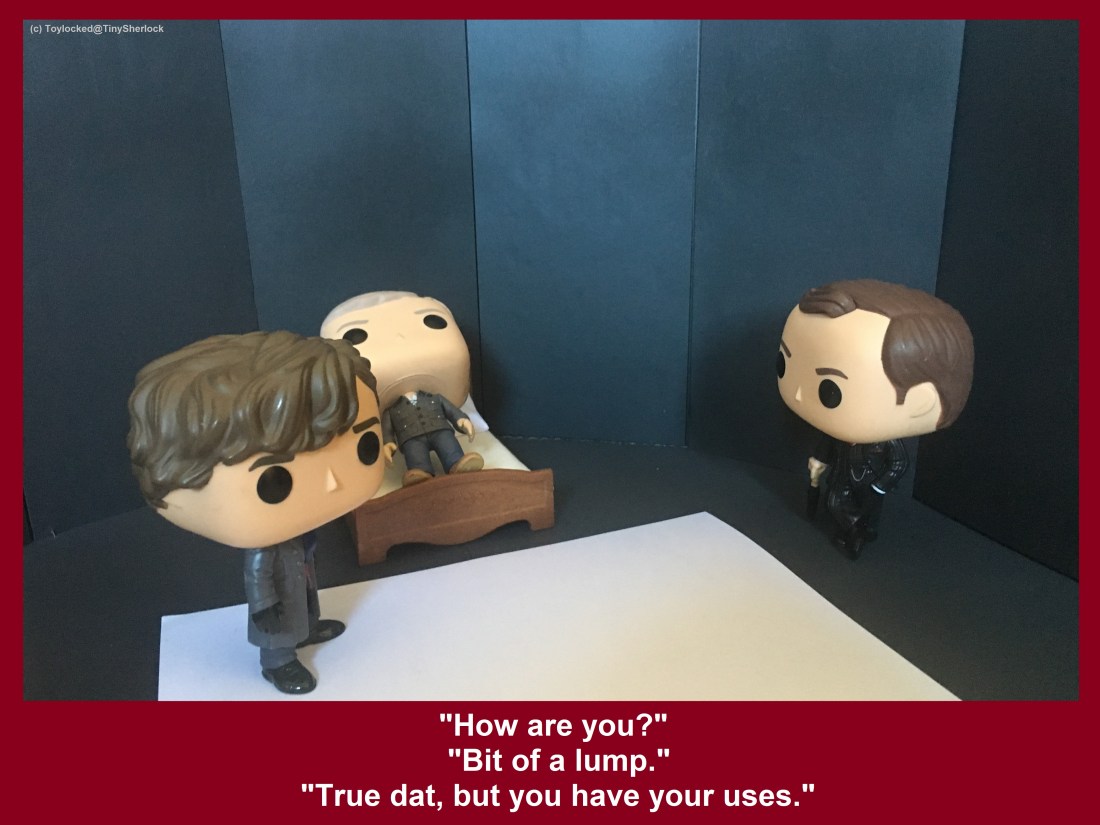
With dimmed lights and carefully balanced torches, I got the gloomy effect I wanted:

final 007

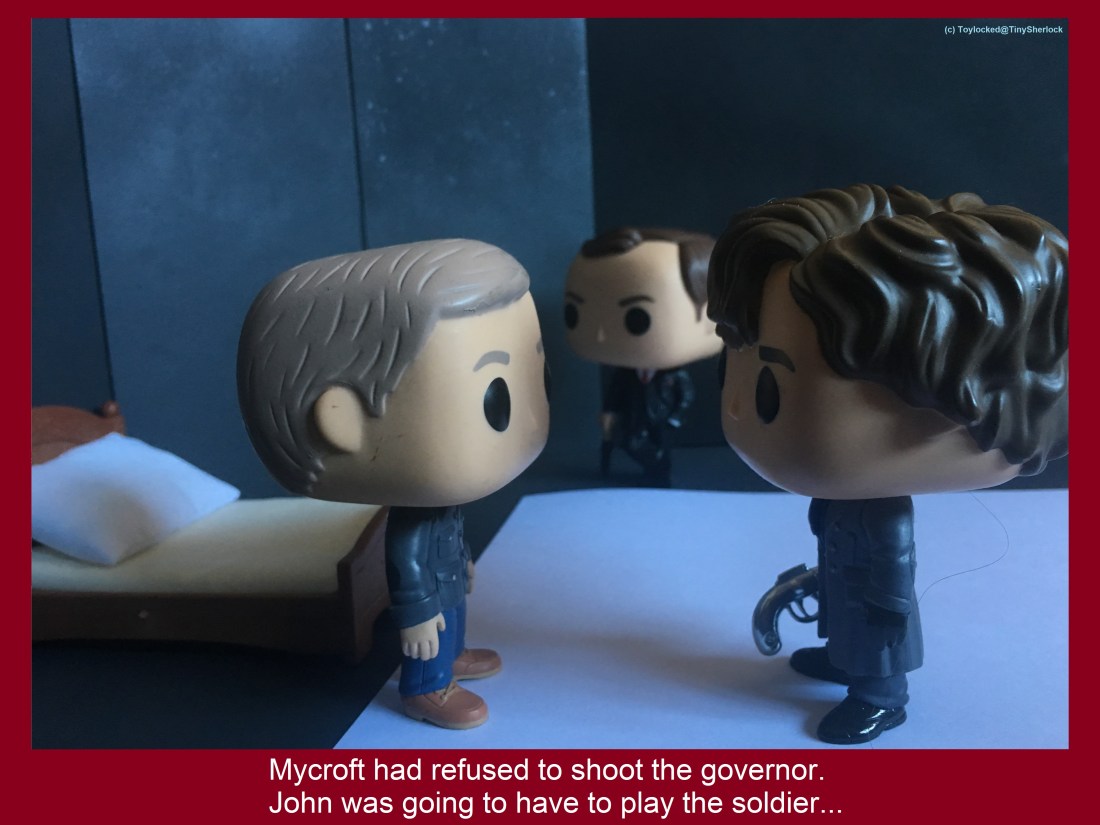
The gun which Sherlock hands to John, after Mycroft refuses to be drawn in, is from the Sherlock Cluedo set, stuck to Sherlock’s hand with Blu-tak:

final 008

As our brave trio go through their ordeal, the situation is made grimmer by Moriarty’s teasing videos from beyond the grave. I took a screen shot of his appearance on the screen, edited out Andrew Scott, placed the Moriarty Funko in front of the laptop screen and took a photo! A little colour adjustment and there he is in his villainous glory!

final 009

For Sherlock’s agonising conversation with Molly, orchestrated by Eurus, the key was to position the toys so that the sizes indicated distance:

sherlock talks to molly

Otherwise, it was simply a question of using the set I’d made for Eurus’s cell, and focussing on Sherlock rather than John and Mycroft:

final 010

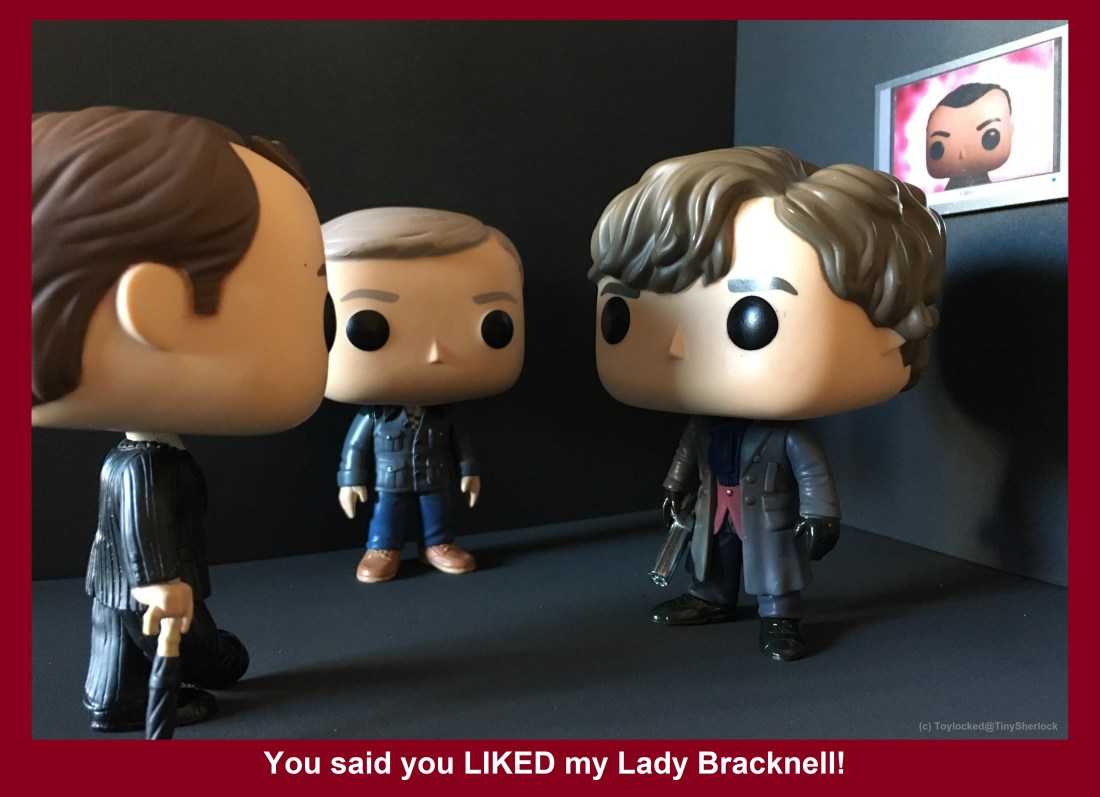
The picture I’d made of Moriarty cheering on proceedings then came in handy for a couple more pictures. I bought a tiny flat-screen tv from an online supplier, printed out the Moriarty picture to the right size and stuck it on the tv.  I made a rectangular room with the same grey-sprayed black card for these.

final 011

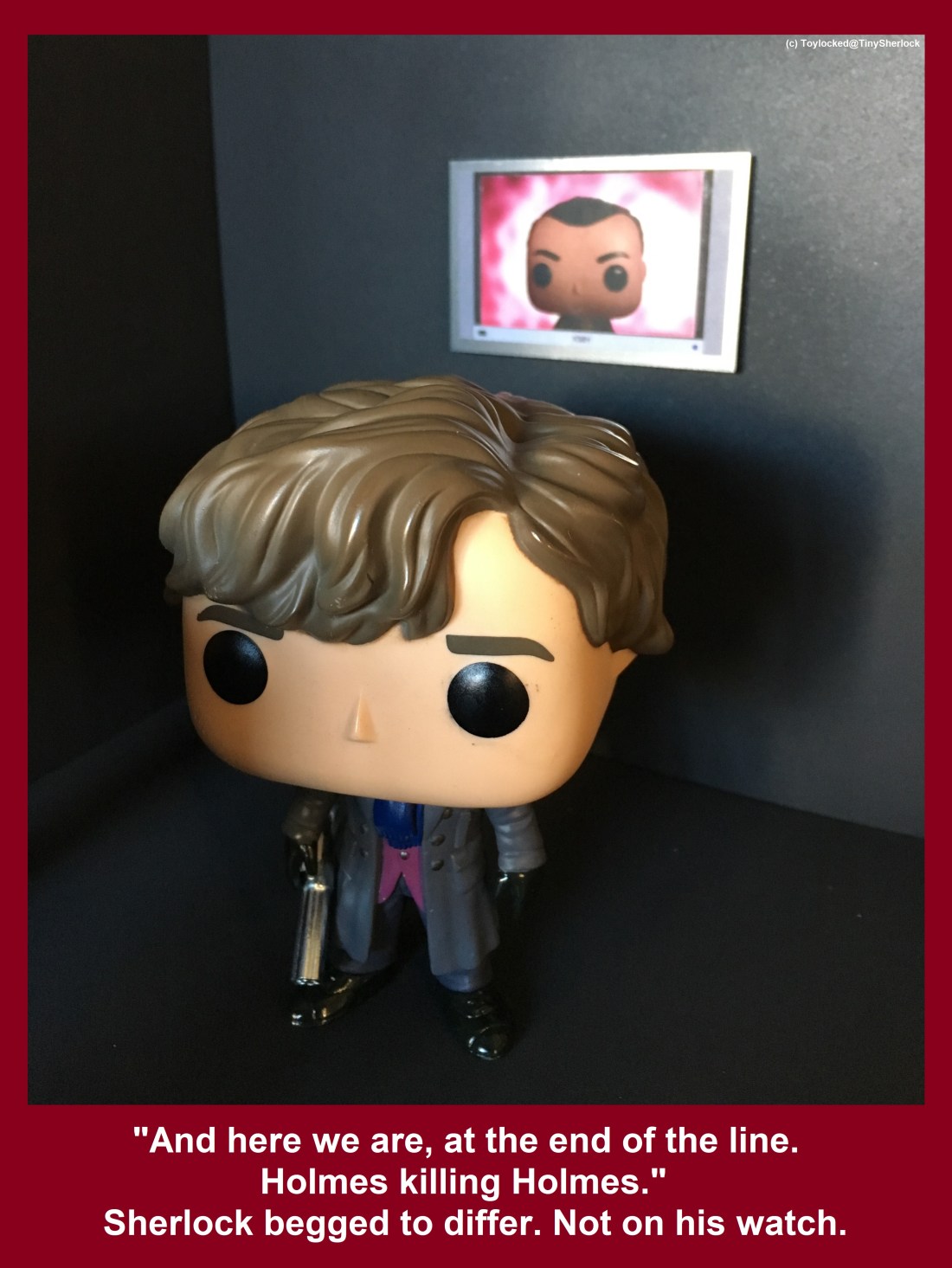
I was particularly pleased with the one of Sherlock standing alone, taking his brave decision to call Eurus’s bluff. Sometimes it’s the simplest pictures which work best:

final 012


Sentiment is a chemical defect

runway titled

The most popular and most shared Toylocked pictures are those which depict scenes which touched viewers’ emotions. Some of these were easy to put together, but required a lot of thought to get the tone right.

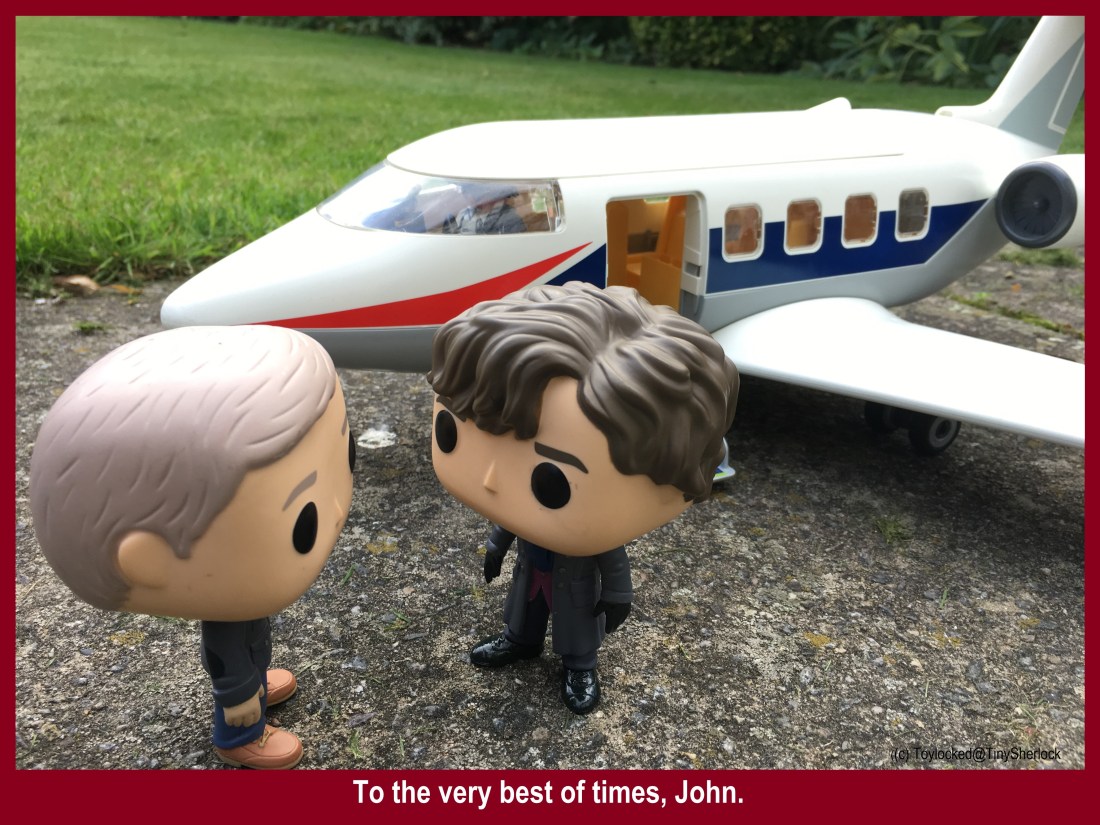
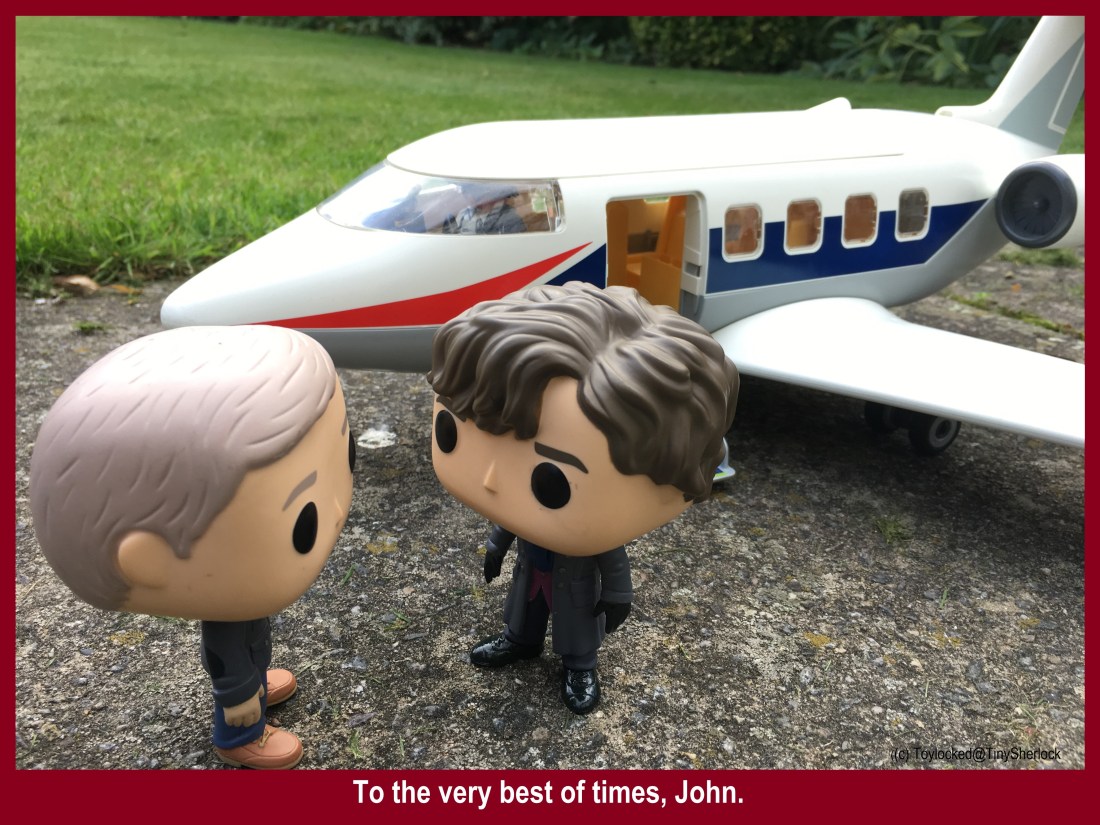
Sherlock and John’s farewell on the runway, at the end of His Last Vow, was a enabled by the purchase of a Playmobil aeroplane on eBay. Playmobil toys have helped with many of the pictures, and there is a young member of my family who has benefited greatly from my purchases! I was not entirely happy with this picture – I took it in my garden, and you can see shrubs in the background – but I like the position of the toys and I do think they look rather sad.

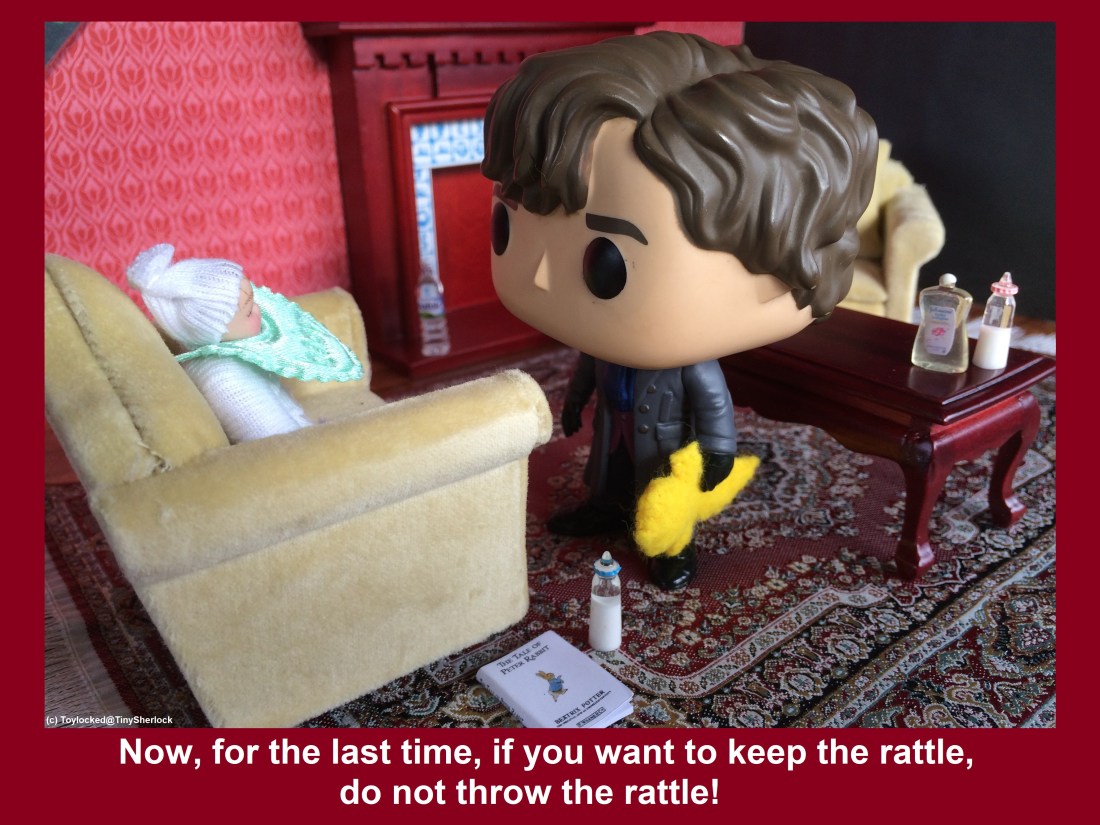
An emotional but funny scene in The Six Thatchers, when Sherlock is seen telling baby Rosie not to throw away her rattle but we think at first he is talking to John, allowed me to use some new props:

sherlock ratttle

The bottles of baby milk, the baby oil, the baby and its bib are all from online suppliers. I really love the tiny version of “The Tale of Peter Rabbit”, which I bought on a whim and found a space for it in this picture. I made the rattle itself from yellow felt and put it in Sherlock’s left hand so it was more visible.

rattle

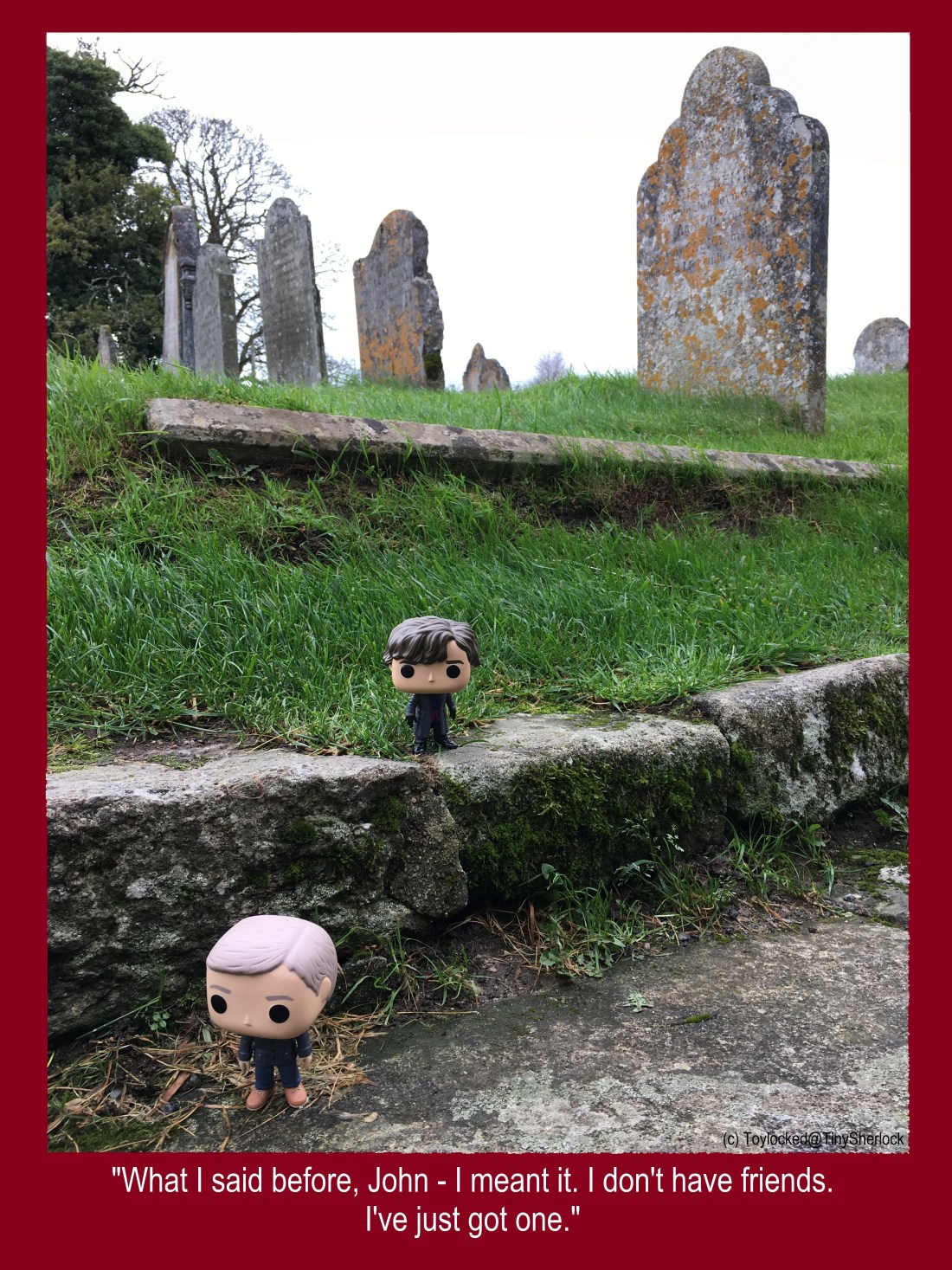
One of the key moments in Sherlock and John’s friendship is in The Hounds of Baskerville when, having had a row in the pub the night before, they start talking again in the churchyard. John walks down the steps, and Sherlock calls him back: “I don’t have friends. I’ve just got one.”

I was on Dartmoor anyway (see my first blog from 15 October 2018 on taking pictures at Hound Tor) and this picture is taken in the churchyard at Widecombe in the Moor, the right area for the story if not exactly the right churchyard (as the scene was filmed at St Hilary, Vale of Glamorgan, South Wales)! By balancing John so his heels were on a bit of grass, I managed to make him appear to be walking away looking down at the ground. Sherlock looks very small and lost with the huge gravestones behind him.

friends titled

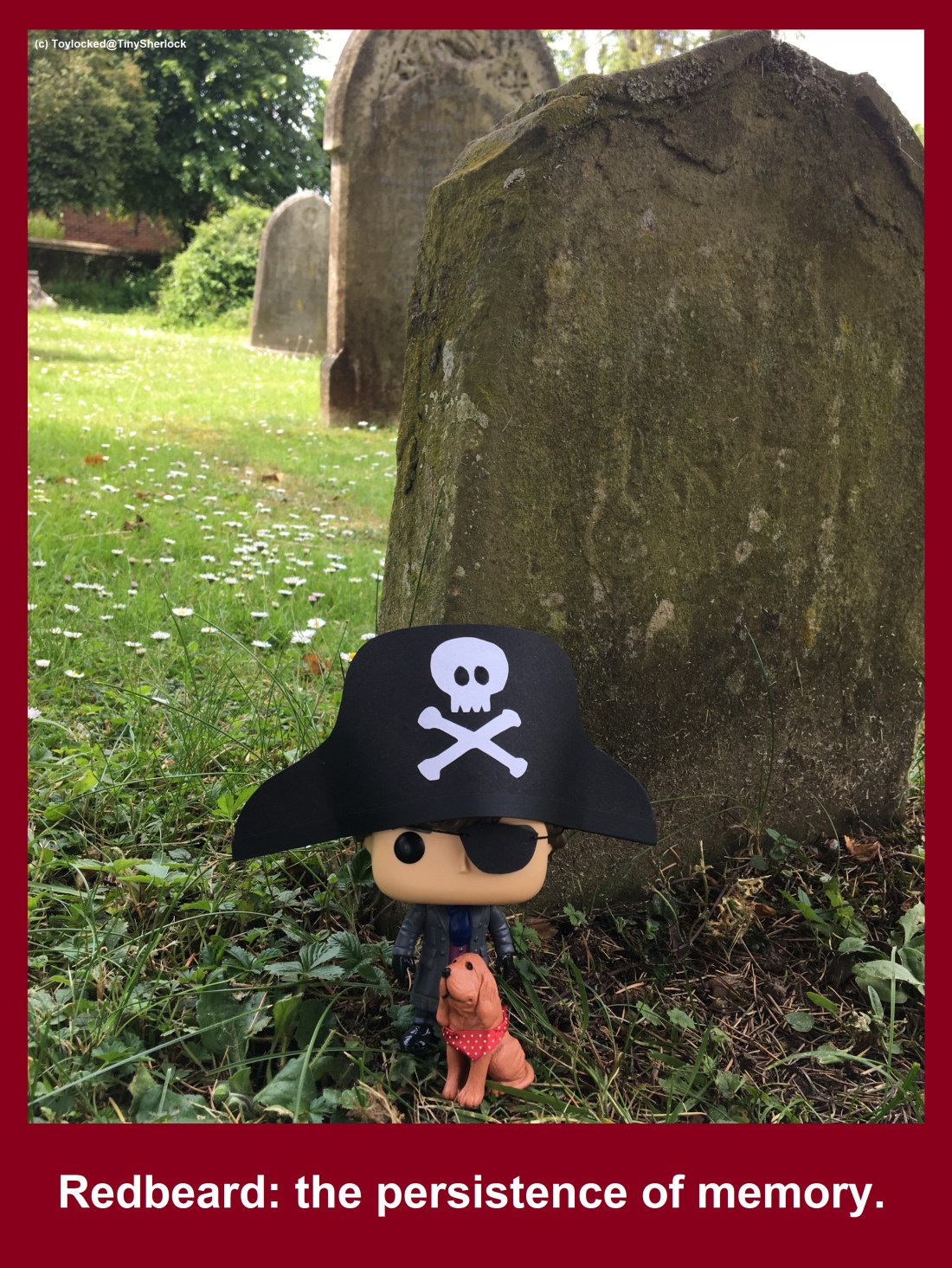
Near my home is a large cemetery which includes a number of old graves as well as modern ones. I wanted to create a picture around the gravestones in the garden of Musgrave Hall, as depicted in The Final Problem.  I liked the idea of Sherlock’s false memory of Redbeard, and found a “puppy in my pocket” on eBay which looked very like the dog in the show.  The pirate hat and patch are made of paper (see my blog “To Cap It All” from 13 November 2018 on making hats), and the dog’s bandanna is from a small piece of spotted ribbon. I was really pleased with this picture – even the dog seems to look wistful…

redbeard

But of course, the most famous cemetery scenes in the show are based around the grave where John believes Sherlock to be buried. Here John makes his heartbreaking speech at the end of The Reichenbach Fall.

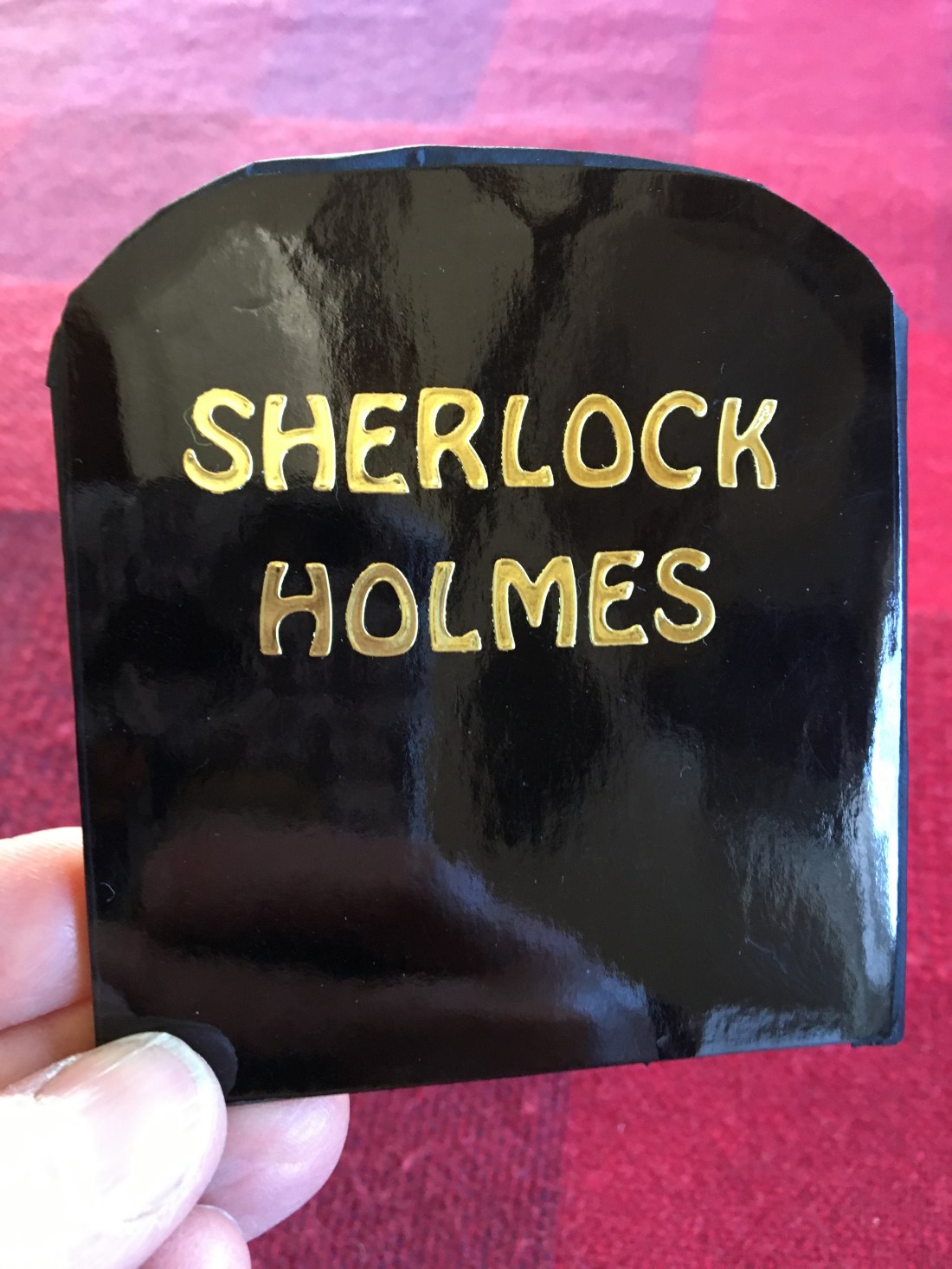
First, I had to make a tiny gravestone. I cut a piece of thick card, covered the edges with black masking tape, and stuck shiny black card on the front and back. Luckily, the stone in the episode is relatively simple, and I found some gold stick-on lettering which caught the light nicely.

IMG_6648

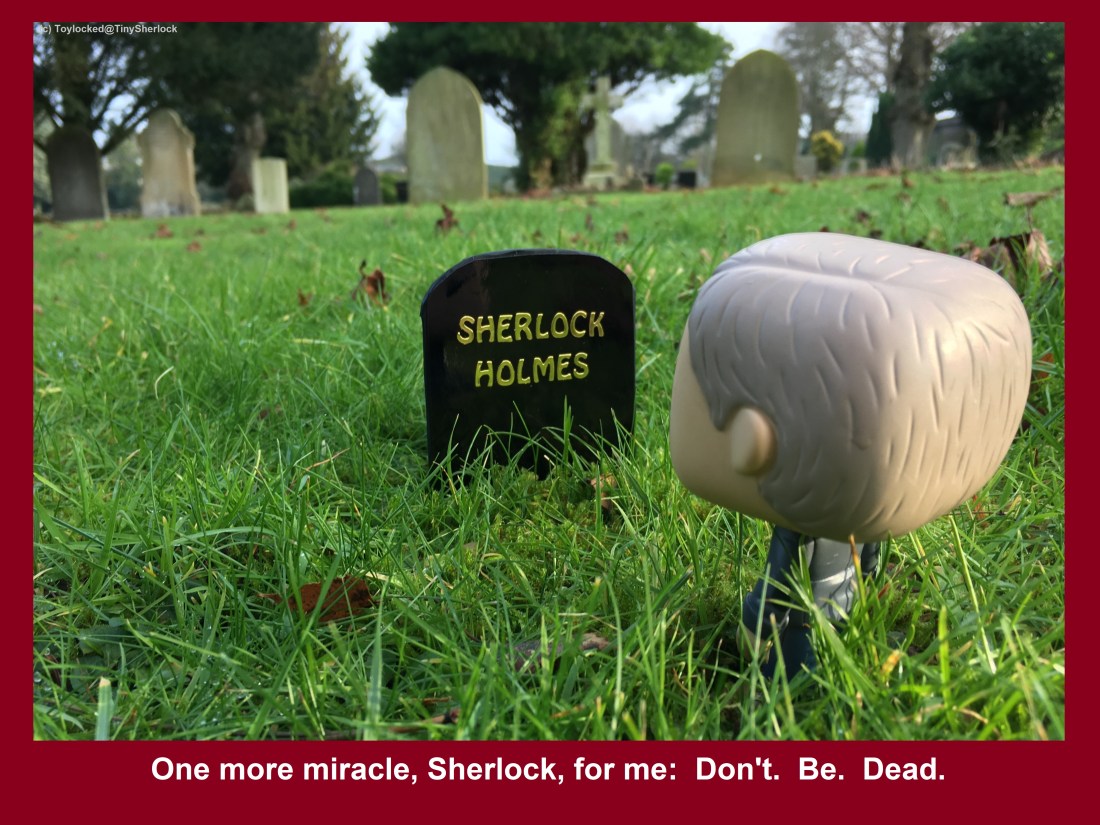
I found a spot with old gravestones in the background, but not too close, and fixed my little Sherlock gravestone by pushing cocktail sticks into the bottom of the card and into the ground. The first shot is relatively close up, with John making his speech.

graves 1

This picture was shared multiple times on Facebook, and was seen by over 120,000 people. I know this is because the scene itself resonated with people’s feelings, but I am glad that the picture worked for people.

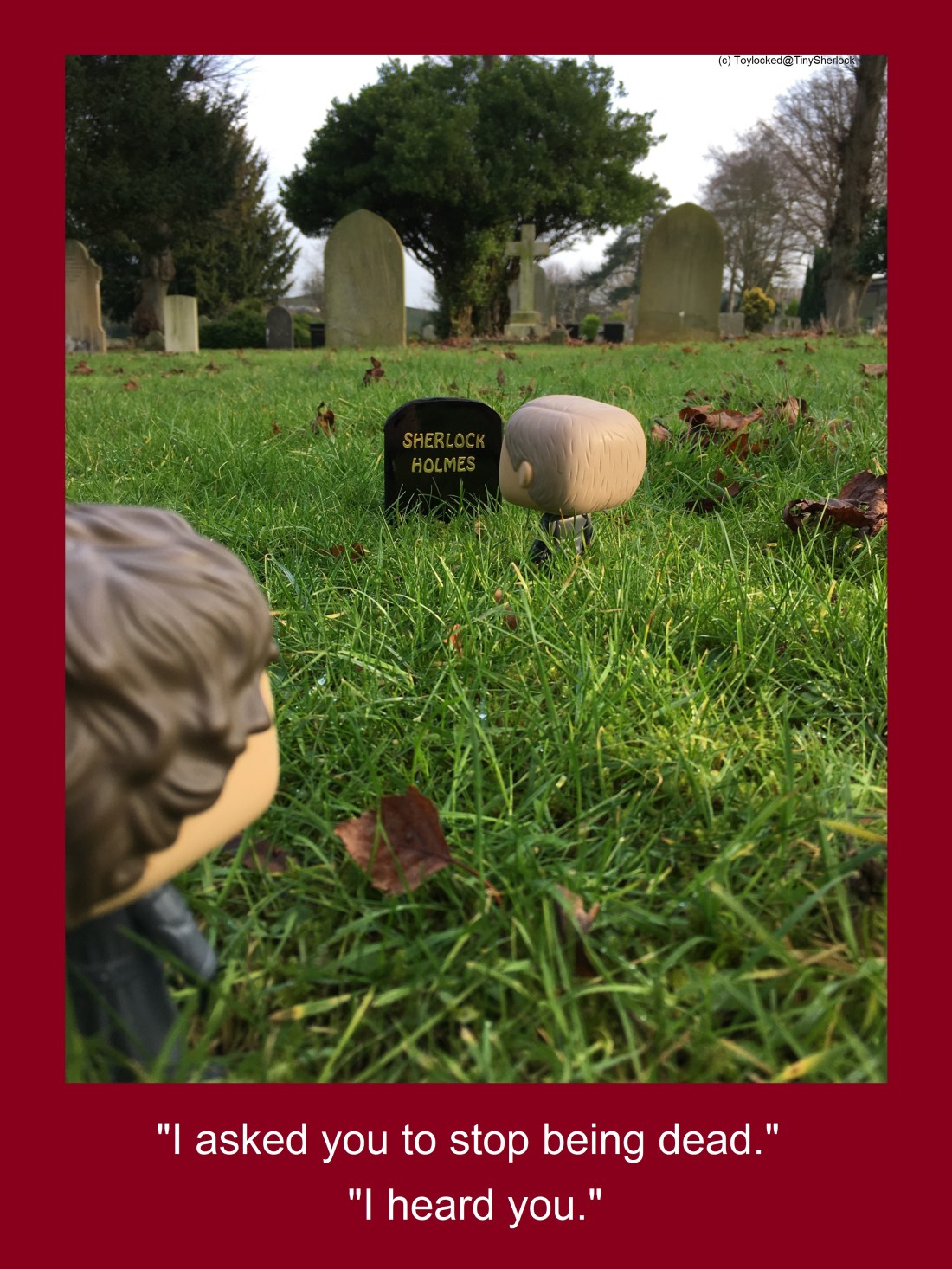
In the show, the camera pans away and we see Sherlock watching from under a tree. To add to the emotional weight, I added the words from The Empty Hearse where John recalls his speech to his dead friend, and Sherlock replies that he heard John’s wish. Hearts broke.

This picture was also popular, although not shared quite as widely. I like the image of poor little John, almost dwarfed by the grass and leaves, grieving while Sherlock watched helplessly from a distance.

graves 2

Interior Monologue (part 2)

The hallway in 221B Baker Street is usually quite dark, and not enormously welcoming. But it is the scene of a lovely moment in A Study in Pink, when we see Sherlock and John beginning to become friends.

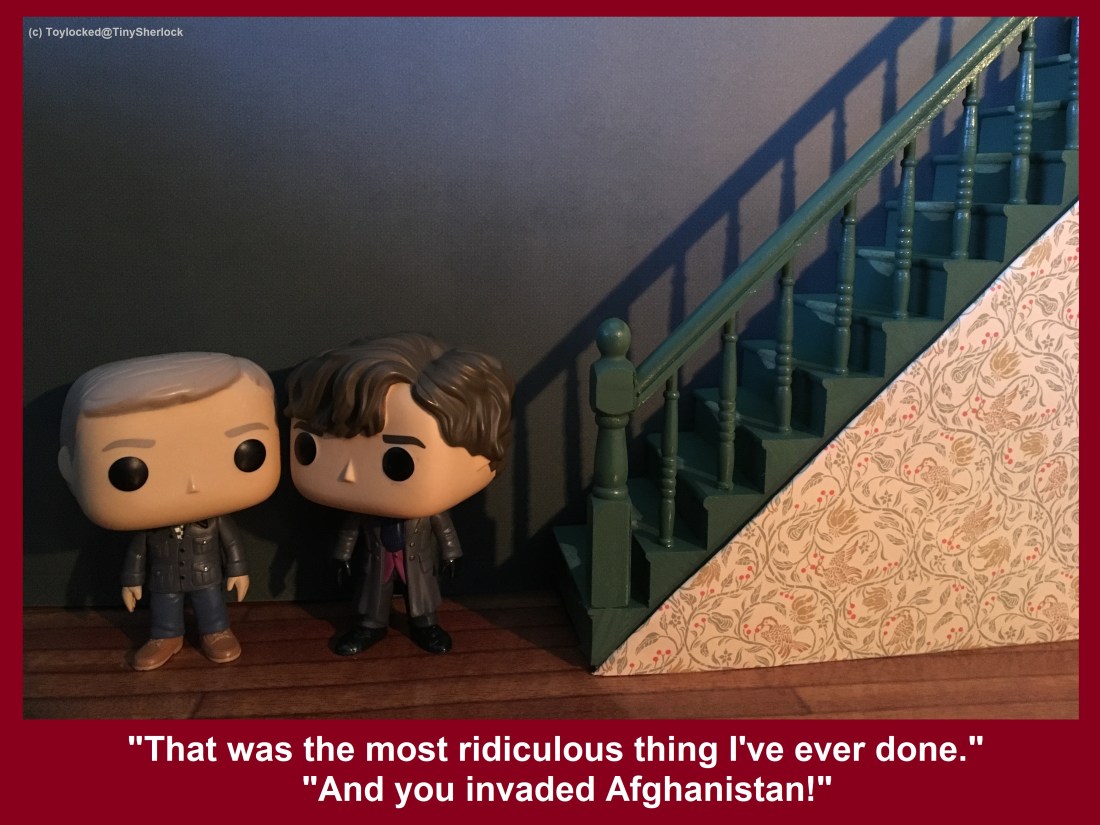
invadedI was really pleased with the shadows in this shot – I set it up in a darkened room and lit it with an old, rather yellow-beamed torch which threw shadows onto the back wall.

The staircase was from an online dollshouse supplier. I wanted to show the rather dilapidated nature of the stairs, so I covered a small part of each step with masking tape before I sprayed the staircase with paint, to give the effect of wear and tear from countless feet.  I made a cardboard frame around it to block it in. From the back it’s not so elegant:

IMG_5962The wall in front of the stairs is covered with a dollshouse wallpaper which was the nearest I could get to Mrs Hudson’s choice of paper for the hallway:

hallway paper

The same staircase set worked for Jim’s arrival at Baker Street in The Reichenbach Fall:

jim stairs

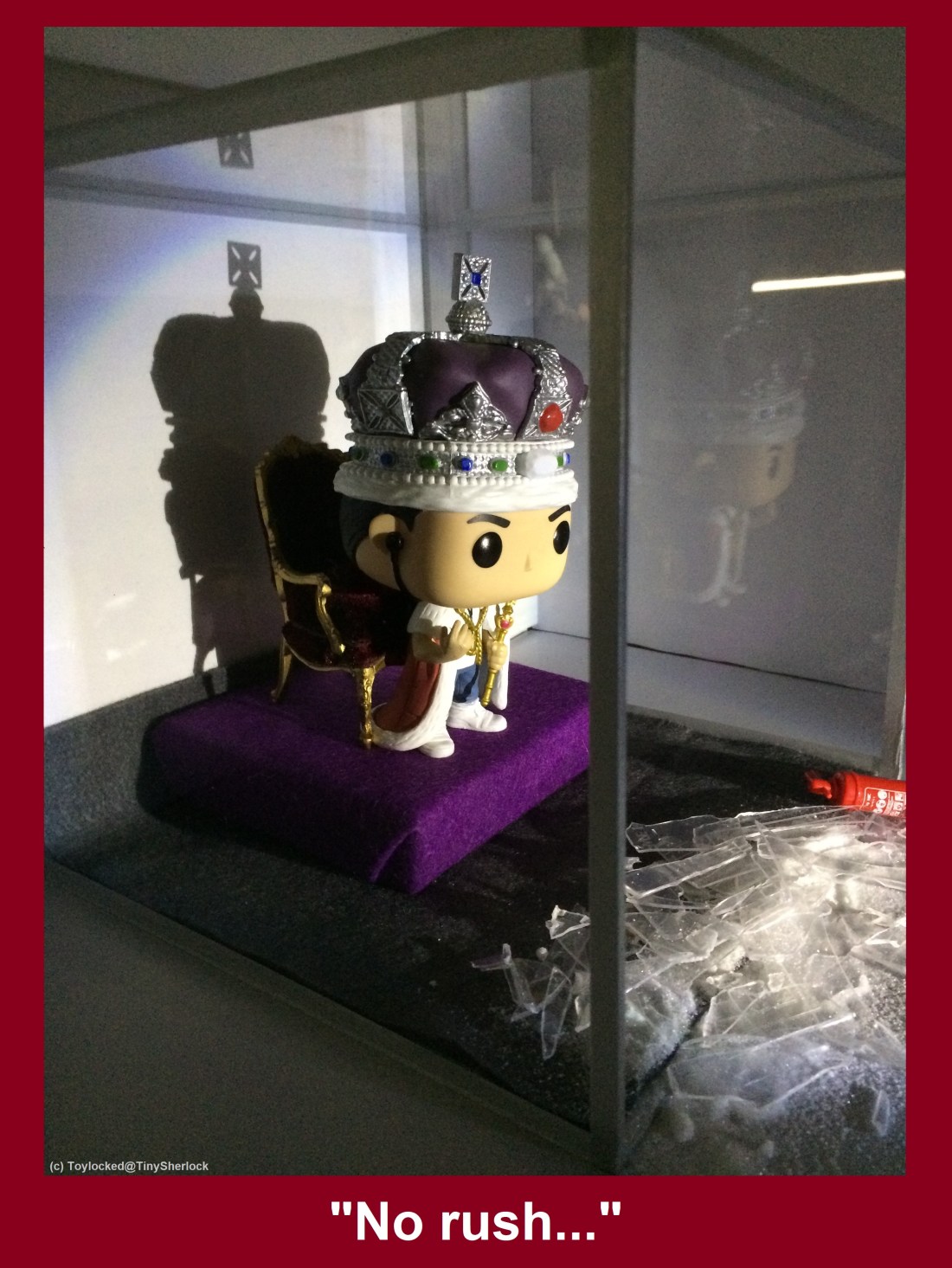
Jim has two FunkoPops. The other one is wearing a crown, as seen at the Tower of London in The Reichenbach Fall. This meant that the only way to use this Funko authentically was to set up the scene when he is in the Tower, trying on the Crown Jewels. To give the impression of the glass case in which the jewels reside, I bought a plain perspex display box and stuck silver masking tape round the edges. The shattered glass is just pieces of broken plastic and some sugar crystals. The throne is from an online supplier, and it sits on a cardboard box covered in purple felt. The fire extinguisher which Jim used to smash the glass is from a Playmobil ambulance. I had several goes at getting the lighting right – eventually I took the picture in a completely dark room, with two torches shining at different angles into the box to create reflections. Here he is, the cheekiest criminal in the world:

crown jewels

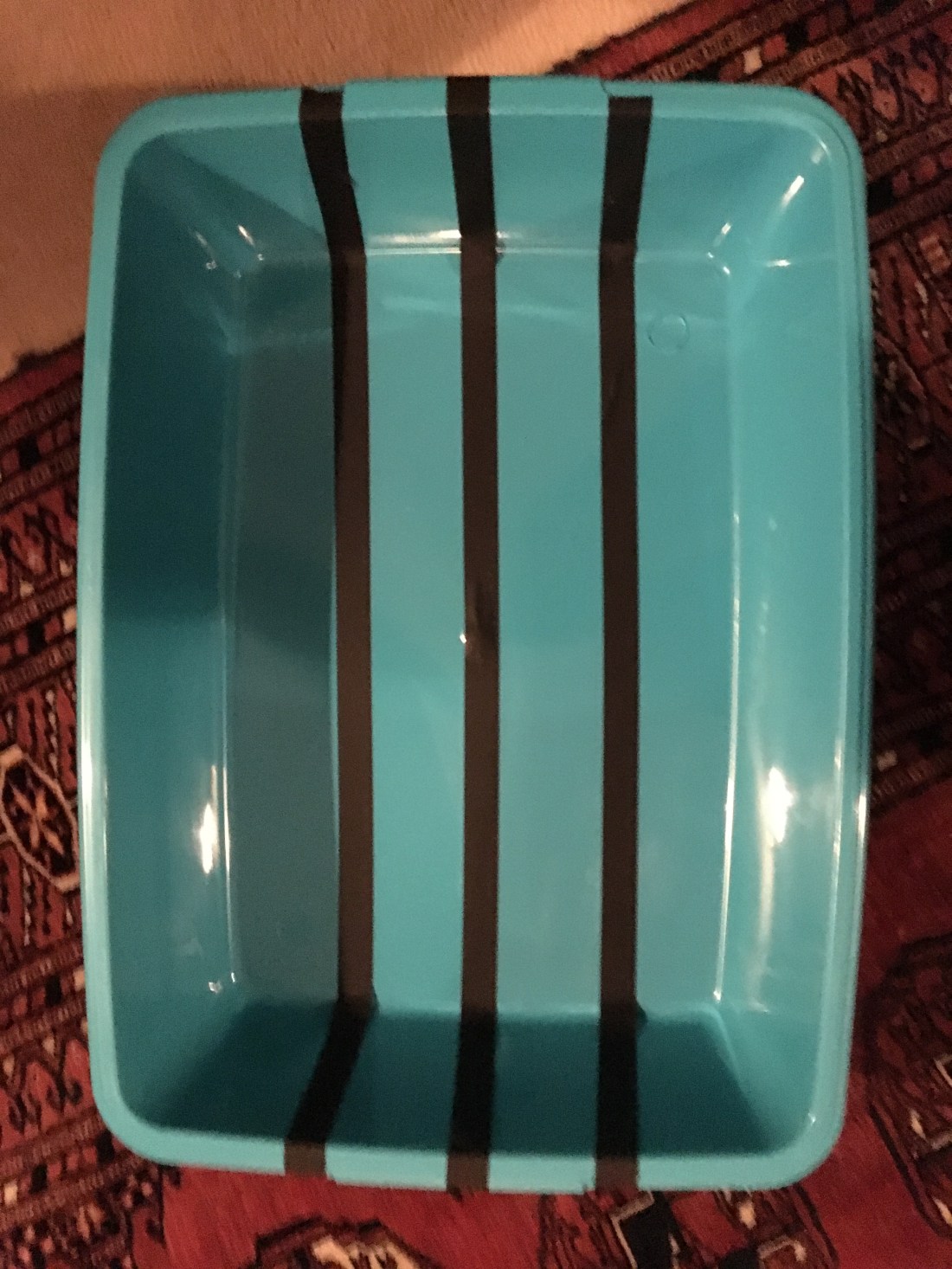
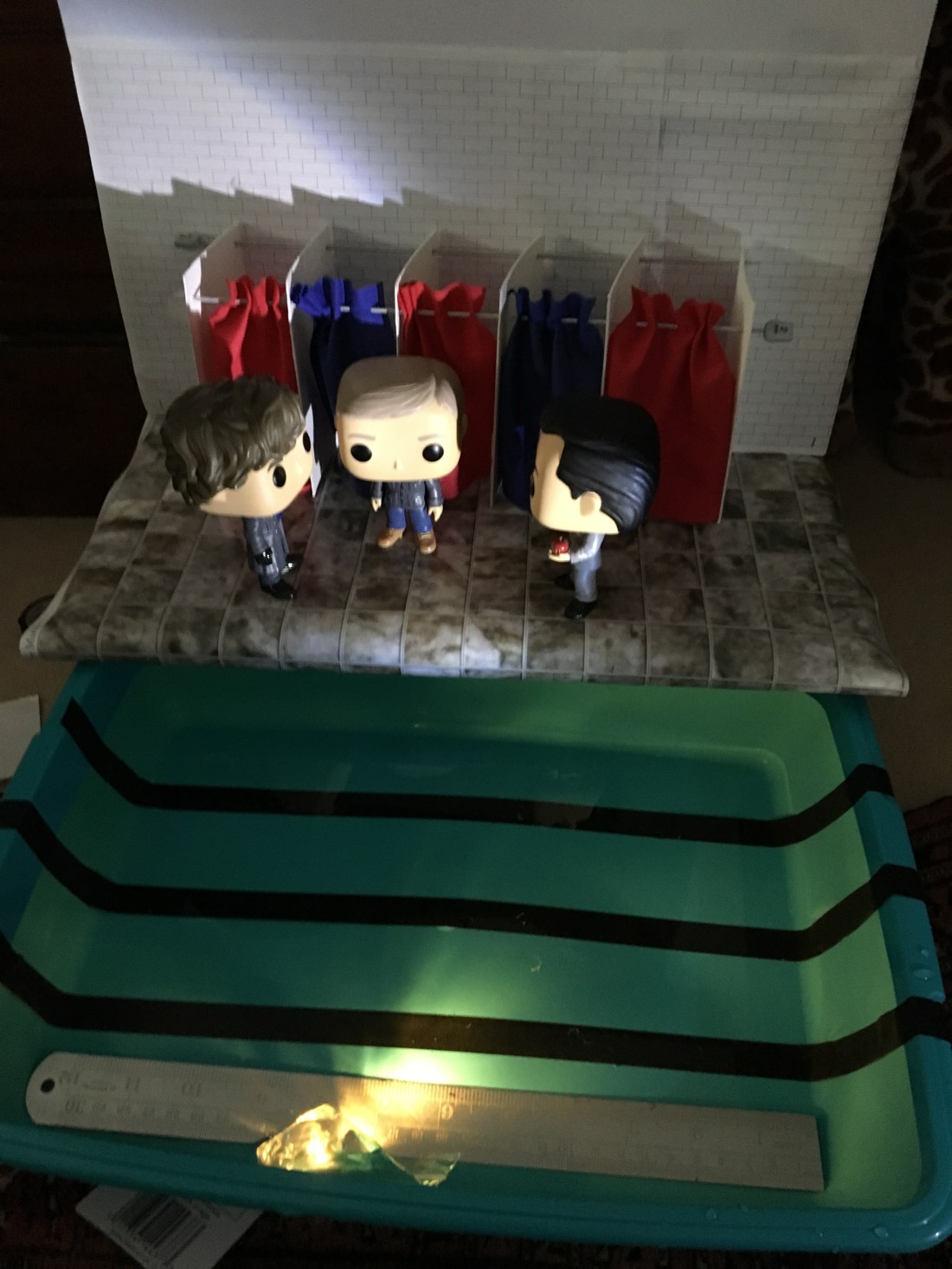
And while we’re on the subject of everyone’s favourite villain, one of the most challenging scenes to recreate was the infamous meeting at the swimming pool at the end of The Great Game.  How do you create a little swimming pool? By sticking black masking tape stripes along the bottom of a blue cat litter tray, that’s how.

IMG_4196 Then I had to make the changing cubicles. The sides of the cubicles are fine white corrugated cardboard. They are held together at top and bottom with thin knitting needles. The curtains are squares of blue and red fabric threaded on the top needle. The back wall is covered with the same tiling paper I used for the police cells (see my previous blog on interior scenes).

IMG_4195

The floor was tiling paper from an online supplier, wrapped round a chopping board. And the water was highlighted by placing a small lamp in a plastic bag in the water, out of shot, held down by a ruler:

IMG_2559

It was very tricky getting the right amount of background into the picture without losing the detail, but end result was suitably dark and a little bit sinister!

pool

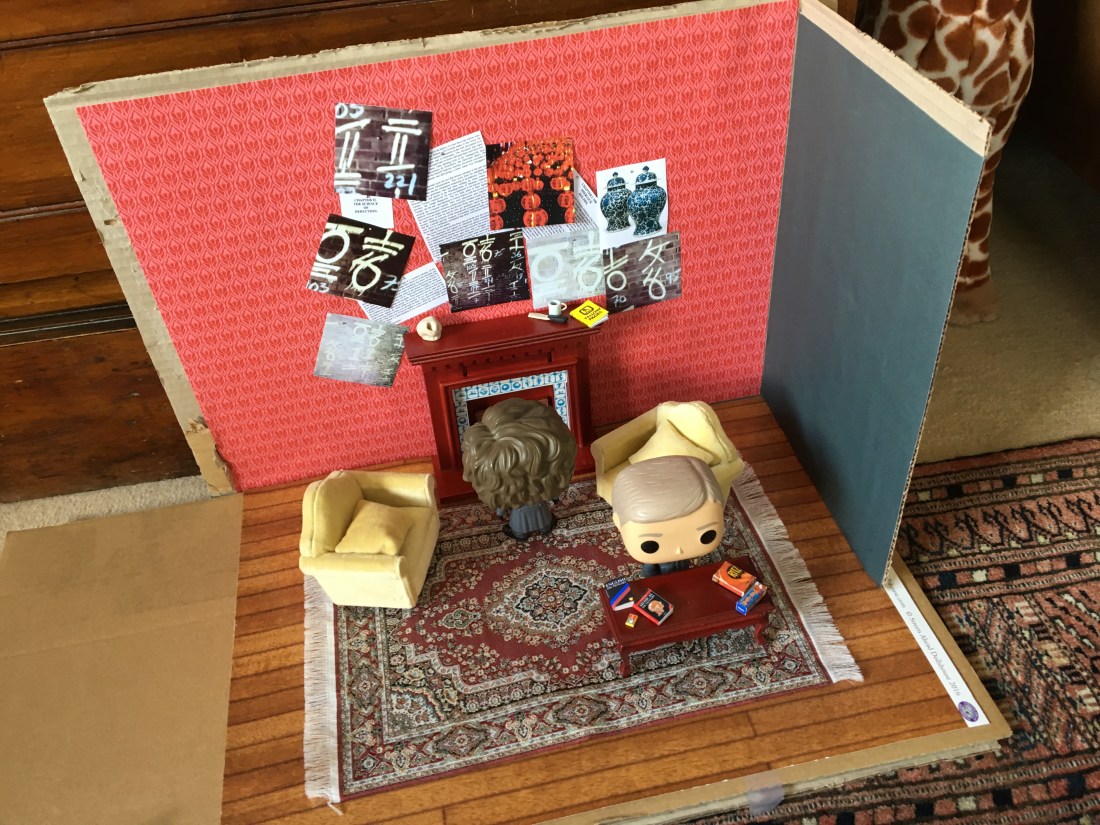
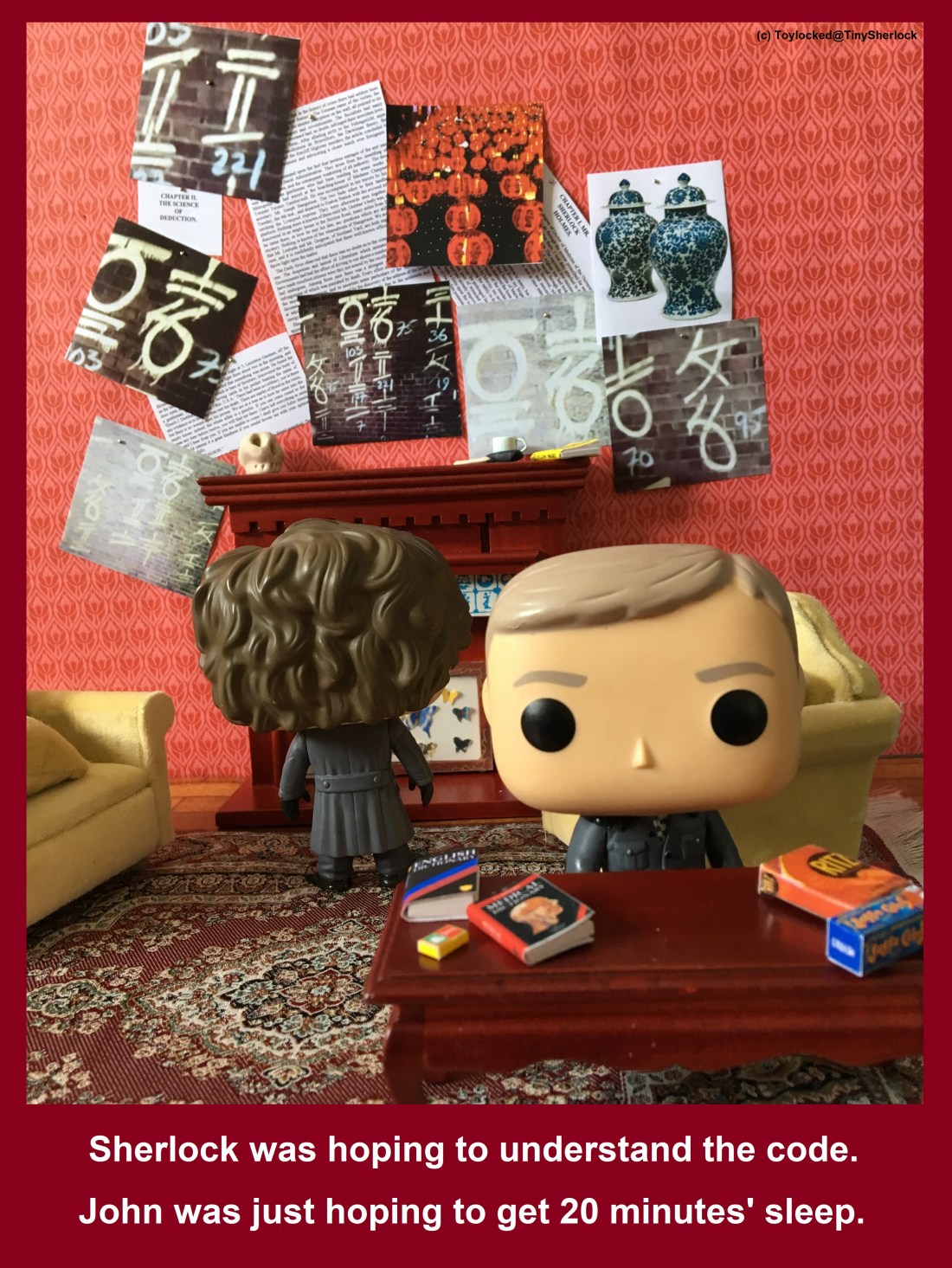
The living room of 221B is a familiar and rather comforting place. I didn’t want to get too wrapped up in trying to match the furniture exactly, but I did want my depictions to be recognisable.  At the fireplace end of the room, the wall is covered with a red and gold paper I wasn’t able to match, so I simply found a patterned paper which had the right feel. The furniture and fireplace are from the usual suppliers, as are the books and most other props. Sherlock’s skull is made of Fimo clay.

I decided to recreate the scene from The Blind Banker, where Sherlock tries to decipher the code graffiti’d round London, while John struggles to stay awake.

weary john

IMG_2240

I took screenshots of the graffiti and printed them out in various sizes. I printed out some pictures of Chinese vases and lanterns. The pages of writing pinned to the wall are actually sections of the text of A Study in Scarlet, the first of the original Conan Doyle Sherlock Holmes novels, printed very small indeed!

sleepy

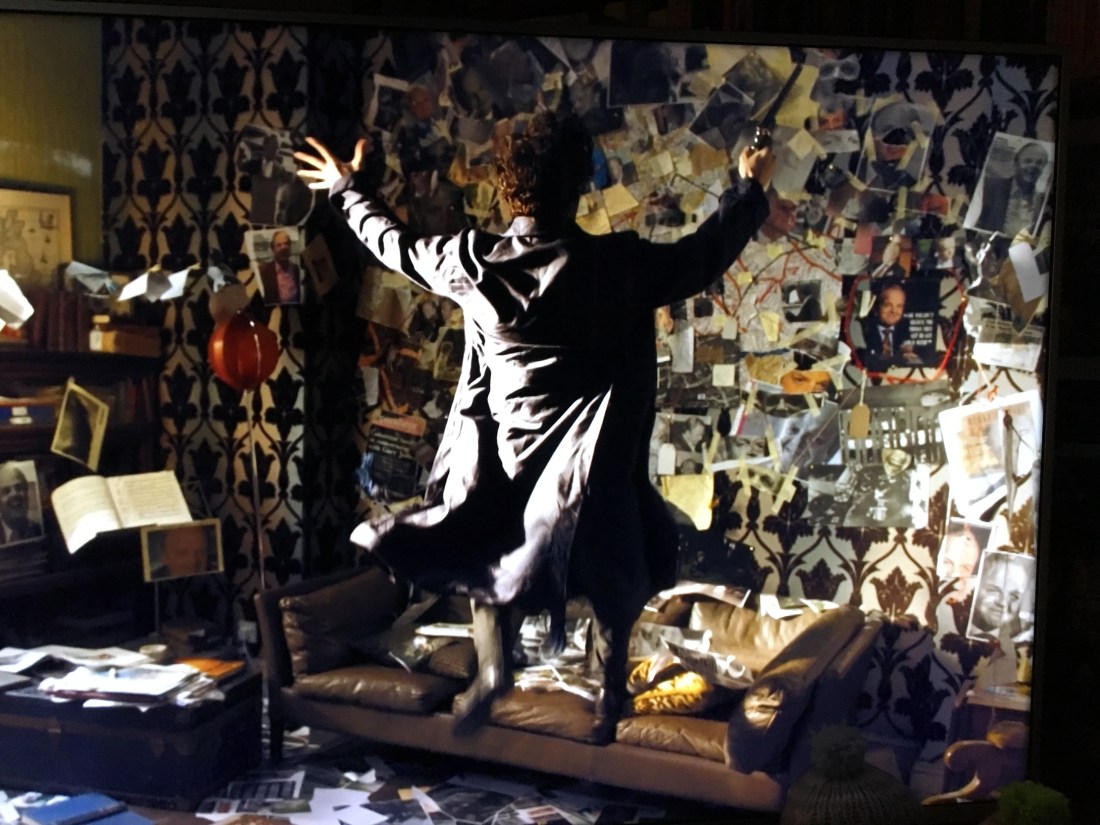
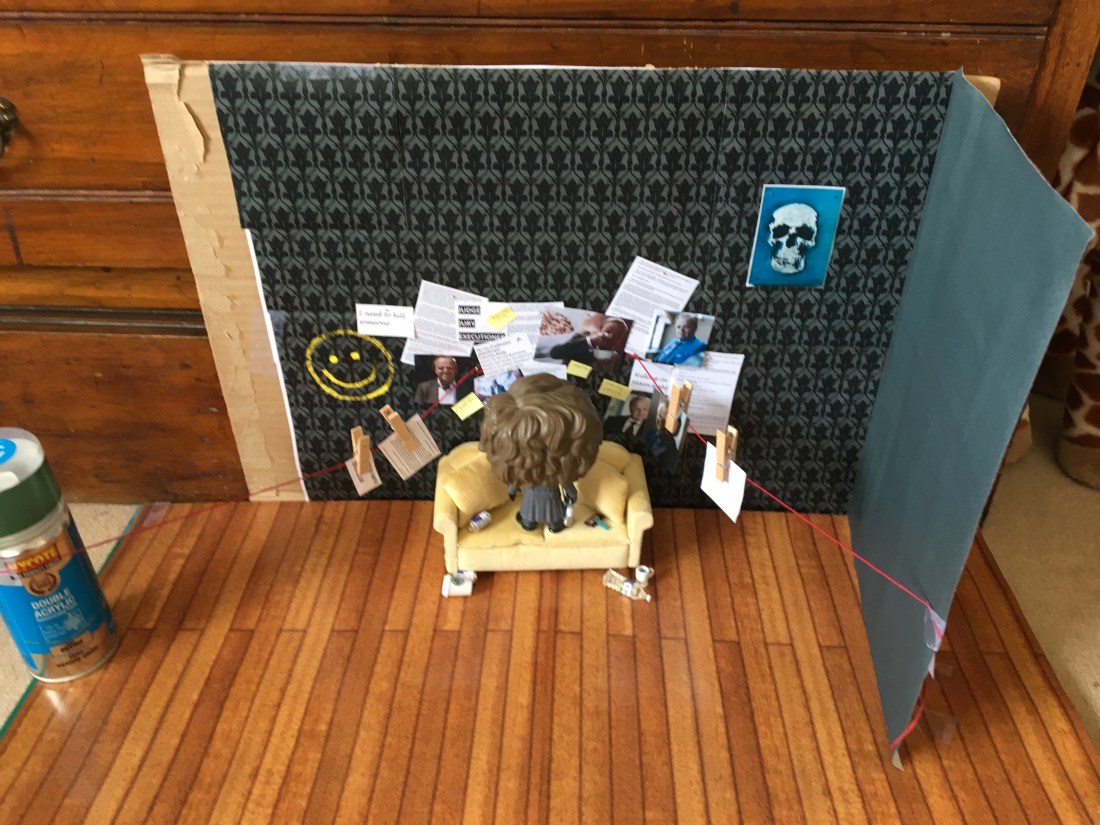
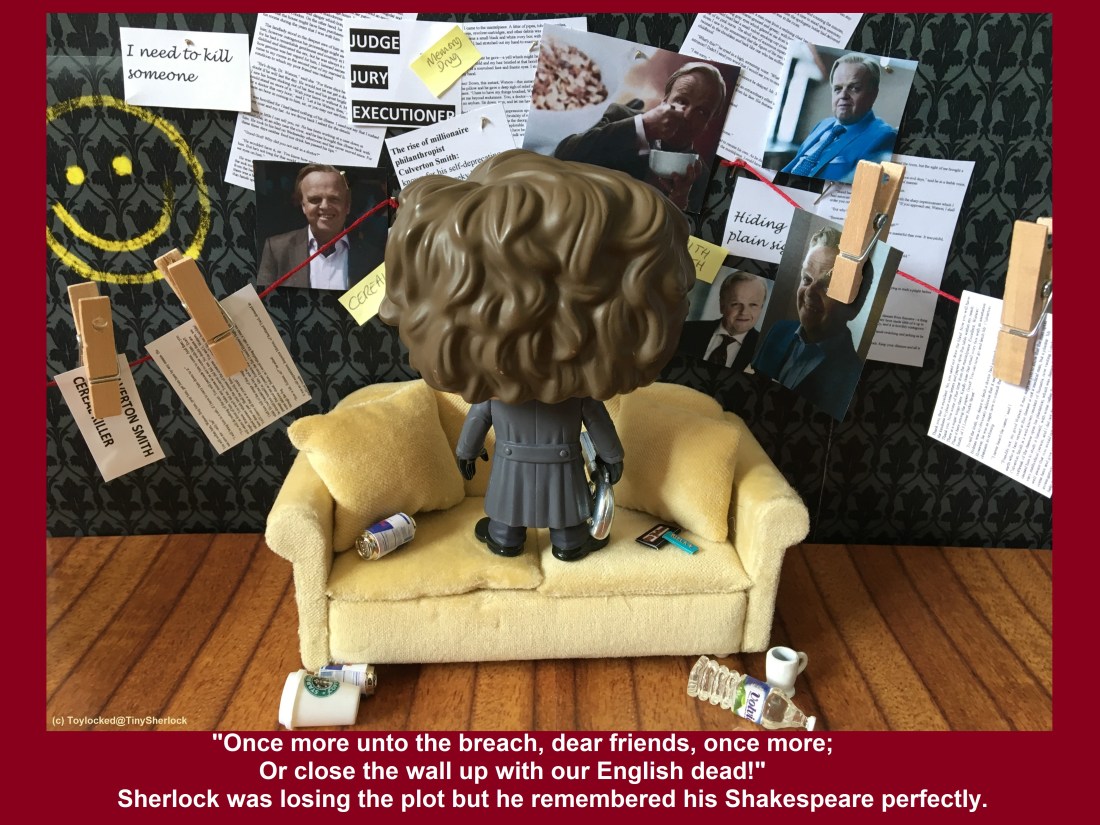
The other end of the room, of course, has the instantly recognisable dark wallpaper. I created lots of scenes using this (downloadable versions available everywhere online!), of which the most complex was the moment in The Lying Detective when Sherlock, out of his mind on illegal substances, is manically leaping about the room, quoting from Henry V and obsessing about Culverton Smith.

IMG_2295(2)

IMG_2492

There are papers pinned to the wall and hanging from tiny clothes pegs. I wanted the pictures and clippings to be as authentic as possible: there are tiny photos of Culverton Smith; there are headlines which appear in the scene itself; there are relevant words on post-it notes; and the pages of tiny printed text this time are from the original Conan Doyle story The Dying Detective, in which Holmes tricks Culverton Smith into a confession of murder by pretending to be dying from his poisons. Oh, and the gun is from my Sherlock edition of Cluedo!

henry v


Location, Location (part 3)

As everyone knows, Barts (St Bartholomew’s) Hospital in the City of London plays a huge role in the life of Sherlock. It is where he meets John, who trained there. It is where Molly works. It is where clues are analysed. And it is where Sherlock meets Moriarty on the roof, and then apparently jumps to his death in The Reichenbach Fall. Or not!

barts titled

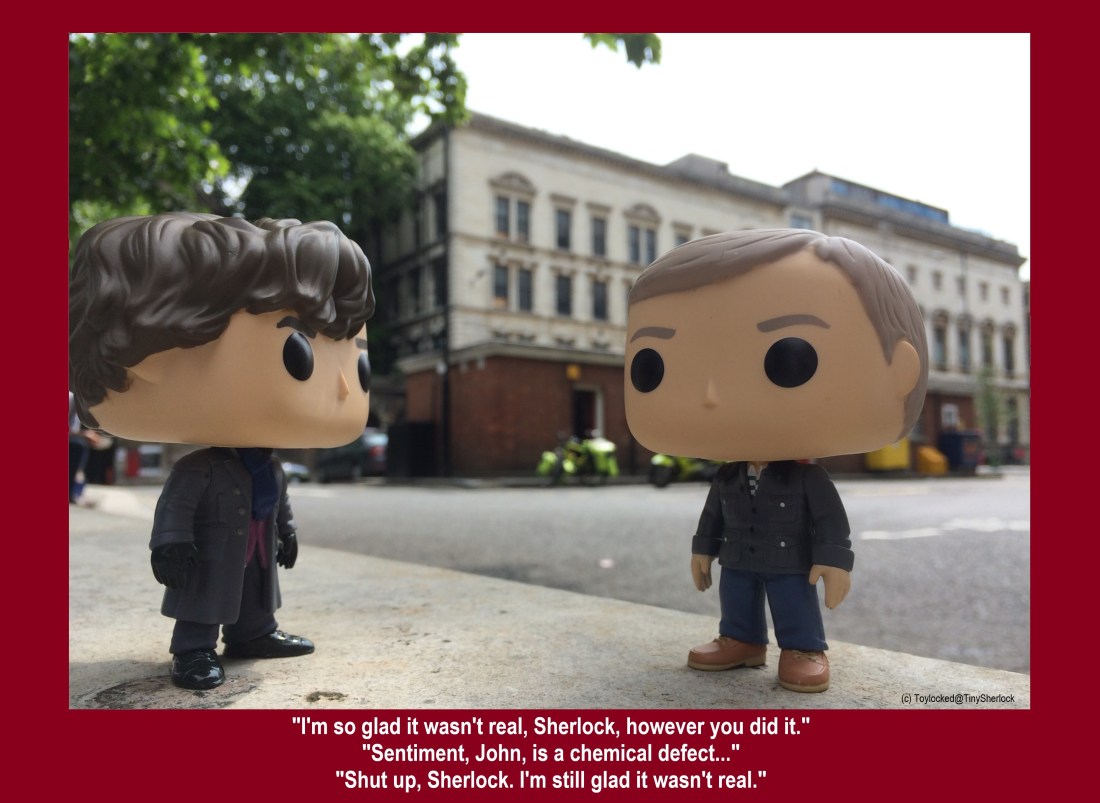
I wondered what it would be like for Sherlock and John when they first came back to Barts, after Sherlock’s incredible reappearance in The Empty Hearse, and this was an attempt to recreate it. The picture is taken outside the hospital, with the ambulance station between me and the hospital building. The toys are standing on a stone bench to help with the perspective.

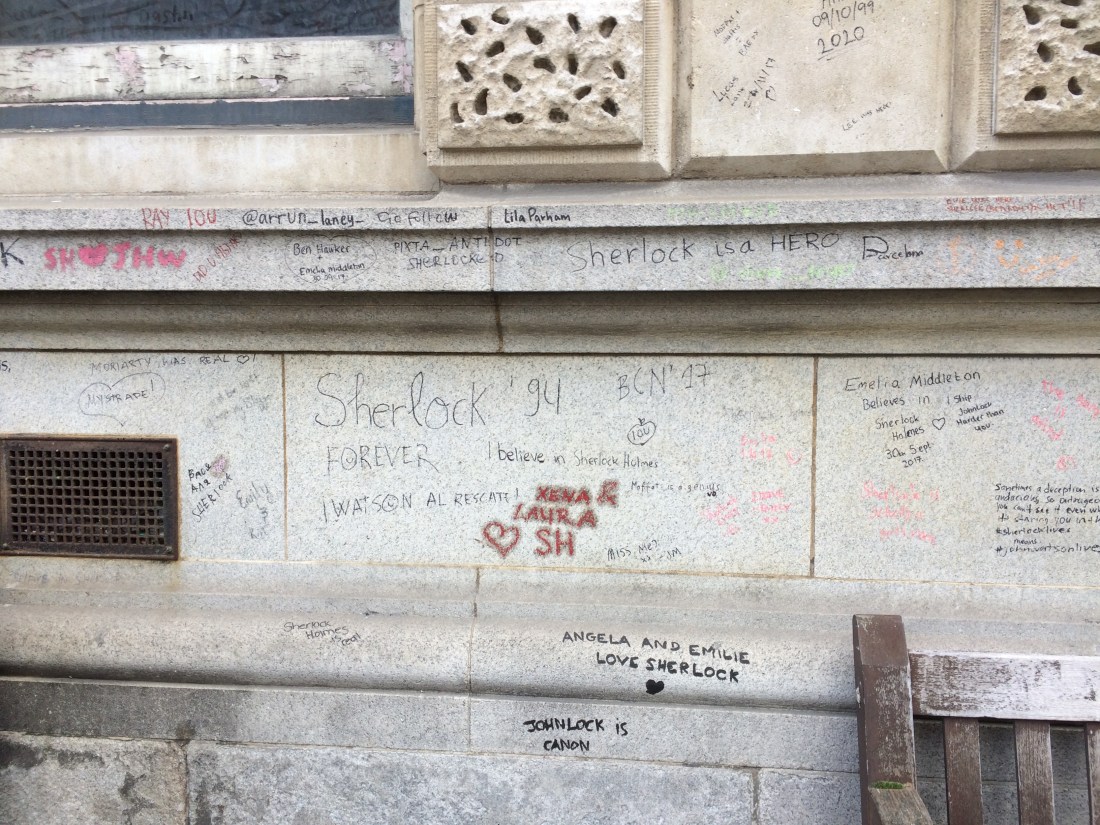
The building itself bears witness to the scenes which are supposed to have taken place there. The walls still carry graffiti written by Sherlock fans, and there are messages on the windows and on the phone box next to the hospital.

IMG_0091

IMG_0093

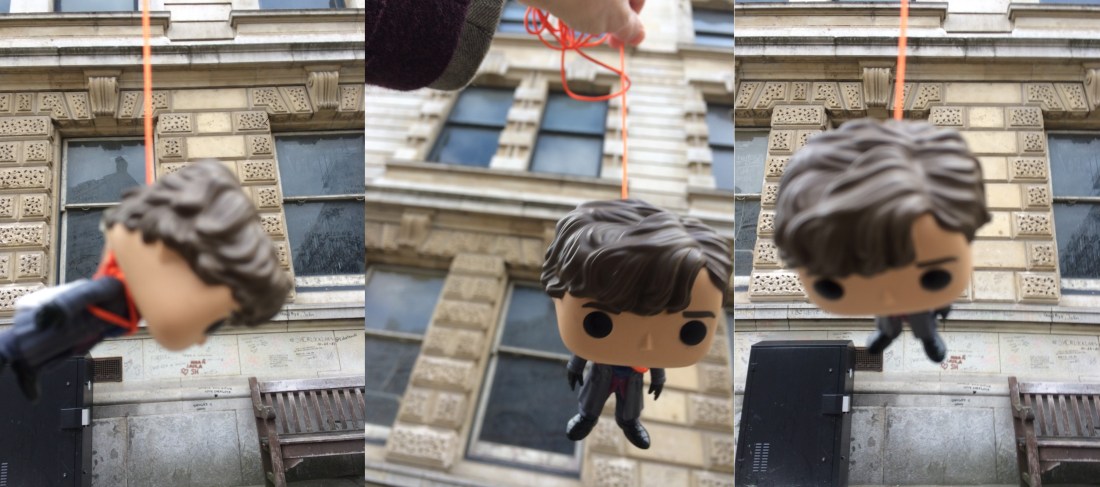
Trying to recreate Sherlock’s leap from the building was rather more complicated. I could have thrown the Sherlock toy in the air near the building and made multiple attempts to get a focussed photo of him as he fell back down again. The toys have been through worse. On balance, I decided it would be easier and more effective to recreate the bungee-jump theory. My first attempt was on my own and it was not a success. It was a very cold day and I nearly froze as I tried to get a picture of Sherlock hanging on a string with a recognisable amount of the building behind. A number of people watched me, but nobody seemed very surprised – I think they’ve seen it all before around Barts.

A few weeks later I was arranging to meet a friend for lunch in London. I suggested we eat near Smithfield Market. I would buy lunch, but in return he had to help me create a picture.  Even with help, it wasn’t easy. Funko heads are heavy compared with the rest of the toy, so Sherlock’s back was weighted down with plasticine, and the string was sellotaped to the back of his head to stop him nose-diving. Even so, I was dealing with a spinning detective:

spinning detective

Finally, we achieved a shot which included a recognisable slab of building, a reasonably focussed picture of Sherlock, and no visible human hands:

bungee

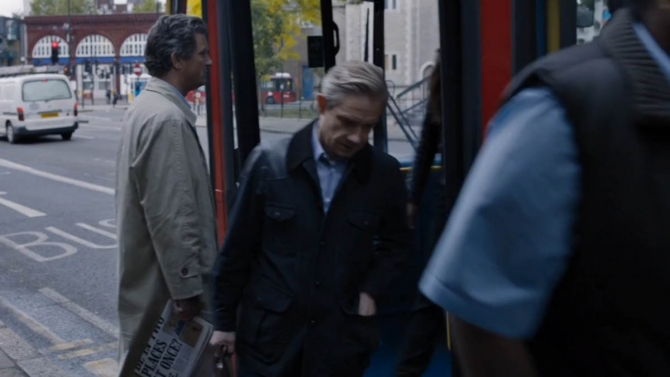
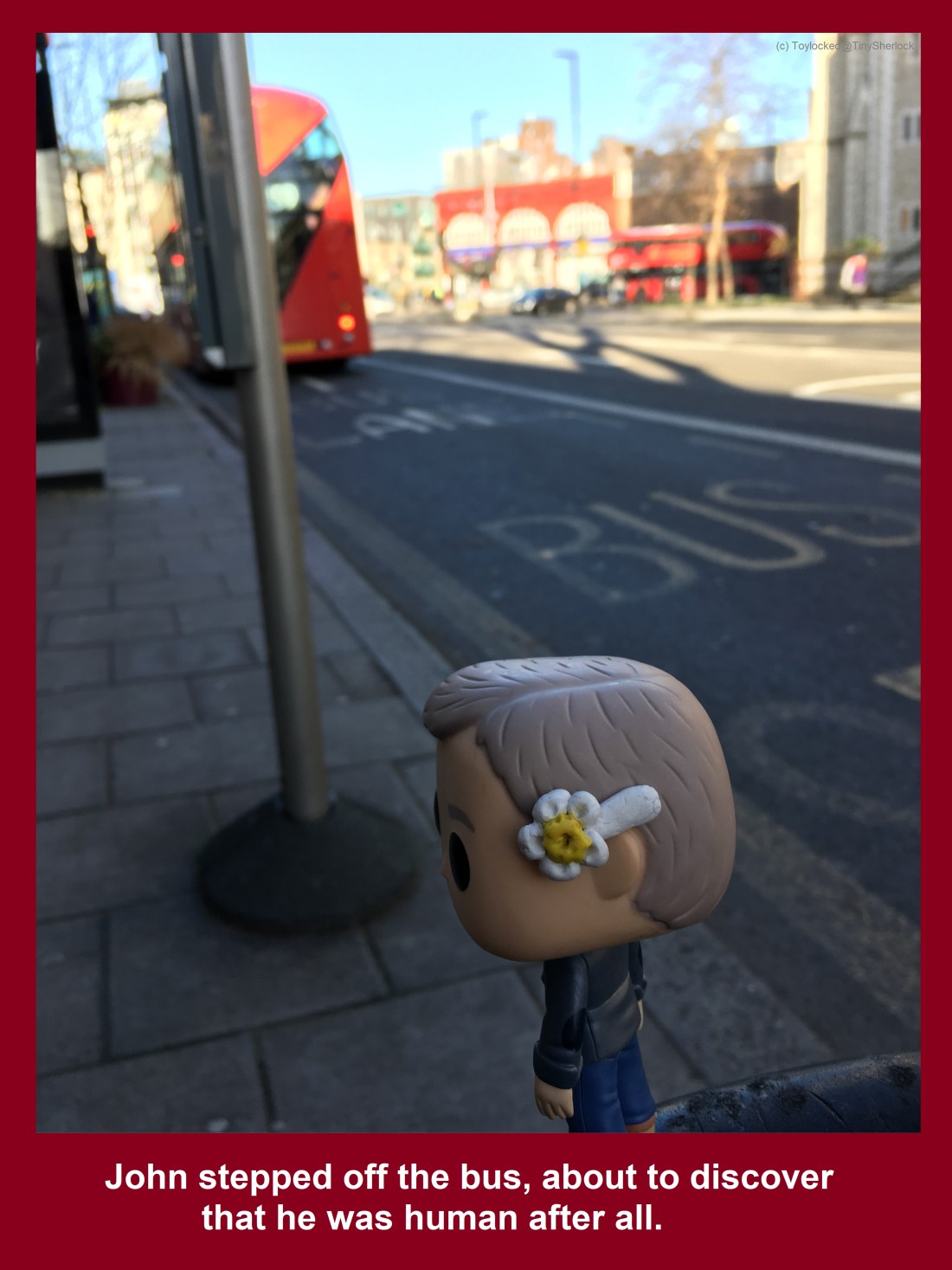
In The Six Thatchers, John enters into a flirtation with a woman he meets on the bus (we all sighed and felt rather sad, but none of us realised the full significance at the time!).  I wanted to picture the moment when John gets off the bus. I spent some time trying to find the right location, because there are many underground stations in London with the distinctive dark red tiling and half-moon windows like the one seen in the background.

john gets off bus

I even took my John Funko toy, with a flower behind his ear, to Mornington Crescent and then realised it was the wrong place. Eventually, a bit more time on Google told me that I needed to search all the stations designed by Leslie Green (he designed an astonishing number before he died at 33 of tuberculosis in 1908). At last I tracked down the location  to Lambeth North, and found not only the station but the actual bus stop. In the episode the bus stop carries an advertisement featuring a huge photograph of Culverton Smith, who will then appear in The Lying Detective.

Conveniently a bus came and went while I had John perched on the side of a litter bin and I got the shot I wanted.

bus stop

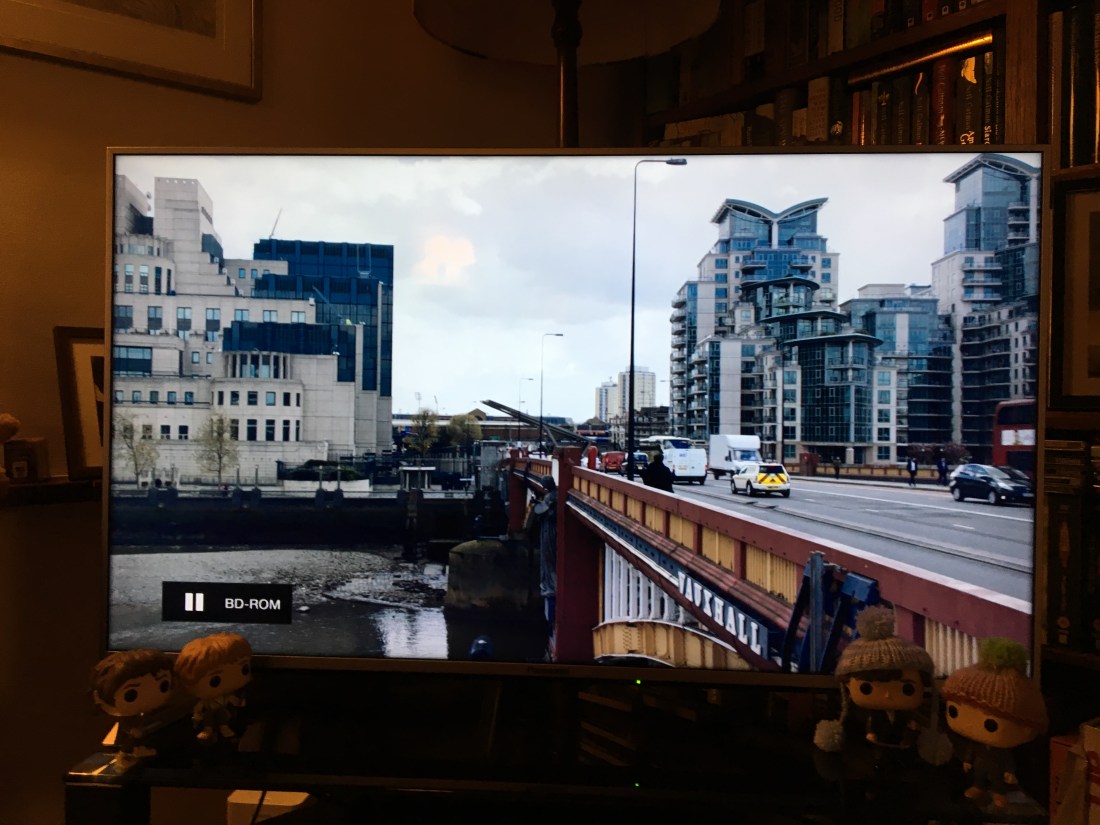
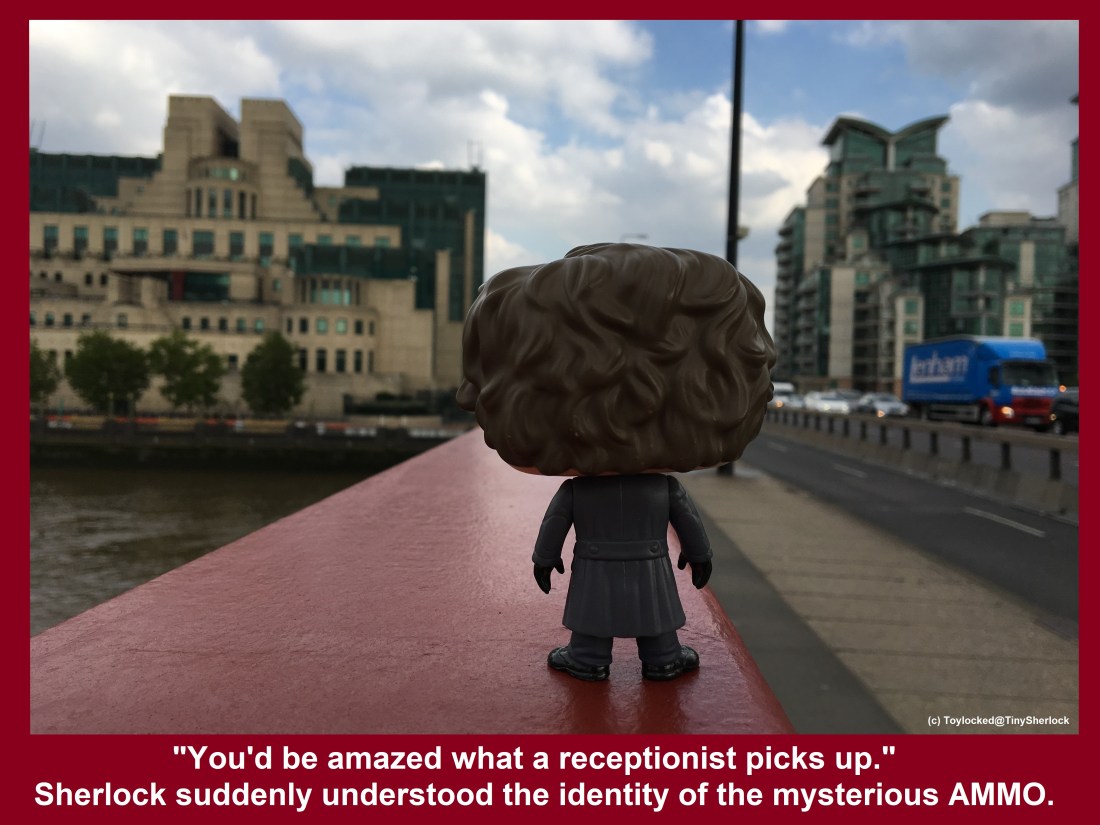
Shortly after we see that meeting, we find Sherlock walking across Vauxhall Bridge towards the MI6 building. At this moment he suddenly understands who double-crossed the AGRA team in Tbilisi. I used to work very near here, and knew the area well. Realising one evening that I was going to be near Vauxhall the next day, I chose the simplest way to ensure accuracy – I took a photo of my TV screen (note the toys!):

IMG_2279Posing the Sherlock toy on the pavement wouldn’t have worked, so I had to stand him on the bridge parapet and hope there wasn’t a strong gust of wind!

spooks

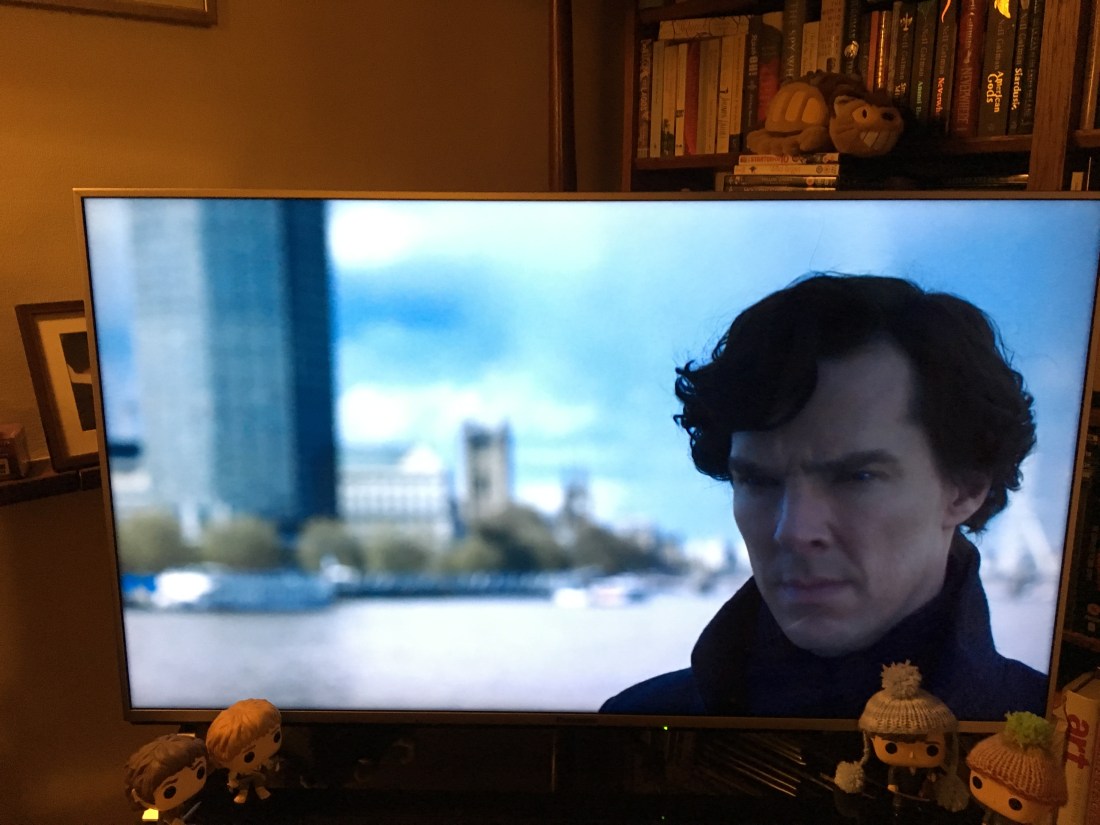
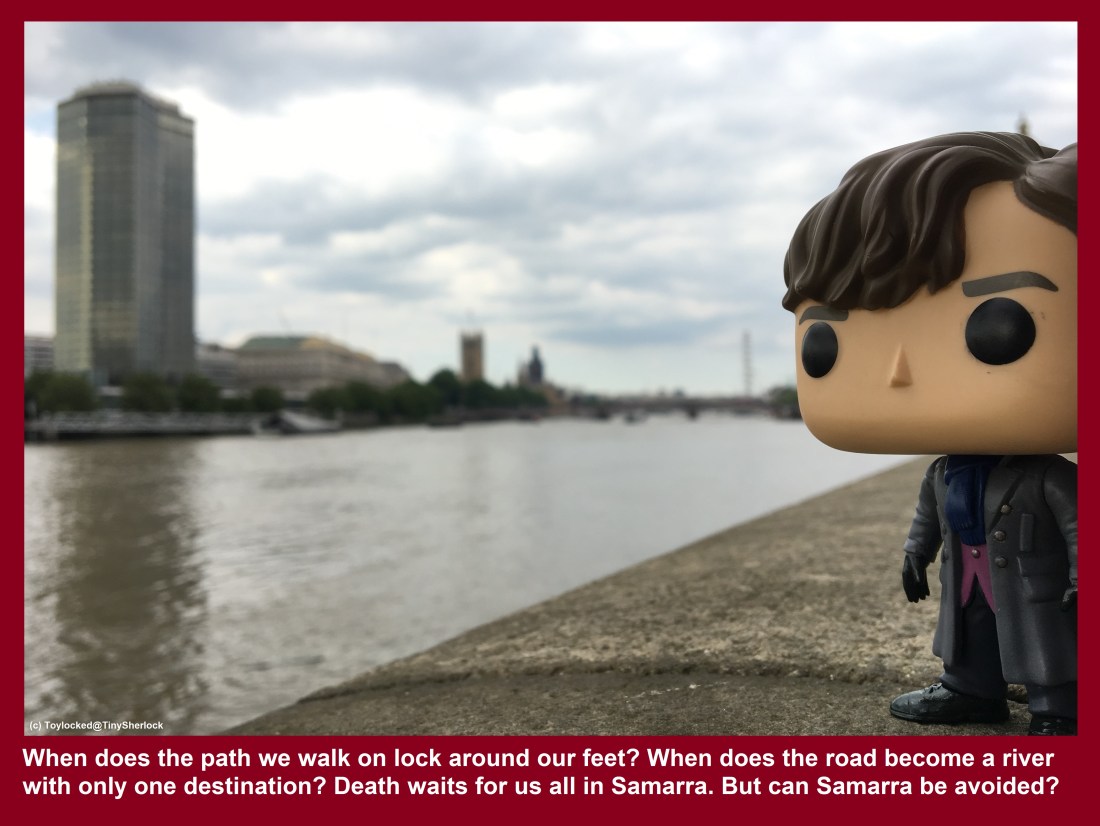
At the end of the same episode, after the shocking shooting of Mary in the London Aquarium, Sherlock sadly walks along the South Bank of the Thames thinking about the story of the appointment in Samarra (you can read the background to the story here).  Again, I had my photo of my TV screen to refer to:

IMG_2281

With small toys and an iPhone camera, it was not possible to get the proportions of the buildings in the background exactly right, but I think I located the spot where it was filmed and did my best:

samara

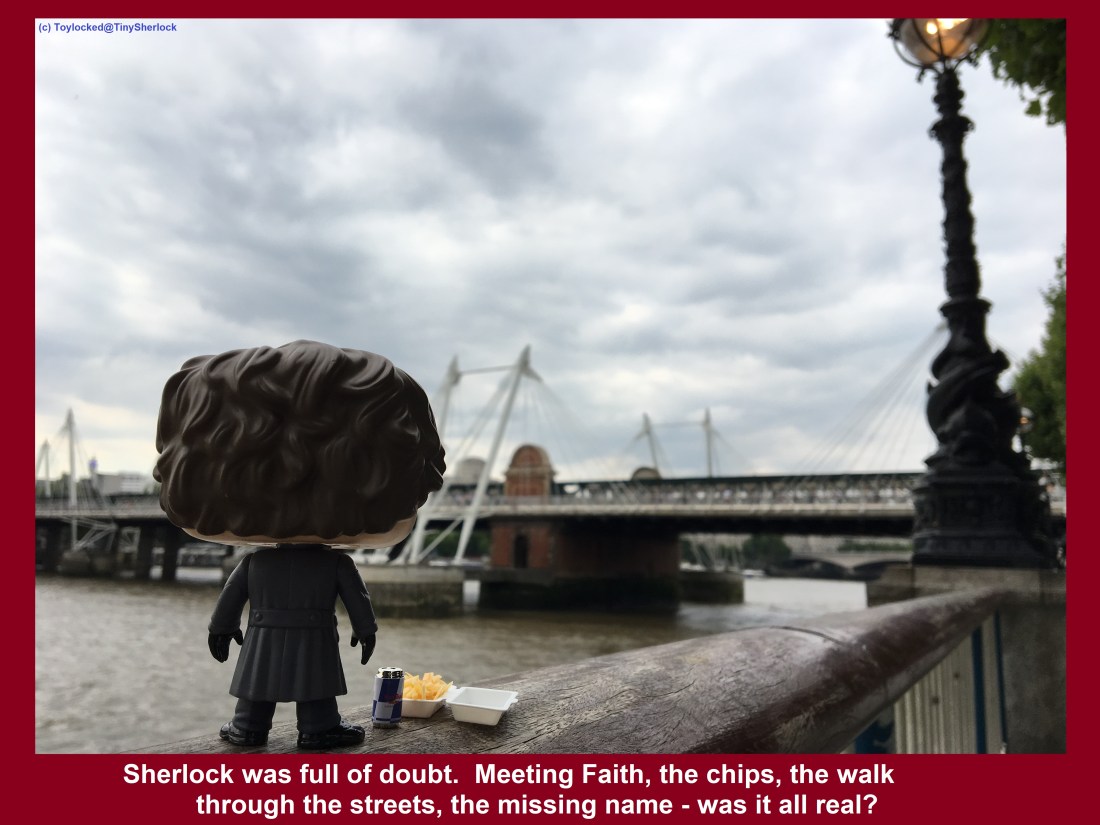
In The Lying Detective, the South Bank of the Thames is also the location for part of Sherlock’s conversation with the woman he believes to be Faith Smith.  I can only imagine that the conversation about suicide (“Your own death is something that happens to everybody else”) was filmed late at night or very early in the morning, because the area where it takes place is usually very busy – next to Hungerford Bridge and the South Bank Centre and surrounded by food stalls and street theatre. While I was taking my photo, in the early evening, people came up to remark on the tiny pack of chips and can of Red Bull, and somebody tried to pick them up! I politely pointed out that they were mine and I was photographing them; apparently they thought I had just spotted them on the railing and was photographing them because they were funny! Despite the interruptions, here is how I imagine Sherlock retracing his steps and trying to remember what really happened:

not your own


The Light and the Dark

crime scene

The creators of Sherlock set us up for a series of dark and stylish dramas right from the start, with night-time scenes in London streets, wet pavements reflecting street lights, the glare of headlights, the gloom of ill-lit rooms. Attempting to depict these scenes in a smaller scale has presented its own challenges.

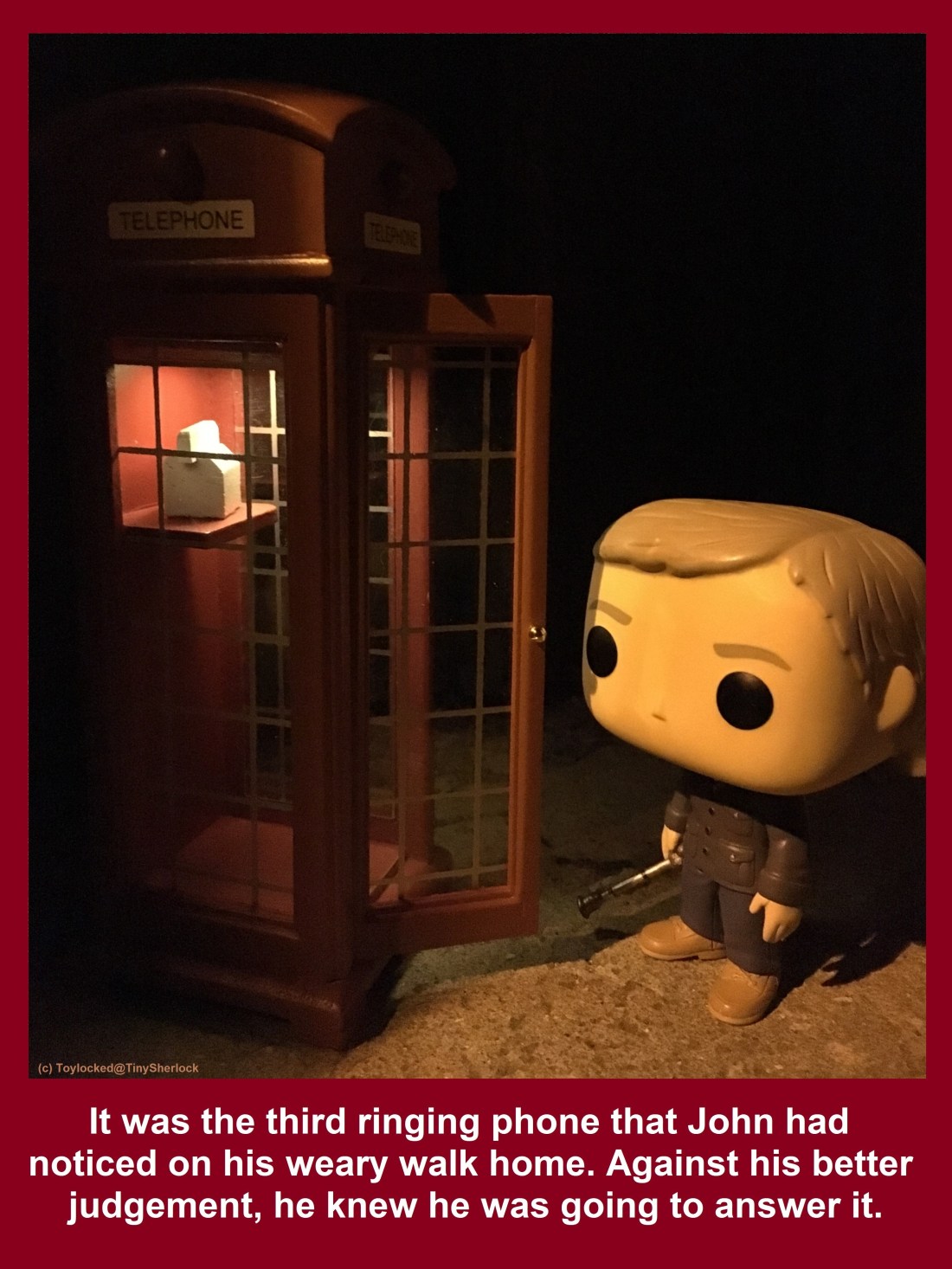
When John is first getting to know Sherlock, in A Study in Pink, he finds himself abandoned at Lauriston Gardens and having to walk (limp) back from Brixton. He passes two ringing telephones before warily deciding to pick up the third. I wanted to portray how alone he is at this point.

I found a model phone box online. It had to be lit from inside to be authentic: I stuck an LED light fitting from a dollshouse supplier onto the “ceiling” of the phone box.  Then it was a question of location, near enough to street lights to show John’s face but without extraneous background.

IMG_5704(1)

This one works well for lighting, but my garden fence does not look like a Brixton street!

Eventually, I took the photo on a neighbour’s front doorstep (the houses face straight onto the street). It was quite late and nobody spotted me!  The doorway created shadows which blacked out the background. The slightly orange glow is from a street lamp almost above me as I took the photo.
phone

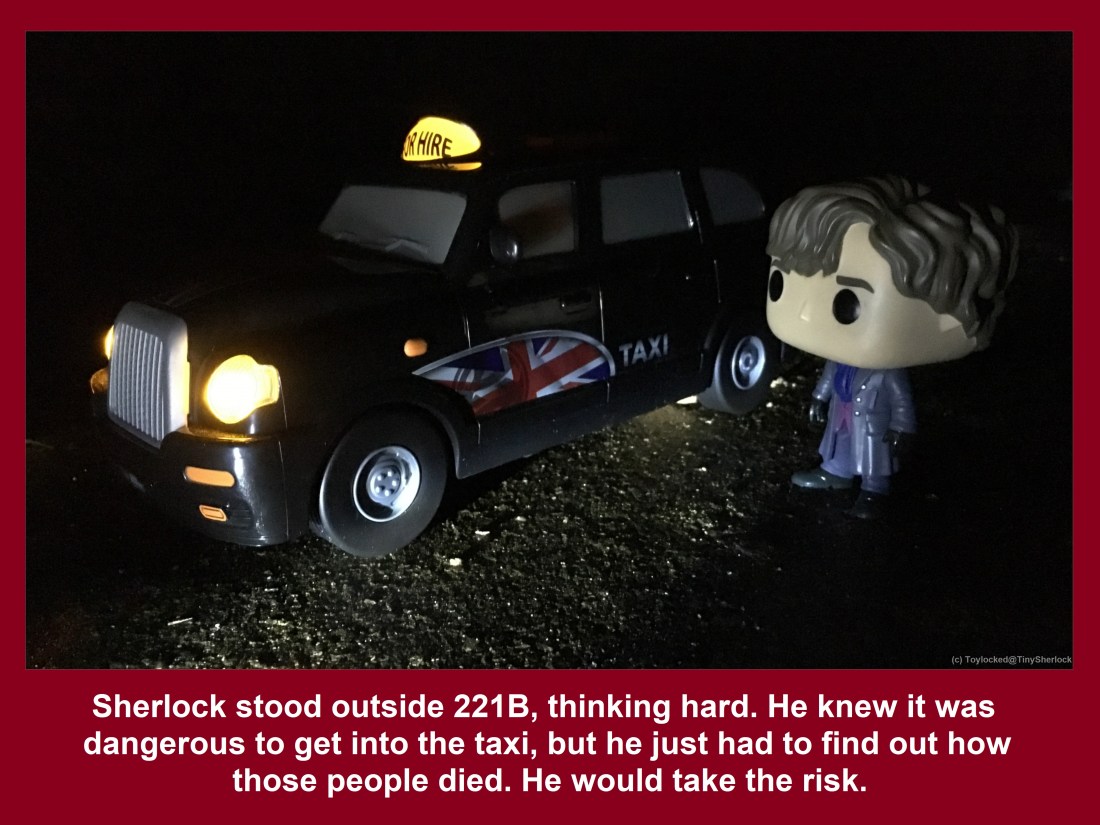
Later in that episode, Sherlock follows the taxi driver to his cab and eventually agrees to go with him to find out more (just say no, kids!).  I was very pleased to find a well-known department store selling toy taxis with functioning headlights and a light-up “For Hire” sign. The only problem was that the button one had to press to make the lights work also made the wheels turn, driving the cab forward while it emitted the noise of an engine.  To set up the photo in my back garden, I balanced the taxi with its axle on a small block of wood to prevent it from driving away. Then I arranged Sherlock with a torch shining on him from several feet away, so that his face could be seen. Finally, I pressed the button on the cab and took a number of pictures in the few seconds when all the lights were working. This took several attempts, and I hope I didn’t disturb the neighbours with the roar of the taxi engine!
pink taxi

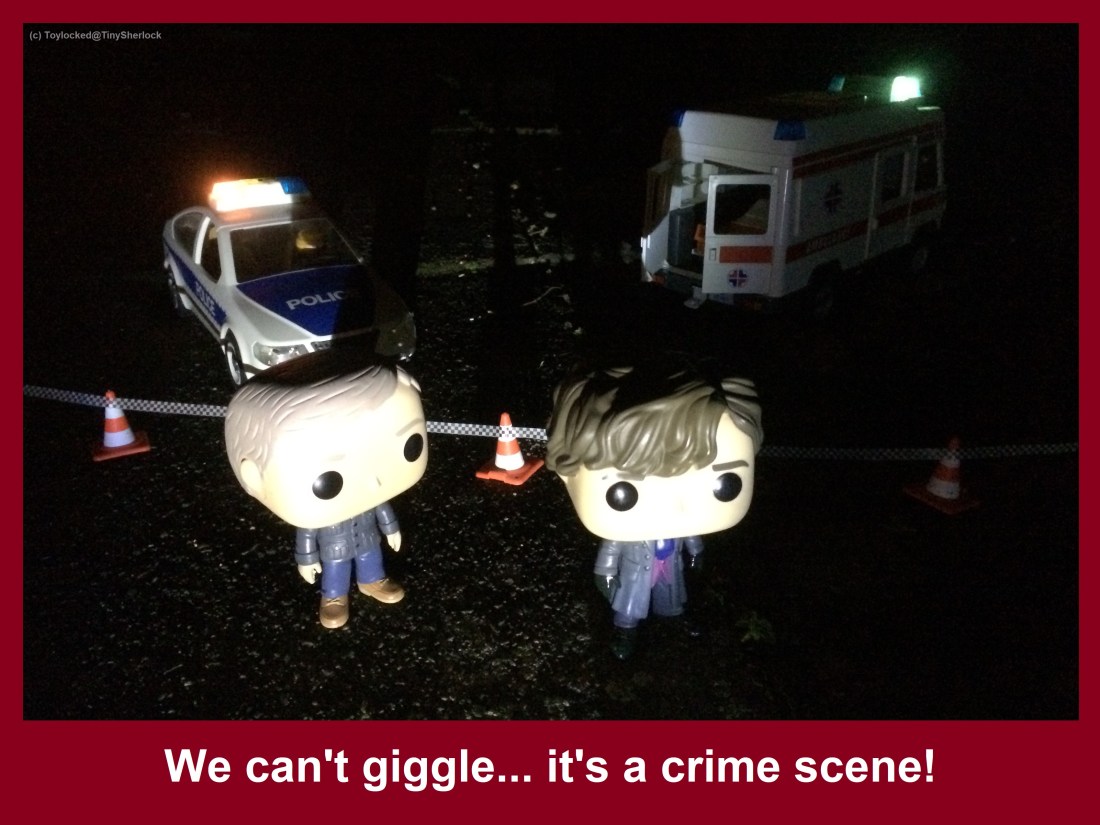
This episode famously ends with a scene outside Roland Kerr Further Education College. The scene at the top of today’s blog, and the scene below, were photographed at the same time. The figures were lit with torches, as usual. The picture was given depth with the Playmobil emergency vehicles, which are conveniently fitted with flashing lights. The traffic cones are also Playmobil, and the chequered tape is Japanese washi tape. Once the picture was set up, I had to press the buttons on the toy vehicles to make the lights flash, and take lots of shots in the hope of getting them all showing at the same time.
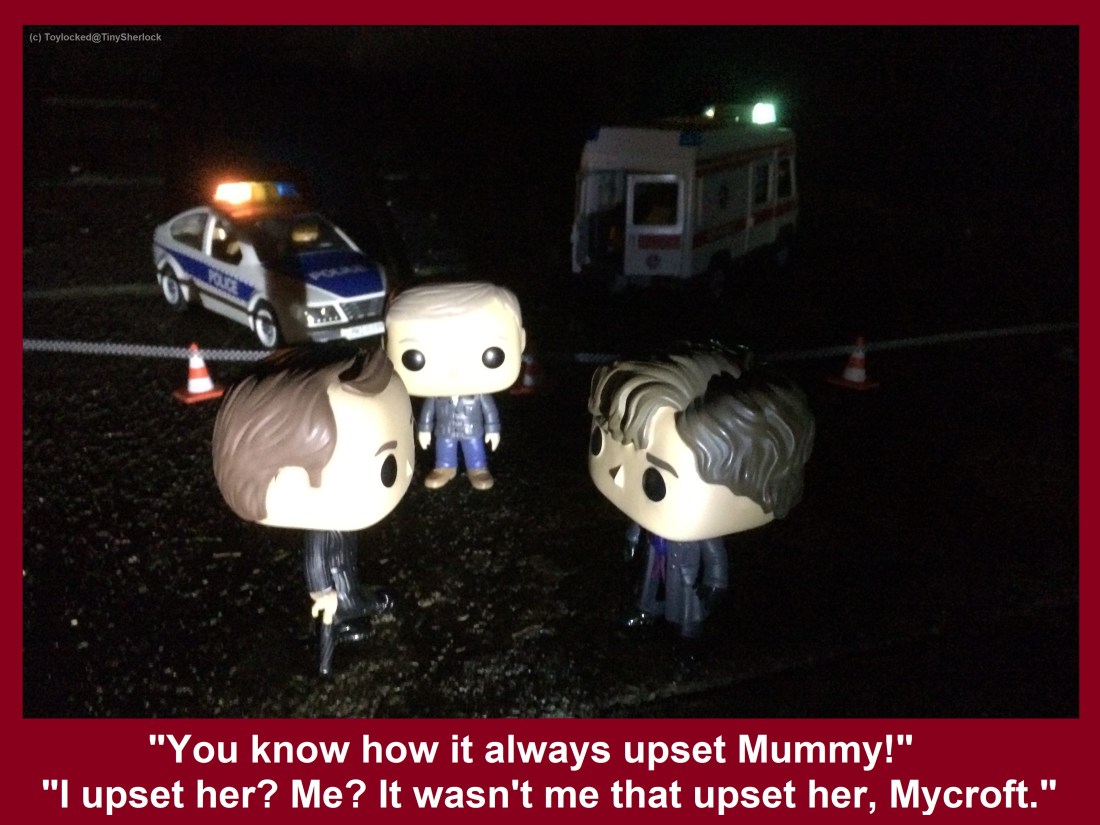
upset mummy

In A Scandal in Belgravia, light and dark are used in a very different way to set a mood. One particular shot I have always admired is in a scene at St Bartholomew’s Hospital, where Sherlock and Mycroft ponder on the grief of bereaved relatives outside the morgue. For this conversation, over half the screen is dark, with only the heads and upper bodies of the brothers in view as they talk.

something wrong

I cut a square out of a piece of black card and held it between the phone and the toys. This was surprisingly hard to get right – I had to re-focus several times, especially as the light was behind the toys. They were in fact standing on my bathroom windowsill. And I created the effect of frosted glass by… you guessed it… taking the photo shortly after having a hot bath!
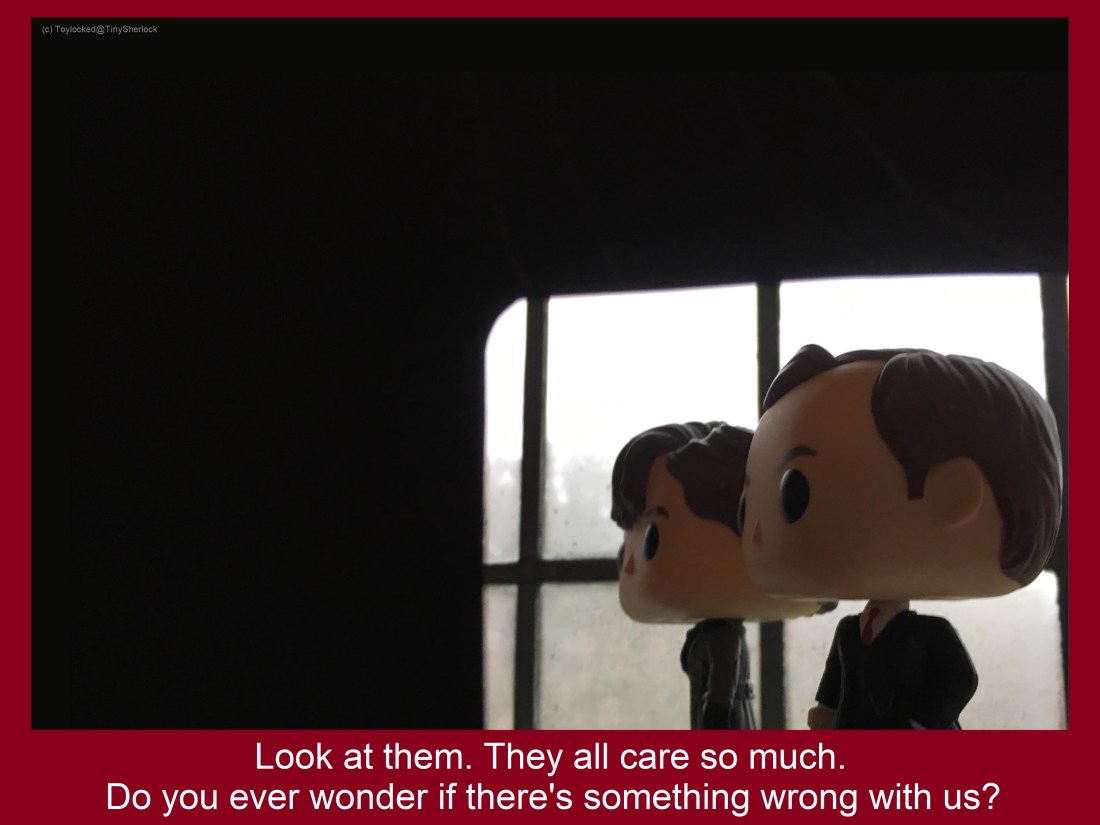
barts brothers

Right at the end of this episode, there is a scene set in darkness apart from the light of flaming torches – Sherlock’s memory of rescuing Irene Adler from execution. Again, I positioned the toys in the back garden, by torchlight. Their clothes were made from black cotton, pinned round them so their heads were covered. Sherlock is carrying a 1:12 sized sabre (there seems to be quite a market in miniature weapons, presumably for war gamers).  As usual, tiny-footed Irene kept falling over in the slightest breeze. The darkness once again hid any extraneous background (like my rubbish bins) and I think the end result is suitably simple but dramatic.

In the Reichenbach Fall, Sherlock uses light to solve the puzzle of the kidnapped children of the amabassador to the US. He realises that Max Bruhl has left a trail using the linseed oil with which he polishes his cricket bat. Using an ultra-violet light, Sherlock traces the footprints and is also then able to analyse residue from the soles of the kidnapper’s shoes.  It’s a very typical Sherlock moment, where he demonstrates happiness quite inappropriate to the circumstances. The floor and background were very simple, but the trick was in the footprints. I was very happy when I discovered glow-in-the-dark felt pens! I drew the footprints, positioned the toys, lowered the lights in the room and balanced a torch on a pile of books so that it highlighted the footprints on the floor.
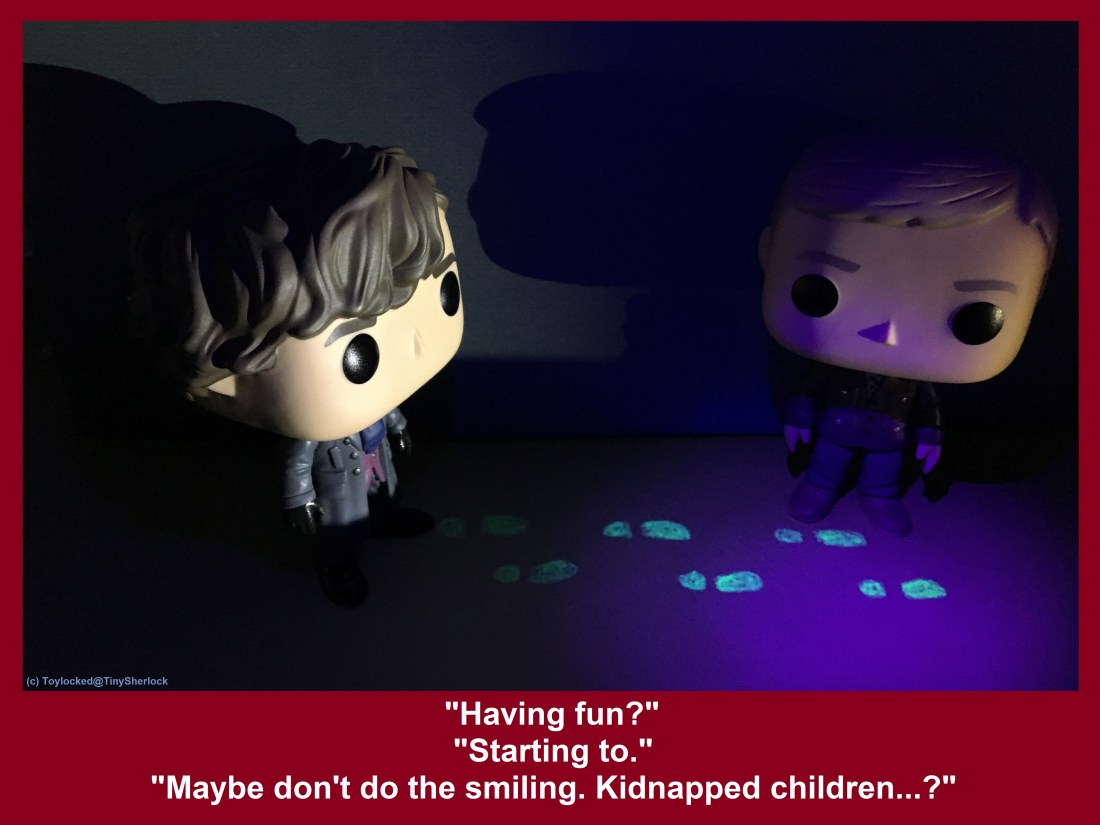
footprints

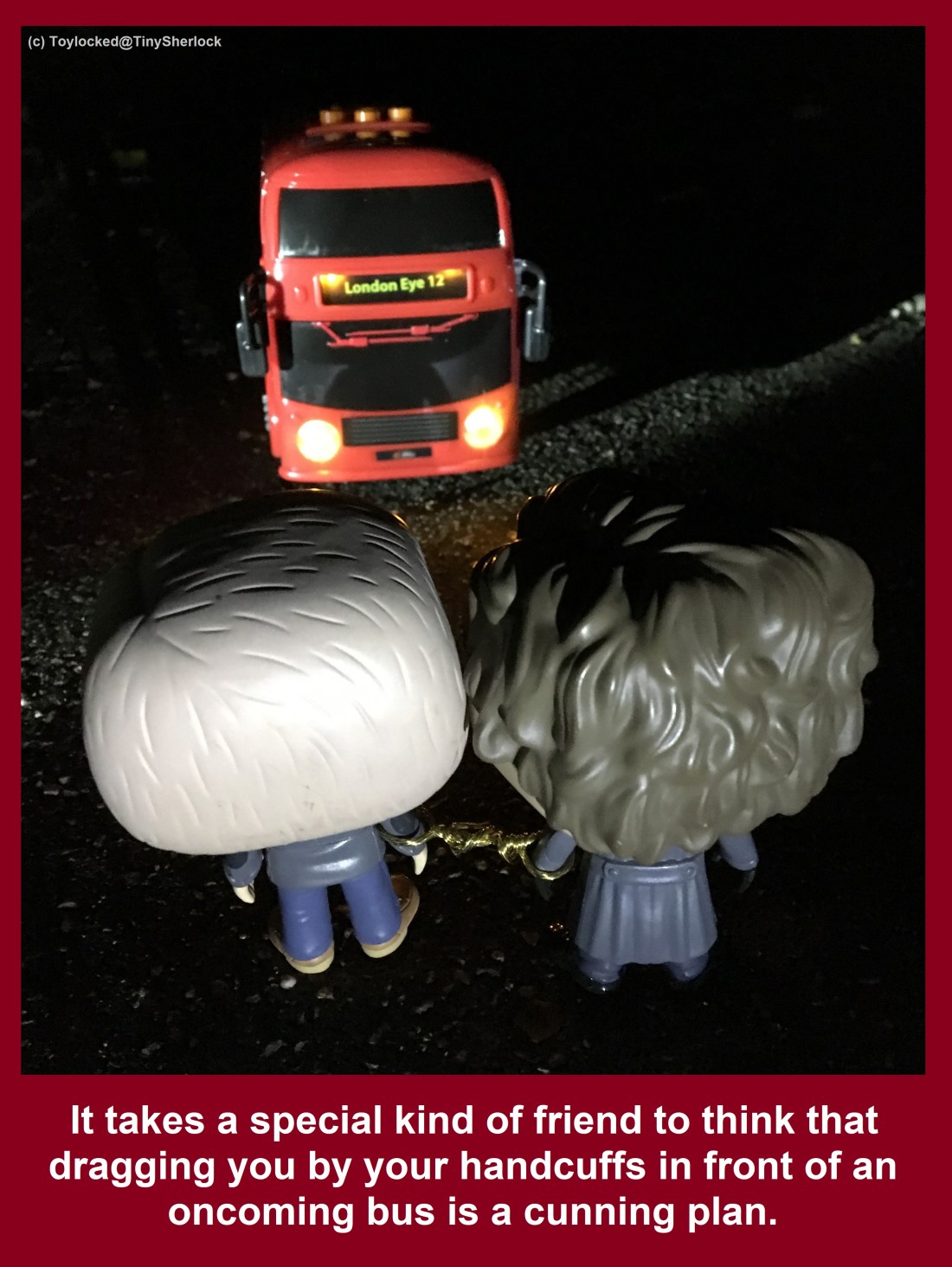
Later in the same episode. Sherlock drags John in front of a double-decker bus in an attempt to draw out one of the assassins who have been trailing him. It’s another beautiful shot in the series, with our heroes silhouetted against the glare of the bus’s headlights.
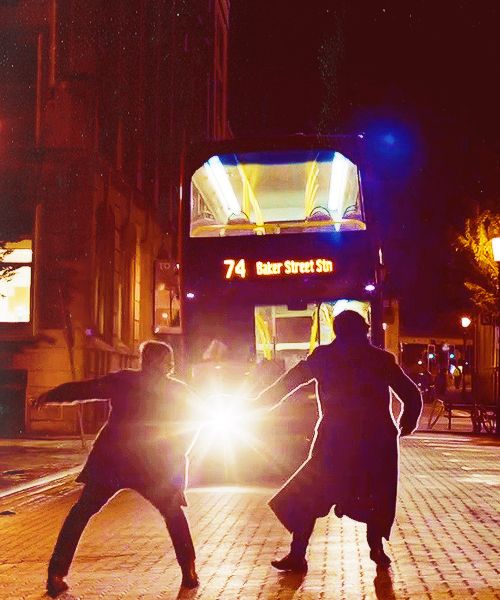
bus headlights

The same department store which sold the taxis also sold buses with working headlights. I had the same problem as with the taxi, in that the button which made the lights work also made the wheels turn and the engine roar (in this case with added music!). I had to balance the back axle on some wood to prevent the boys from being run over. Cue more engine noises and inappropriate musical accompaniment as I took multiple shots to get the lighting right (yes, my poor neighbours!). The “handcuffs” are simply some wire – I couldn’t find toy handcuffs which fitted round their little Funko arms! Obviously the bus destination is wrong, but I have a basic rule to try not to use Photoshop or similar and to show the toys as they really are. I had to settle with a bus going to the London Eye instead of Baker Street.
oncoming bus

Mycroft’s office in the later episodes has very distinct lighting, because its windows are all in the ceiling. This means that rectangles of light are projected onto the walls, floor and furniture.
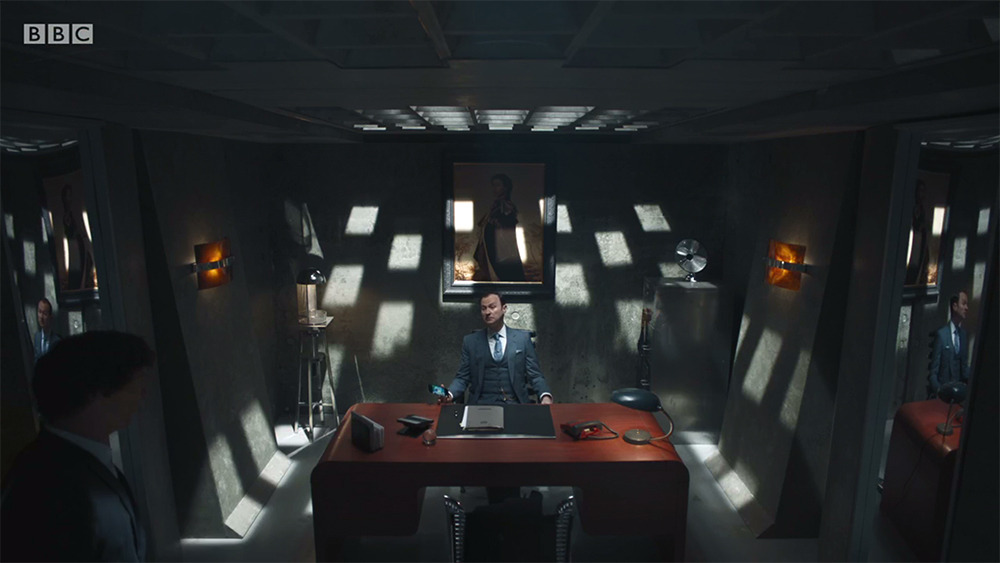
mycroft office

In recreating the scene from The Six Thatchers where Sherlock asks Mycroft what he knows about AGRA (the freelance assassins) and Mycroft replies with information about Agra (the city in India), I wanted to replicate this effect.  The room itself is fairly simple: I bought a desk from an online supplier, and also a tiny working desk lamp. The globe is a novelty pencil sharpener. The newspaper is actually a miniature version of The Daily Telegraph with a picture of the Duchess of Cambridge on it (I think Mycroft is a staunch royalist). The portrait of the Queen is available all over the place (it is in the same picture frame as I used for The Lost Vermeer). It was the lighting which was tricky. I cut square holes in a piece of black card and shone a bright torch through it.

IMG_0542(1)

The angle of the torch had to be just right to get the shapes right on the walls, and if the torch was too near, or the room too dark, the contrast was too great and the picture was spoiled. Eventually, by half closing the curtains, balancing a torch on a pile of books, and holding the card with the holes in with my left hand while taking the photo with my right, I got it more or less right. Ladies and gentlemen, I present the heart of the British Government!

wikipedia


Interior Monologue (Part 1)

When the characters of Sherlock step away from 221B Baker Street, they aren’t always to be seen against a London backdrop. I wanted to recreate some of the scenes inside other buildings too.

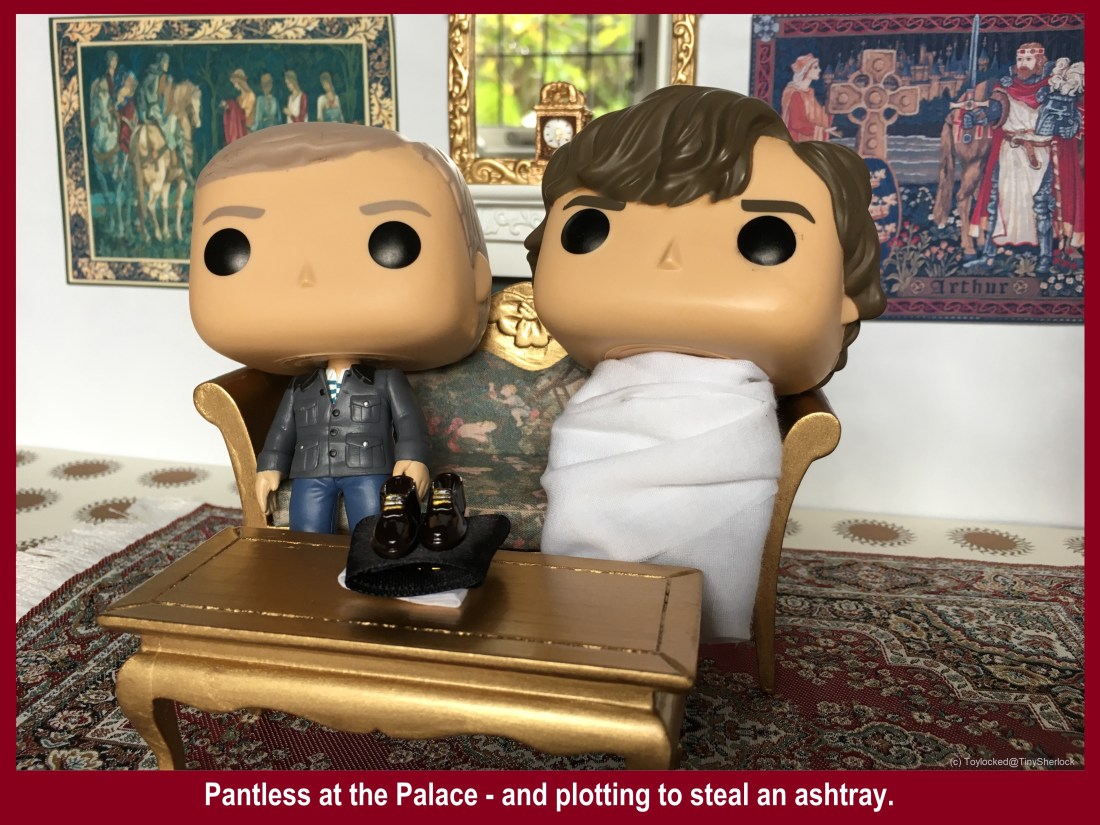
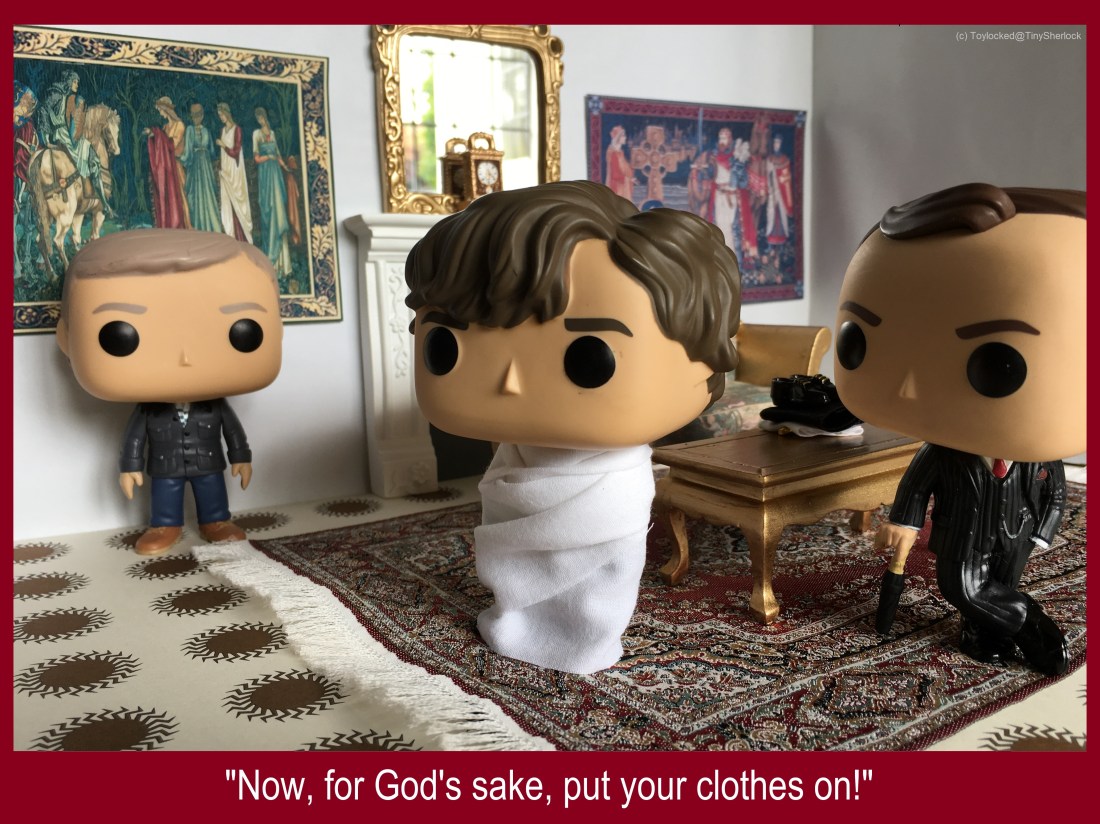
One of the most popular scenes from A Scandal in Belgravia is Sherlock and John’s meeting with Mycroft and a royal equerry at Buckingham Palace.  Sherlock is not wearing any clothes under his sheet, much to John’s amusement.

palace pants titled

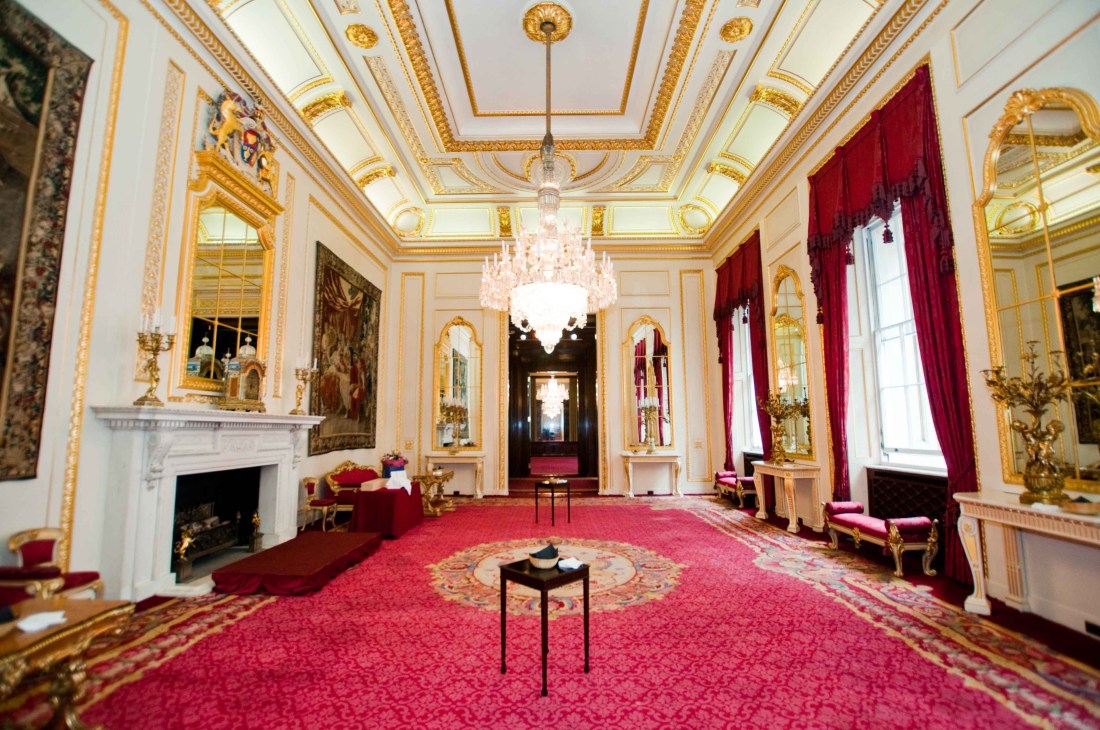
This scene is filmed in Goldsmiths’ Hall in the City of London, so I found photographs of the interior to check my recreation of the scene.

goldsmiths-hall-drawing-room

I bought a very smart sofa and coffee table, the mirror, clock and tapestries, and the tiny shoes online. Sherlock’s clothes are small pieces of folded fabric, while the sheet around Sherlock is cut from a plain cotton handkerchief.

palace clothes titled

Using mirrors in these pictures is tricky, because of the risk of including a reflection of me or the camera or parts of my house. For these two pictures, I positioned the scene to show the reflection of my garden through the dining room window. It was not possible to show the classic moment when Sherlock’s sheet unravels – this Tiny Sherlock still has his clothes on underneath!

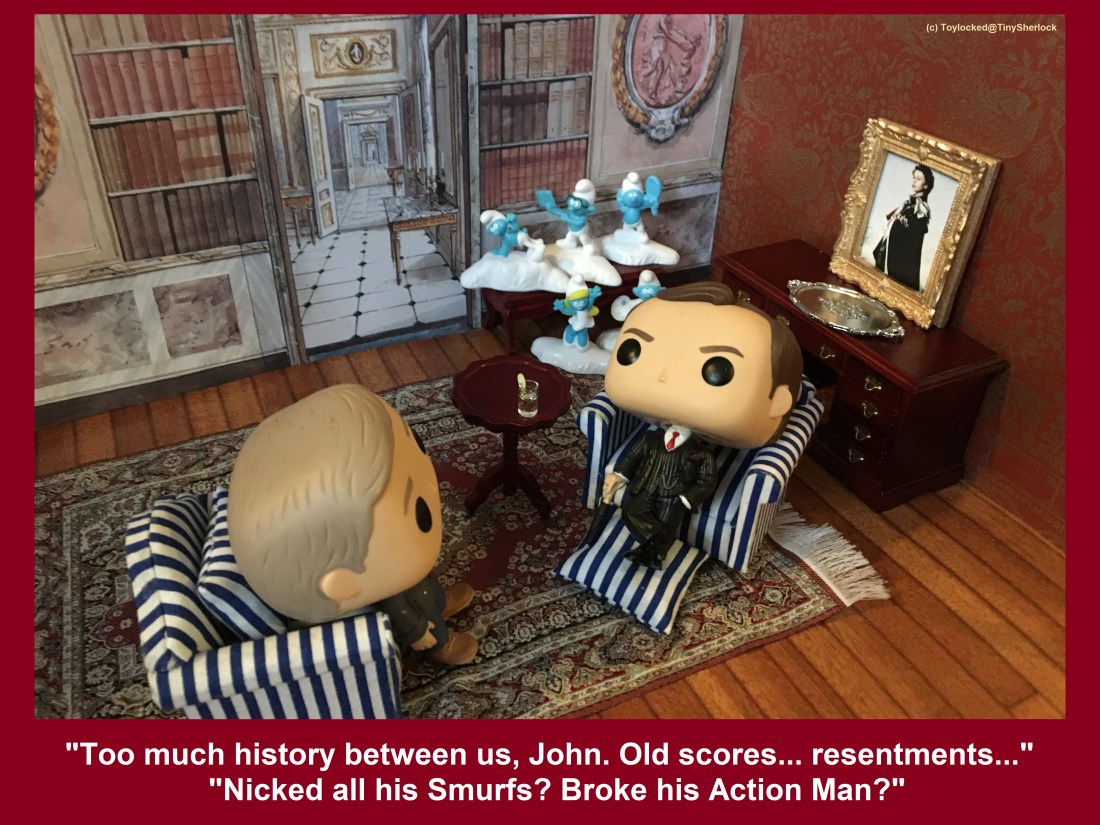
In The Reichenbach Fall, John is taken to the Diogenes Club by Mycroft’s mysterious staff. Unaware of the club’s rule of silence, he causes a disruption; he is led away by two members of staff and taken to a side room which appears to be available for private conversations – and is almost an extra office for Mycroft. Here John does actually meet Mycroft, who wants to warn him about the assassins setting themselves up around the Baker Street flat.

smurfs

I had been wanting to recreate this scene for some time, but when I discovered on the website of a dollshouse supplier (the excellent minimumworld.com) the paper which covers the back wall, I knew I could do it. It is a single sheet, printed with the doorway, the rooms beyond, the bookcases and the wall decorations. I had owned the chairs for some time, but hadn’t used them in the current incarnation of Toylocked, so they were perfect, being so much smarter than the ones I use for 221B. The other props had largely been used elsewhere, apart from the beautiful silver tray. And of course, there are the Smurfs – which I bought on eBay in a job lot for about £2!

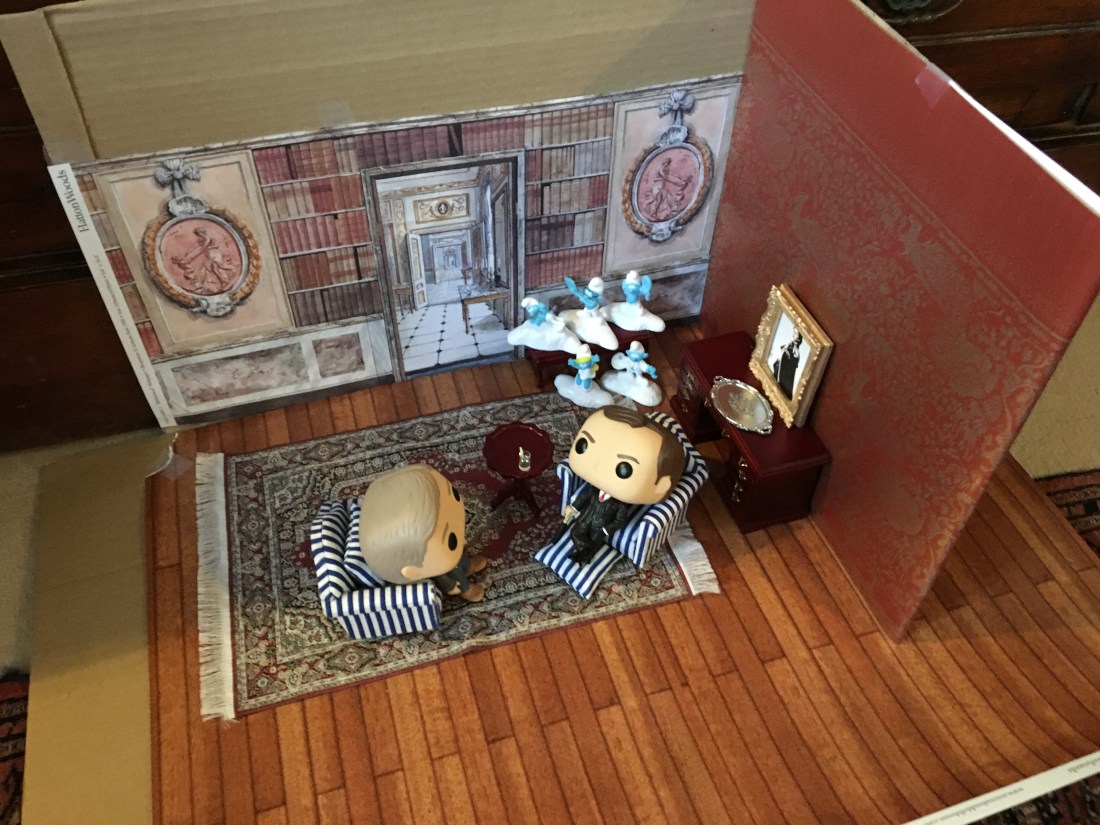
Scenes like this look best when two walls are visible, and I have created a number of rooms using the sides of cardboard boxes. At the risk of destroying the illusion, this is what the set-up actually looks like:

img_6156

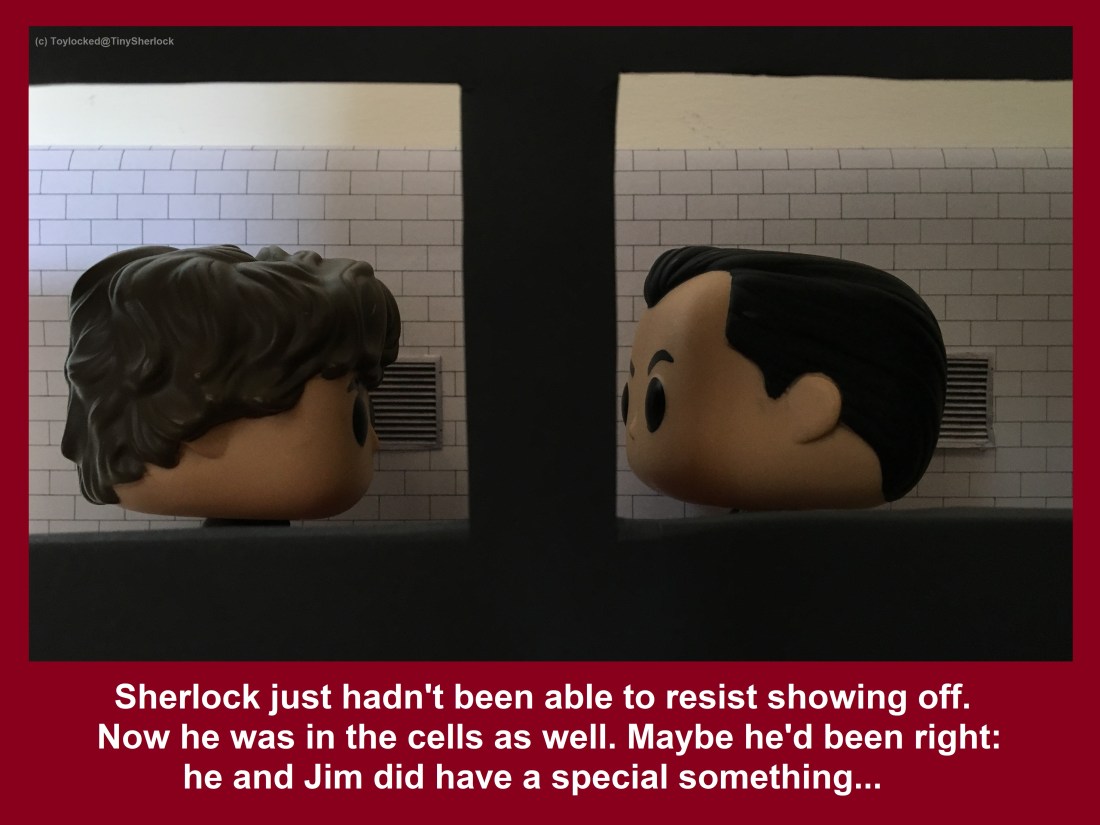
Police cells appear more than once in Sherlock. In The Reichenbach Fall, Moriarty and Sherlock are both put in the cells following Sherlock’s failure to respect the authority of the court.  There follows a beautifully framed scene where we look through the windows in the cell doors to see the two of them turning in their cells, separated by a wall:

cells

I bought a template from Etsy to print the old-fashioned tiles, I created some tiny gratings (printed at a very small scale, and stuck onto the walls with folded edges to give a little depth) and cut two holes in a piece of black card to frame the heads.

cells

This was one of those occasions when the simplest ideas are the hardest to carry out: getting the positioning, the lighting and the focus right was nigh on impossible and the picture is not as clear as I had hoped, but I try to tell myself I have achieved a dark, moody ambience!

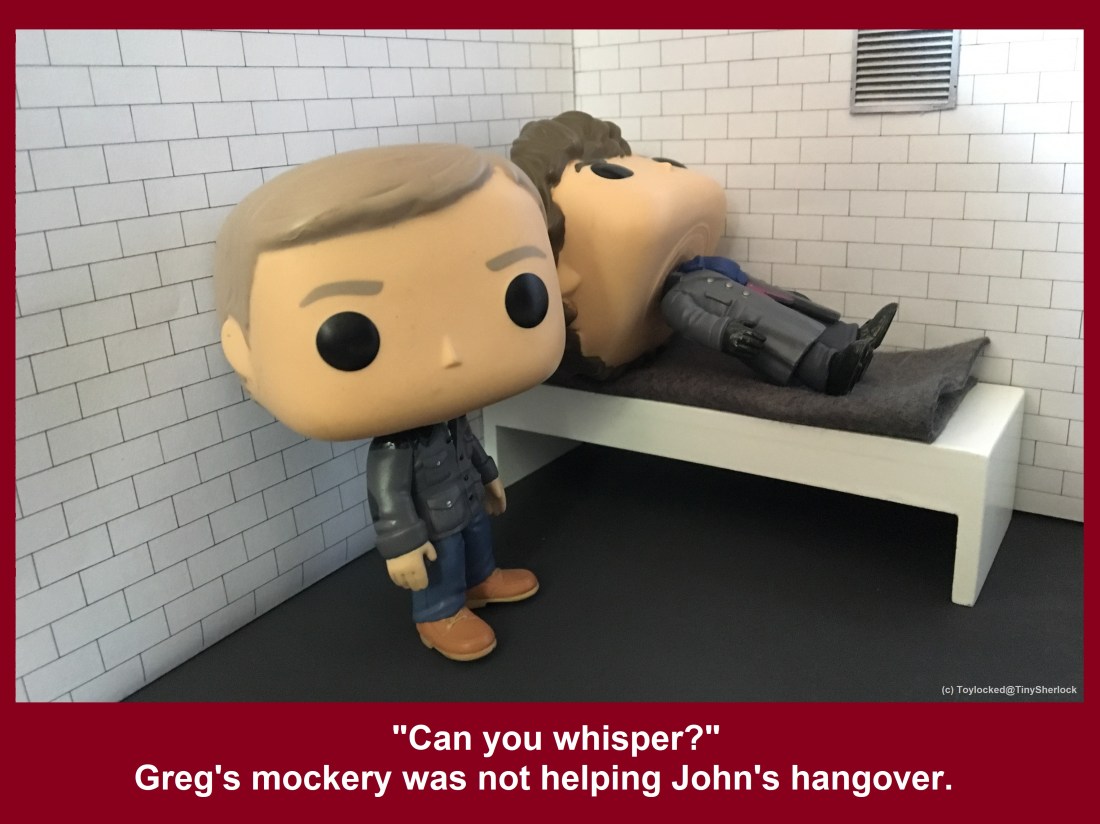
I used the same set-up to picture Sherlock and John waking up in a police cell following John’s rather hopeless stag night. A simple table and some folded felt created the bed. The back wall wasn’t very stable and as you can see I propped it up with an old Tardis money-box which happened to be handy (Toylocked’s house is full of such useful things!).

img_1625(1)

This was another very simple picture, but it received positive feedback – mainly because it is such a funny scene anyway!

morning after

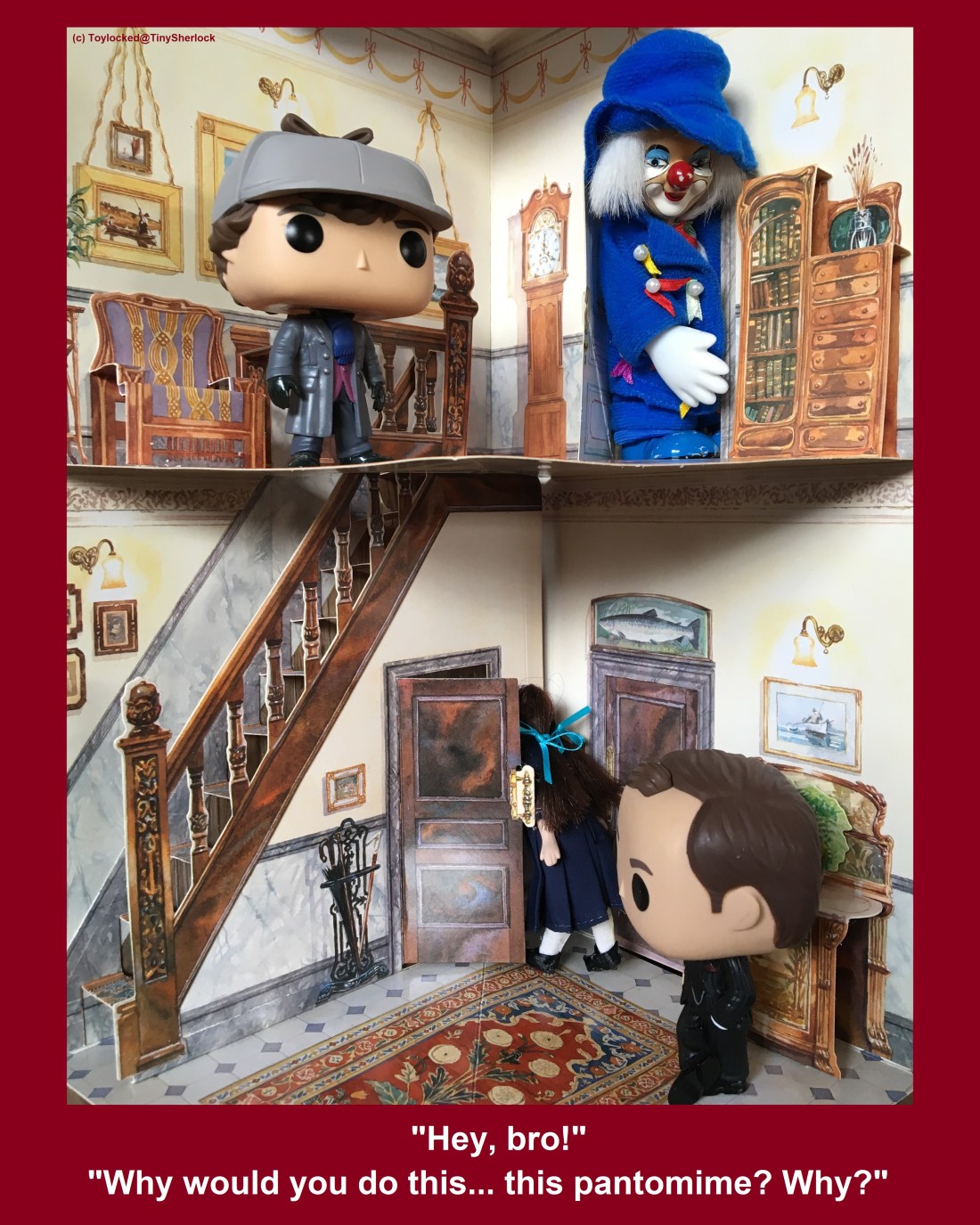
One of the most intriguing locations in Sherlock is Mycroft’s extraordinary house.  To recreate the scene at the beginning of The Final Problem, where Sherlock arrives to gloat over a Mycroft who has just been scared out of his wits, I was able to use a wonderful piece of work by some artists who live quite nearby. The enormously talented Brian and Lizzie Sanders created a beautiful book over 20 years ago, called A Three-Dimensional Edwardian Doll House.

dollhouse

This extraordinary book opens right out, so that when the covers are tied back to back with the ribbons provided, one has a two-storey, eight-roomed house, as shown in the photos above. I bought my copy on eBay some years before I started creating Toylocked, having admired Brian’s other work (including the wonderful book Evacuee, about spending part of his childhood in my home town). If you don’t know Brian and Lizzie’s work, it’s worth looking out for: Brian illustrated many many book covers and UK postage stamps, and co-produced an amazing book about the Titanic, with a huge fold-out model of the ship inside; Lizzie, amongst other work, illustrated the Yorkshire Tea packet familiar to UK readers. You can find out more about Brian’s work here: http://artofbriansanders.blogspot.com/

I realised that in this book I had a ready-made setting for Mycroft’s house in which Sherlock could stand at the top of the stairs and Mycroft in the hall downstairs. It even has opening doors. A small doll and a rather scary porcelain clown were purchased on eBay and I had my scene!

clowns

(Huge thanks to Brian for permission to use this work in the furtherance of Tiny Sherlock fun!)


Size matters!

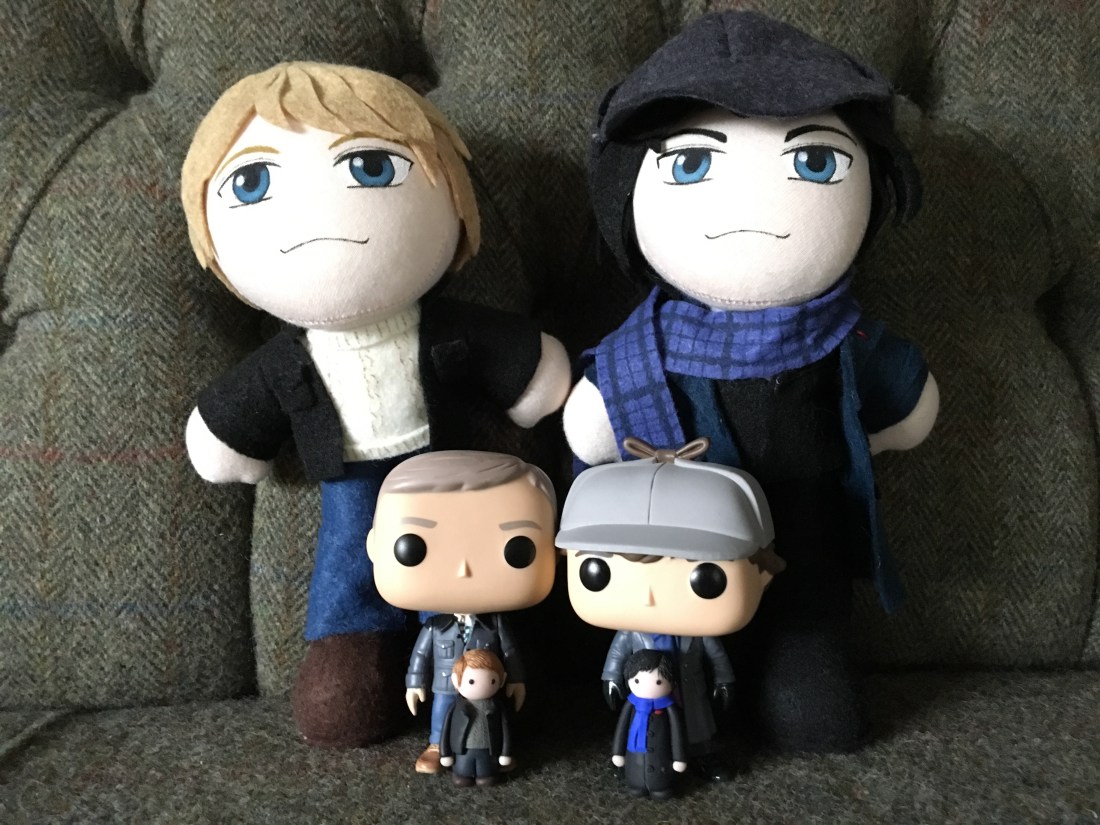
Most of my pictures are made with Funko Pops – small vinyl people, with very big heads, available for a huge range of film, television and real life characters. They are easy to transport for location shots, and easy to create interior scenes for because standard dollshouse furniture (1:12 scale) works well with them. I have sometimes used other toys, because they are interesting and allow me to create different kinds of pictures, but they present a whole new set of challenges. Here are the three kinds of figures I have used, to show the differences in scale:

img_6195

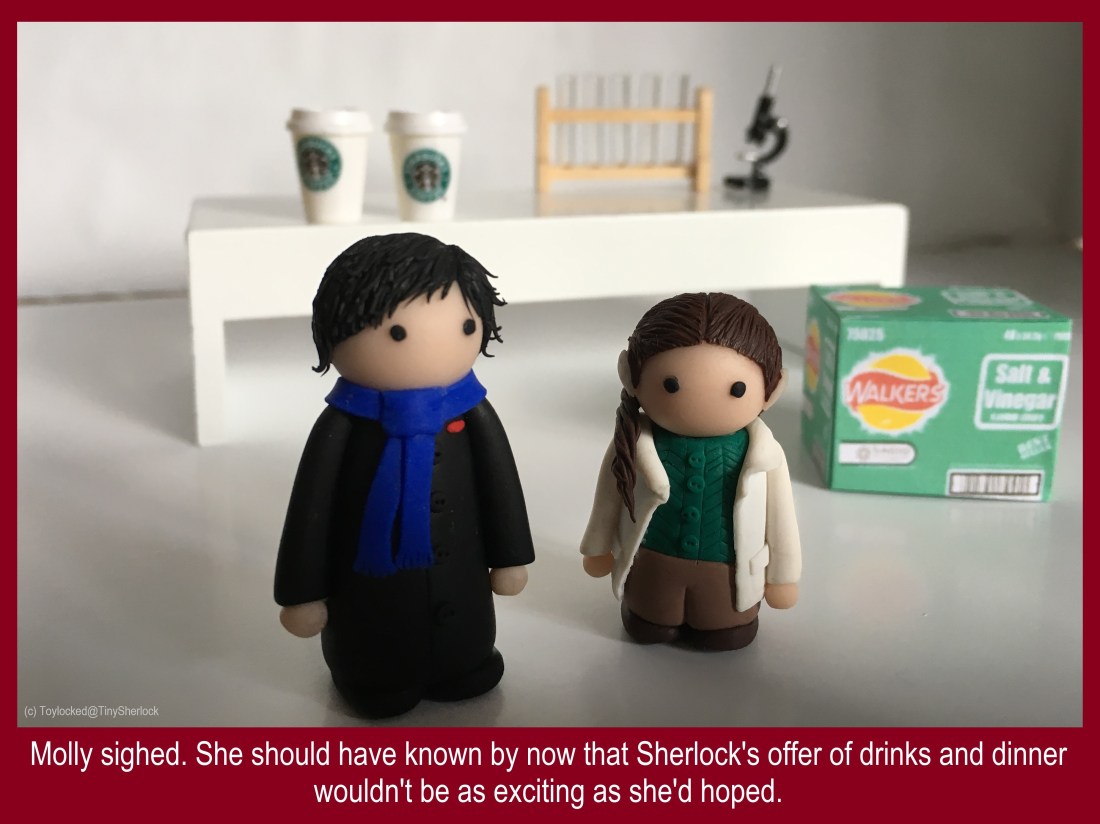
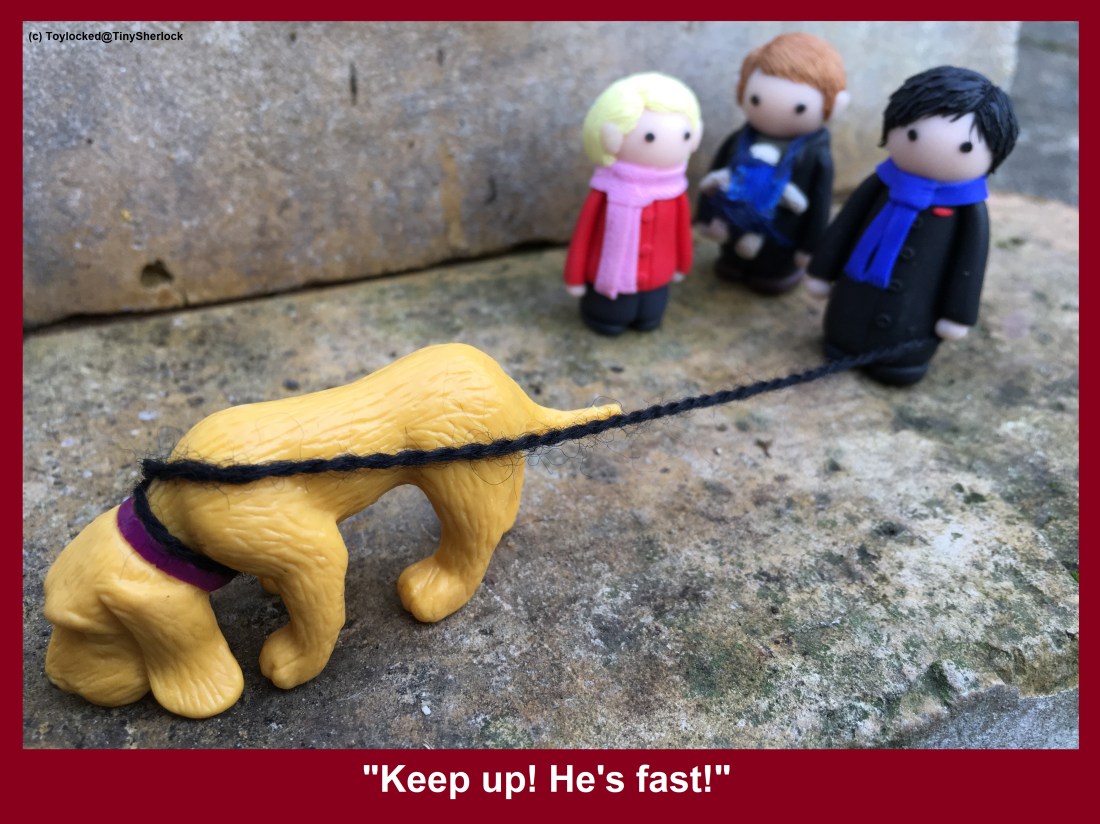
The tiny little Sherlock toys, at the front of the picture above, are made by the very talented Carolina Alkstål, who used to sell them on Etsy. She also made me a tiny Molly and Mary. This enabled me to create scenes which included these characters, which was lovely. The figures are so small, however, that they are quite hard to find suitable props for. This meant that I often had to put them at the front of the picture, with everything else some way behind (and therefore out of focus). It was essential that the figures themselves were as in focus as I could manage with a hand-held iPhone: just look at the amazing detail on Molly’s clothes in these two shots based on The Reichenbach Fall, which seem to me key moments in demonstrating the relationship between Sherlock and Molly.

lab dinner titled

sad

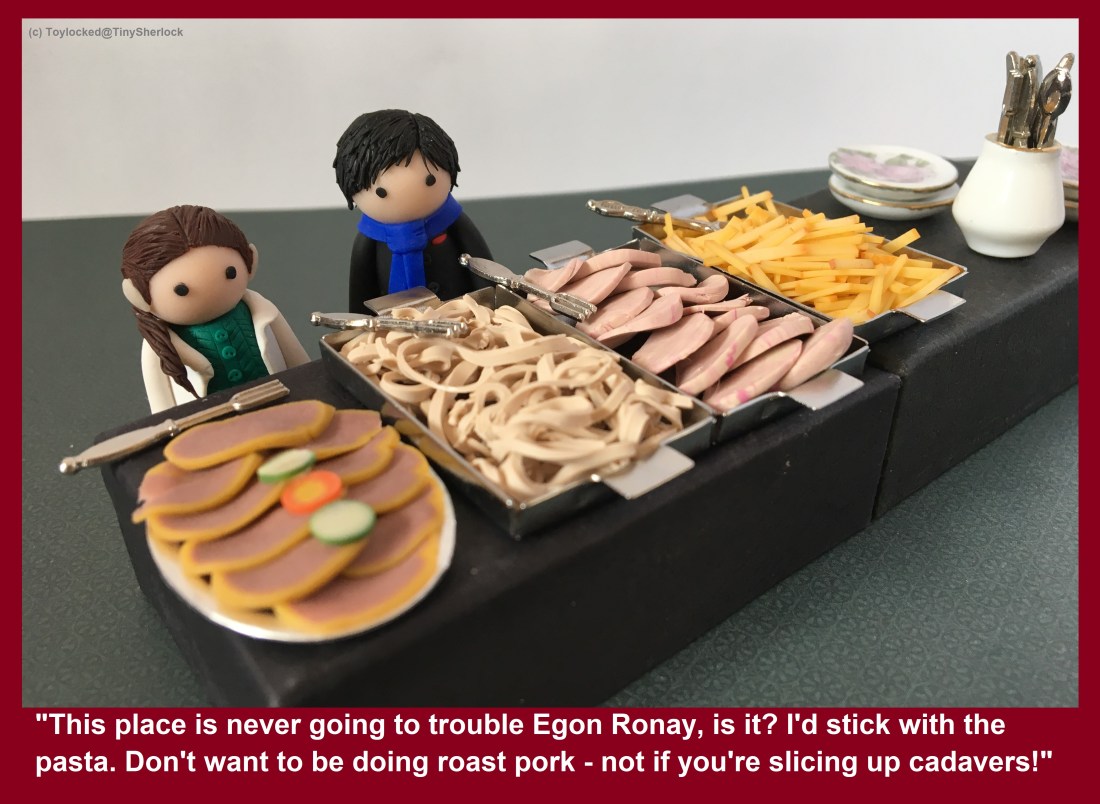
I wanted to show the two of them in the Bart’s Hospital canteen, as seen in The Blind Banker, but this took a lot of planning. It was easy enough to get hold of dollshouse knives and forks, and the plate of sliced meat decorated with salad was bought too. I had the tiny plates which I had used in other pictures. I was also able to buy the serving trays. I bought the tiny chips (fries), but I made the pasta and sliced pork out of Fimo clay, using a scalpel. The counter is actually the boxes the figures arrived in.

canteenAnother key moment between Molly and Sherlock occurs in The Lying Detective, when Molly appears dramatically in an ambulance to test Sherlock for drug abuse, which she does on their way to meet Culverton Smith.  The figures are a bit too small for a Playmobil ambulance, but at least I could fit Sherlock inside to recreate the scene:
slab

I took this photo on the path outside my house: if my neighbours aren’t use to my occasional displays of oddity by now, it’s too late!

I was anxious to use the figure of Mary too, and decided to try for the scene with Toby the bloodhound from The Six Thatchers. I had already tried to create the scene with the Funko toys, but since they never made a figure of Mary it seemed incomplete. After a number of attempts to find a toy bloodhound (including one where I didn’t read the eBay description properly and ended up with a cuddly bloodhound over a foot long) I found a “Puppy in my Pocket” toy. For this picture, John had to be carrying baby Rosie in a baby carrier. Rosie was hurriedly constructed from white plasticine, and the carrier from blue ribbon. The bloodhound was still very big compared with the toys, so I deliberately placed him in front and in focus, with the people at the back (this also hid any faults in the baby and carrier!).

toby

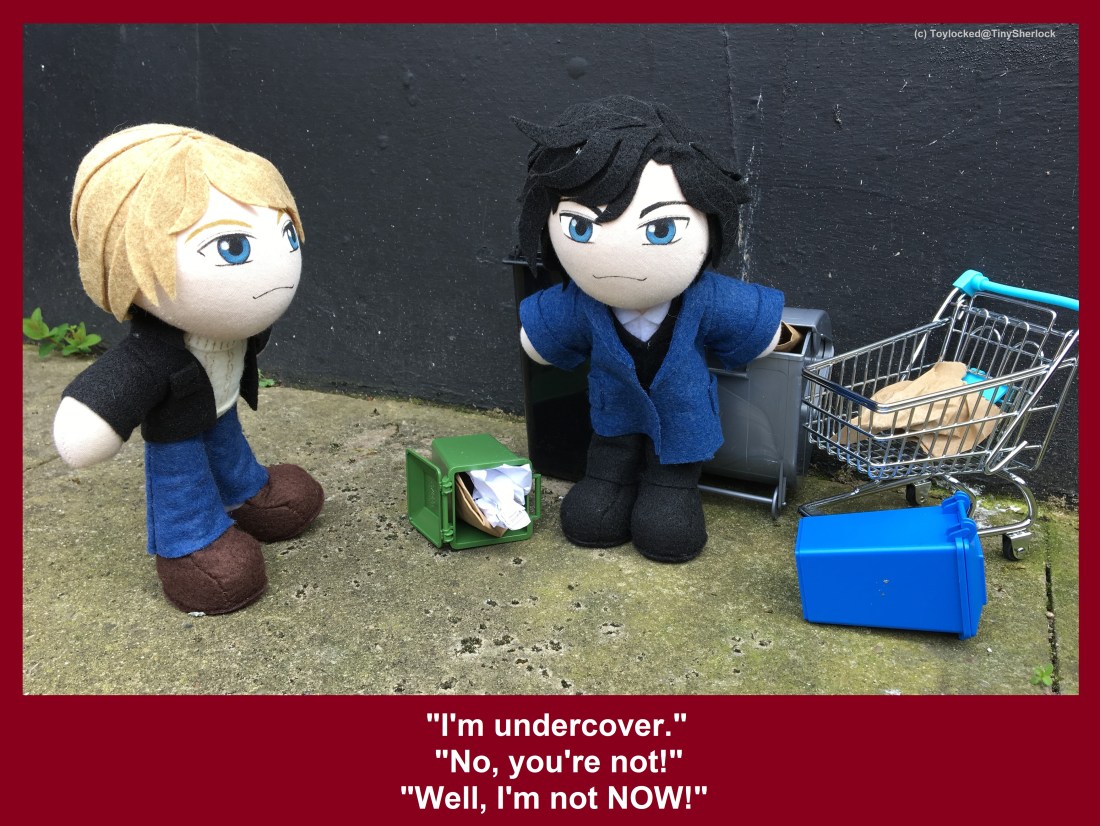
So much for creating pictures with very small figures. At the other end of the scale, I commissioned the beautiful large plush figures of Sherlock and John from The Plushie Lady – https://www.deviantart.com/theplushielady – and I absolutely love them. They are too big for most of my usual props, so some imagination had to be deployed.

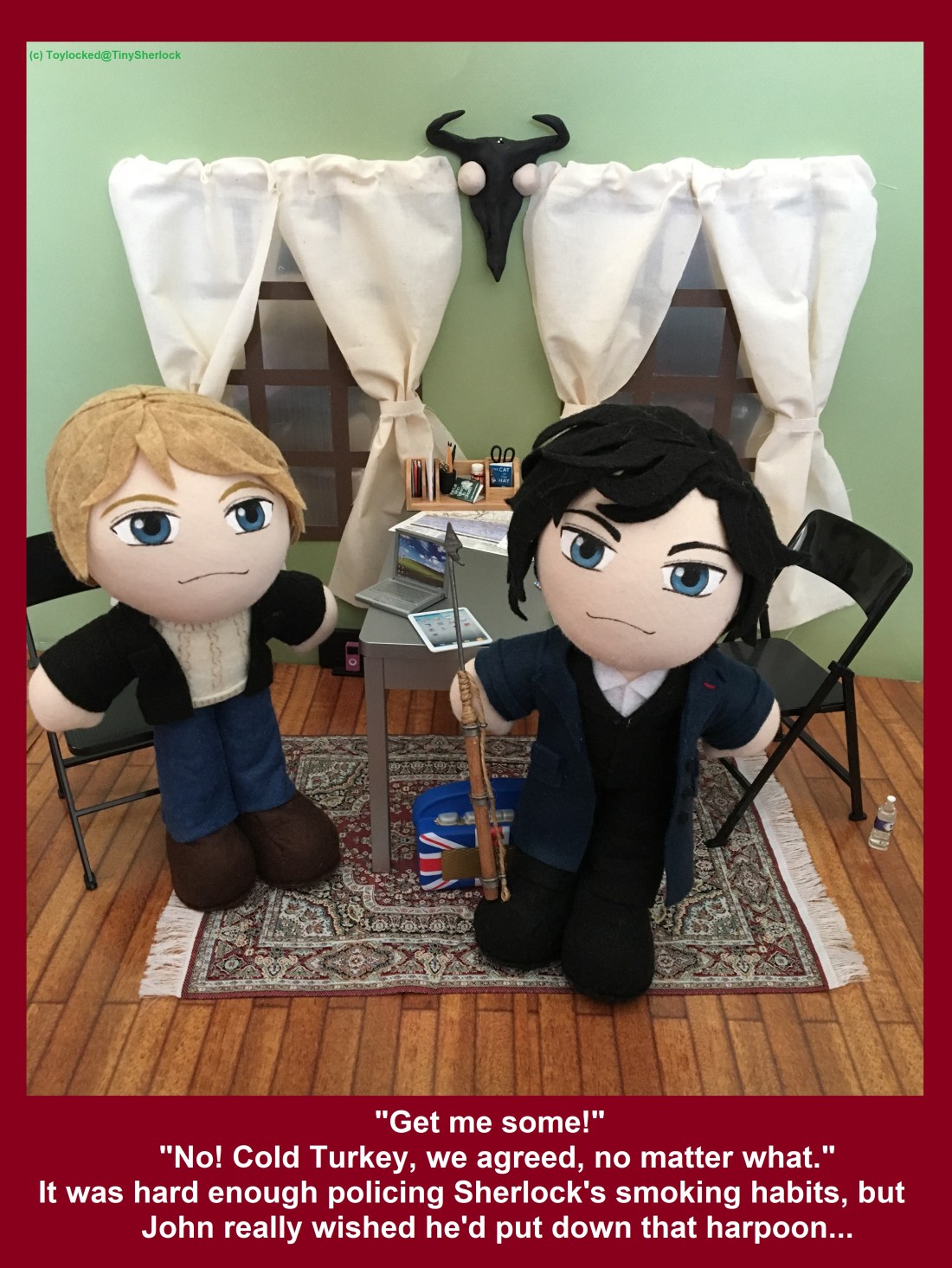
For the scene at the beginning of His Last Vow, where John finds Sherlock in a drug den (a very clever echo of the scene from the original Conan Doyle story, The Man with the Twisted Lip), I used toy rubbish bins and a supermarket trolley which I think were actually designed to be stationery tidies! In this scene, Sherlock is wearing the dressing gown which the Plushie Lady made for him at my request. You can also see that John’s sweater is embroidered to show the pattern of the knit. I love the fact that the way these toys stand up makes it easy for them to appear confrontational, as though they really are having the row which this picture depicts.

not now

To create an interior of 221B for these toys, I could not use the rooms I had made for the Funkos as they would have been hopelessly out of scale. I started from fresh, finding a paper roughly the colour of the wallpaper around the windows and creating the windows themselves from foiled paper with brown paper cut-outs stuck on top. In this scene from The Hounds of Baskerville, Sherlock is wearing his coat and you can see the detailing on John’s clothes even better. More about the harpoon in another blog.

cold turkey

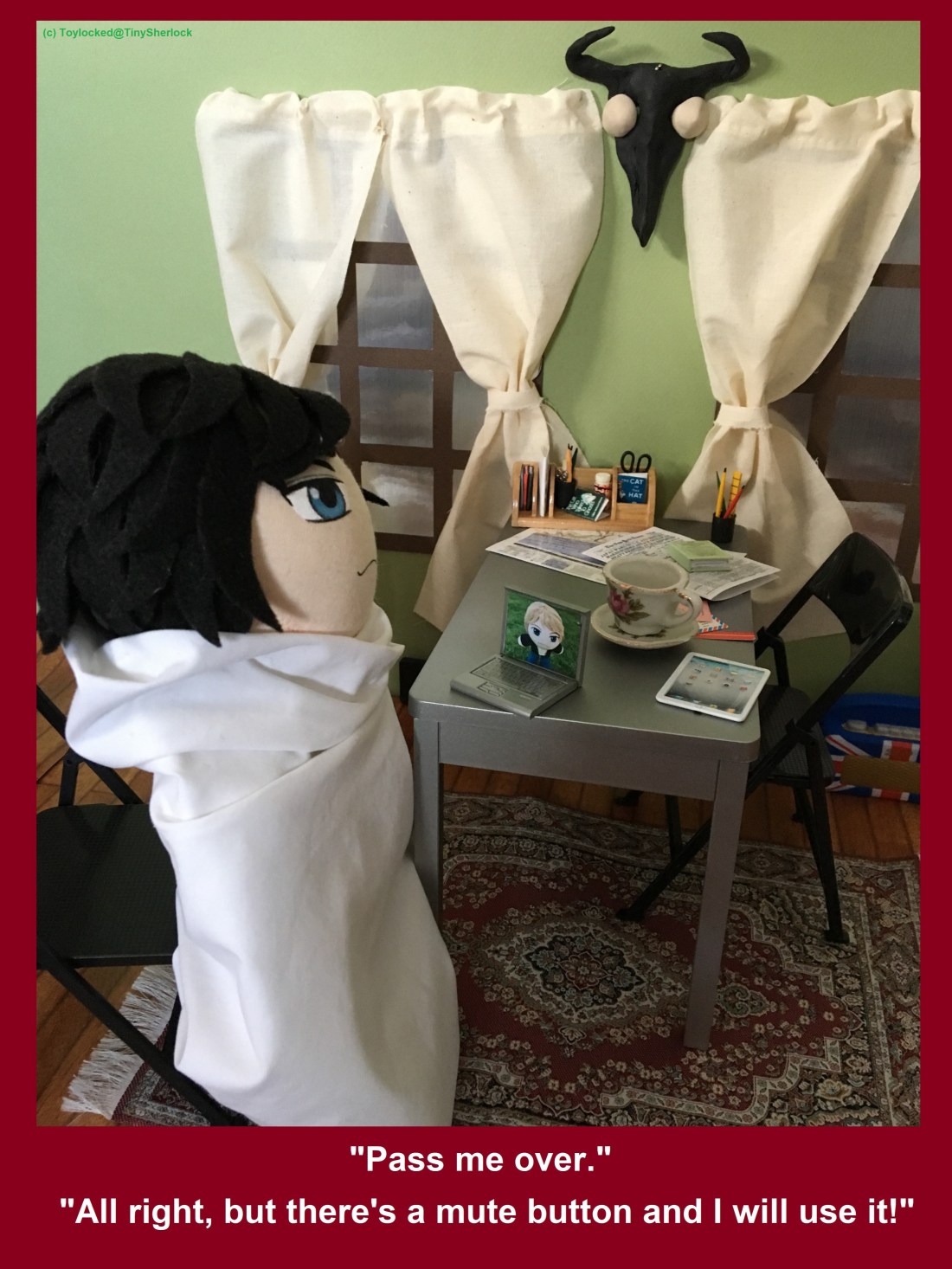
The curtains are made from unbleached cotton with a hem sewn into the top, which is threaded onto cord. The table and chairs are toys designed to be the right scale for playing with Action Man or similar figures. The radio is a promotional toy made by a well-known radio manufacturer. I made the bison skull on the wall out of Fimo – one of my friends saw it on my table and thought it was an attempt at a model of the female reproductive system, which I now see every time I look at it! It lasted for a couple of pictures before I accidentally broke one of the horns, so I will have to make a new one if I make more of these pictures.

mute

I used the same arrangement for the scene in A Scandal in Belgravia where Sherlock, wrapped in a sheet, talks via the laptop to John, whom he has sent to investigate the death of a hiker in the countryside. Dressing Sherlock for this was easy – a piece of an old pillowcase pinned round him. The books on the table include “The Cat in the Hat” (I like to think Sherlock reads this at home!). I took the plush figure of John into the garden to photograph him, printed it off small and stick it onto the miniature laptop. The scale of the laptop isn’t quite right but I couldn’t find a bigger one!

I would like to create more pictures for the tiny and the large toys, but they take a lot of time and planning. In the meantime, the tiny figures live in their boxes for protection and the larger ones sit on my sofa as part of the household!


Location, Location (part 2)

A further exploration of the joys of photographing the toys in the original Sherlock locations.

trafalgar 1

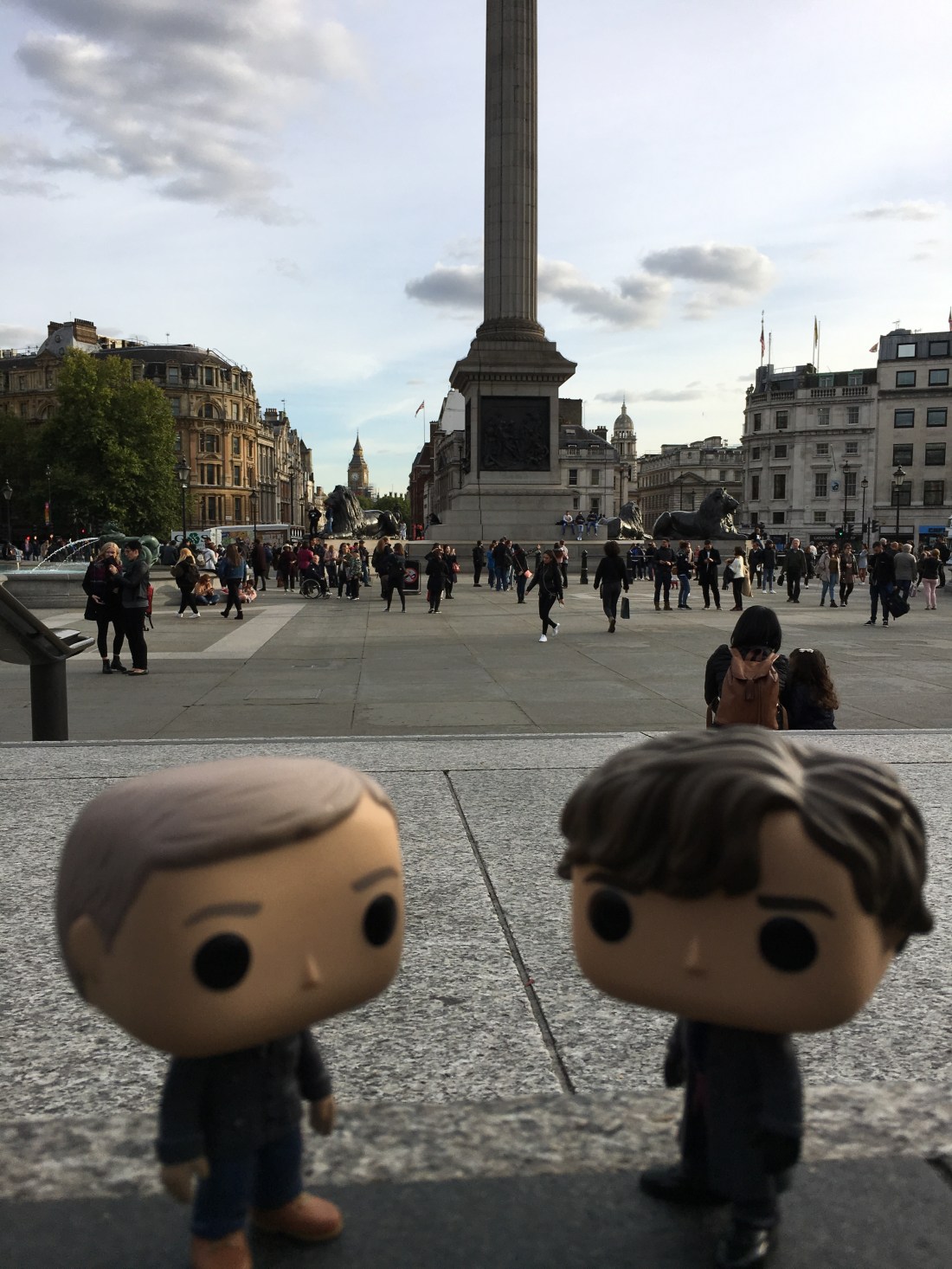
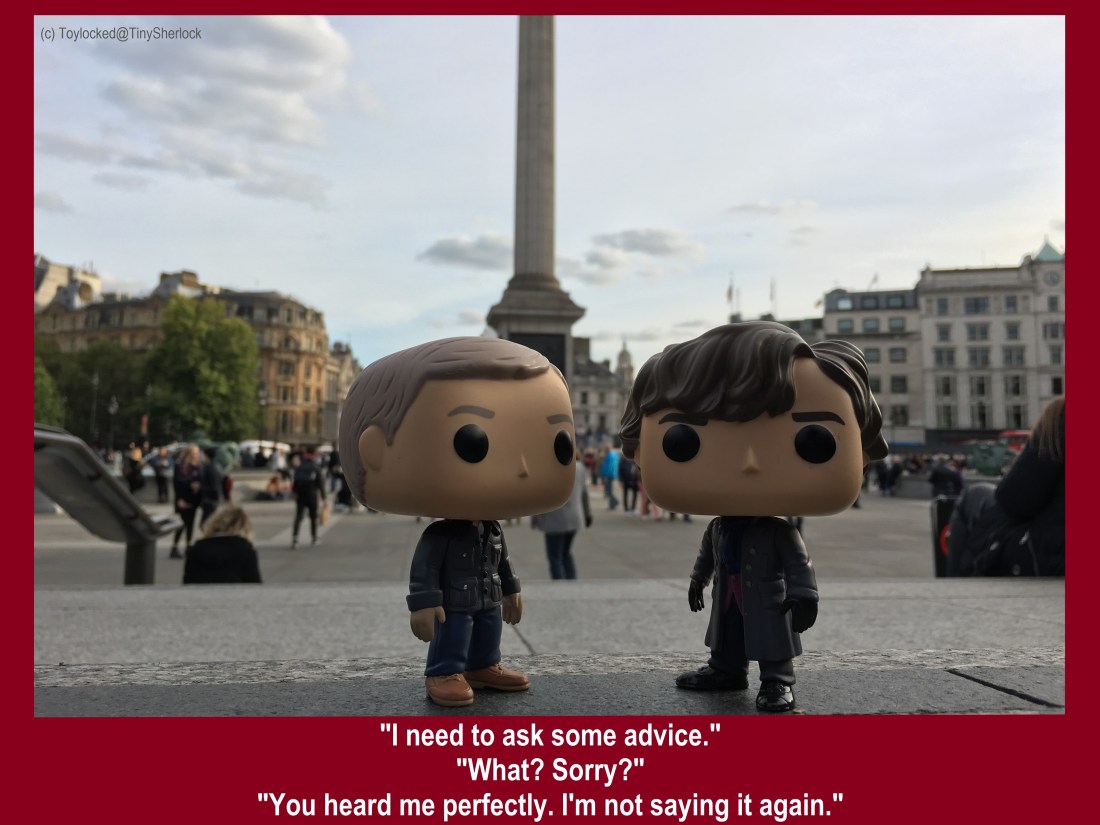
Taking photos of toys in the middle of London involves some indignities. Trafalgar Square, through which Sherlock and John walk in The Blind Banker, is a busy place, full of tourists, street artists, office workers, police and shoppers. In order to show the location properly,  I needed to have Nelson’s Column clearly in the picture, but to focus on the toys I needed the camera to be low. This meant that I was lying on a step in one of the busiest places in London to take the picture, and getting some very strange looks. Even in a city full of eccentrics, where all sorts of behaviour is smiled upon, I probably looked a bit odd. As always with these pictures, the differences in distance between the background and foreground also caused problems – I could get the Column in focus…

IMG_1851(1)

… or the toys in focus. Obviously, Sherlock and John are at the centre of the picture and they had to be clearly defined, as in the final picture:

trafalgar 1 titled

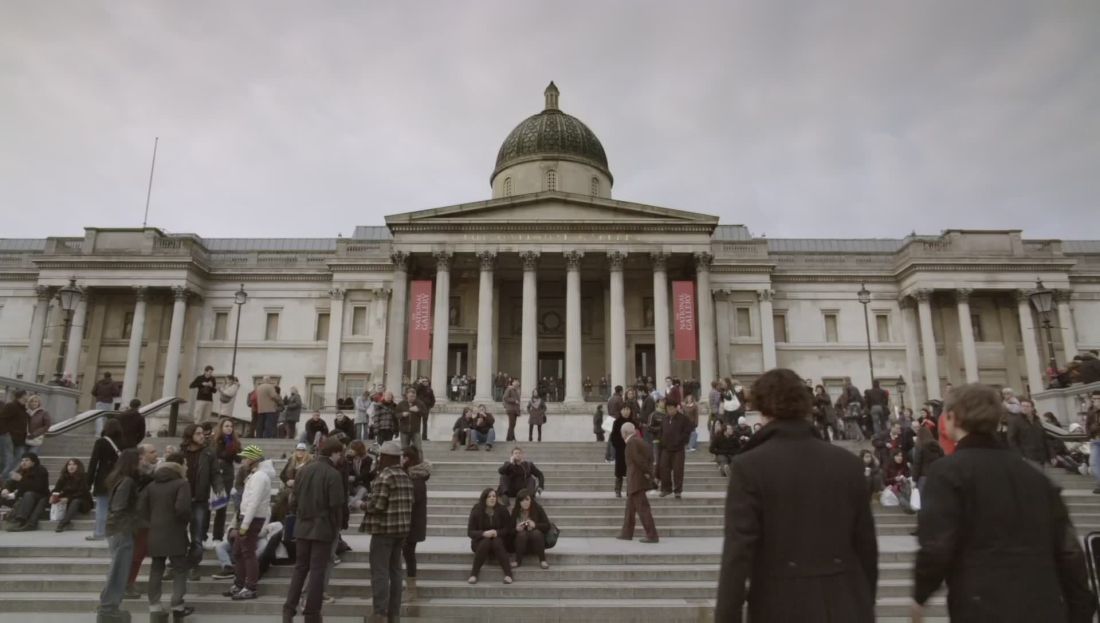
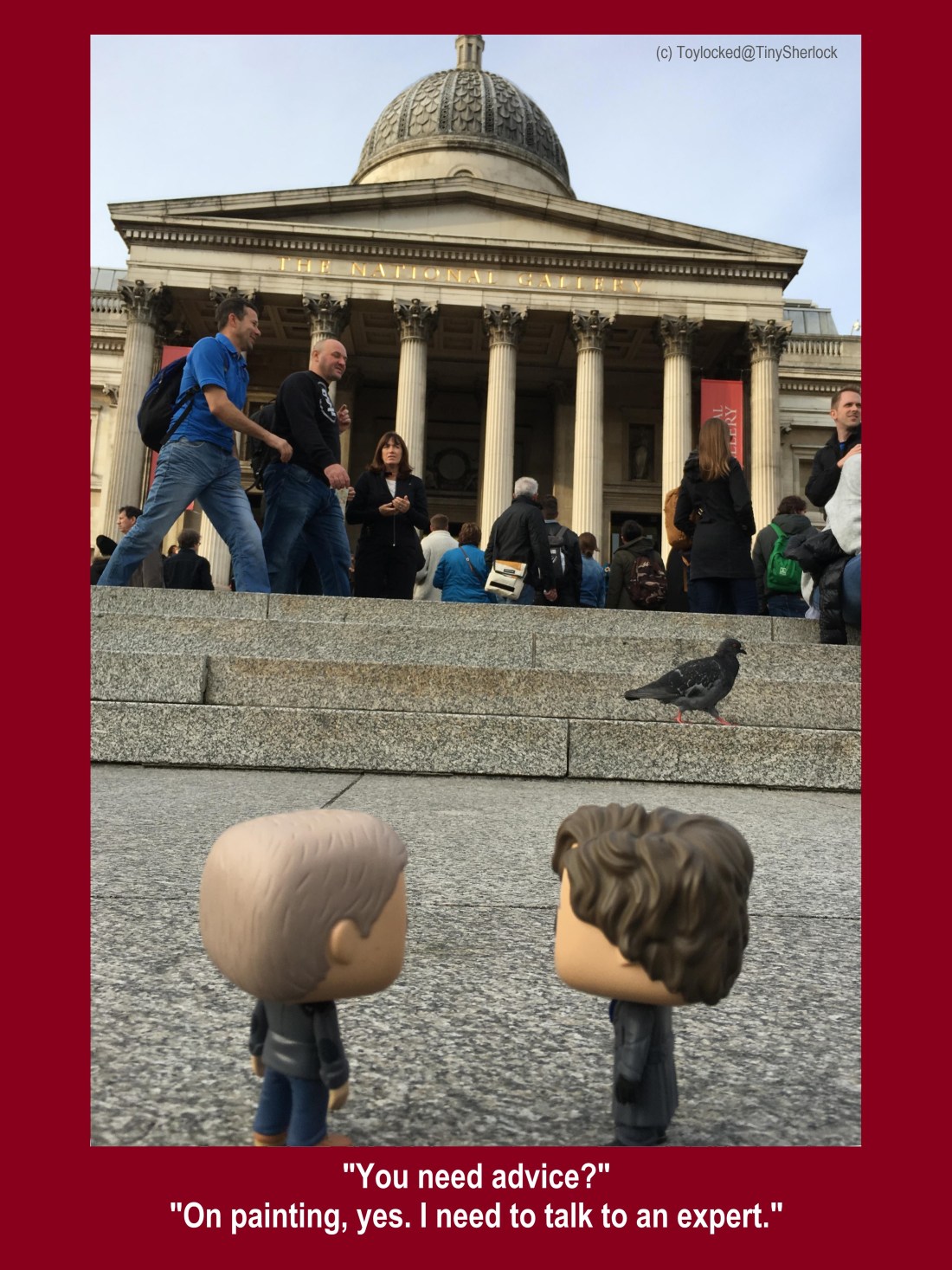
Turning the viewpoint round, so that the two of them are looking at the National Gallery, was even more complicated. The top of the steps was even more crowded than the rest of Trafalgar Square.

trafalgar 2 Luckily the original showed a crowded scene, but several of my attempts at the picture include people giving me disgruntled or questioning looks, and getting the angle right was surprisingly hard under the circumstances!
IMG_1870

It was slightly breezy and the toys kept falling off the step and had to be replaced. This explains why, when the final photo is compared with the previous published picture, Sherlock and John have mysteriously swapped places on their way up the step!

trafalgar 2 titled

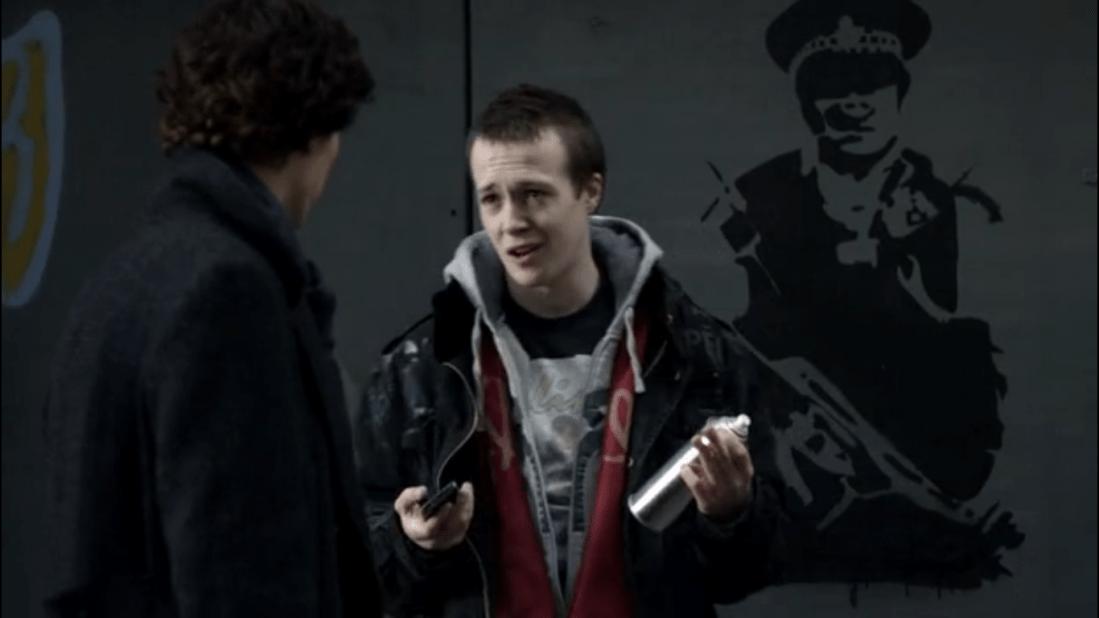
Of course, when Sherlock says he wants to consult an expert on painting, he isn’t actually thinking of anyone working in the National Gallery. Instead, he takes John round the back of the building to meet Raz, who is a graffiti artist. Trying to locate the scene when Sherlock and Raz run away, leaving John to be arrested, proved more difficult than expected. With my (very patient) friend Lucy, with whom I was going to the theatre that evening (Aidan Turner in The Lieutenant of Inishmore, if anyone’s interested), I walked twice round the National Gallery and National Portrait Gallery and failed to find the place.

graffiti

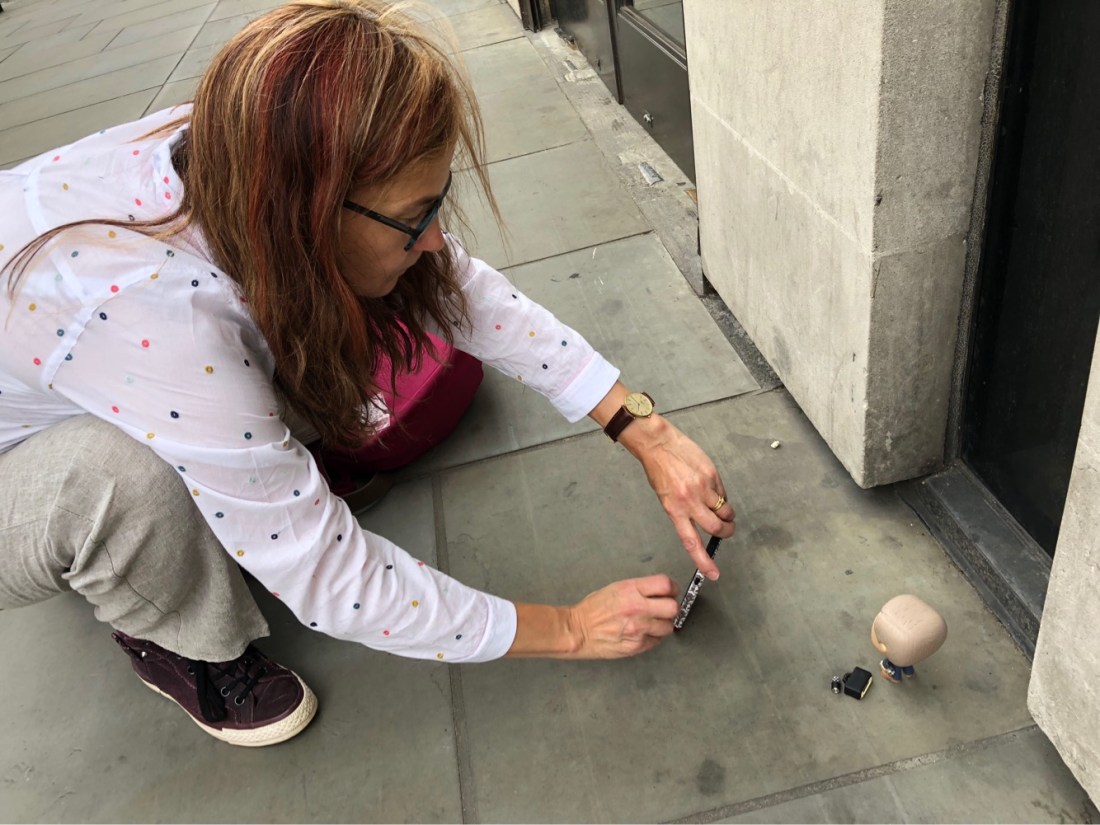
As far as possible, I like Toylocked scenes to take place in the right location, so we eventually chose a doorway at the back of the National Gallery (thanks for the action photo, Lucy!):

IMG_2439(1)

John’s tiny tins of paint are doll-sized drinks cans with black, silver and chequered masking tape around them, and Raz’s bag is a Playmobil suitcase covered in masking tape. And he really is standing behind the National Gallery!

graffiti

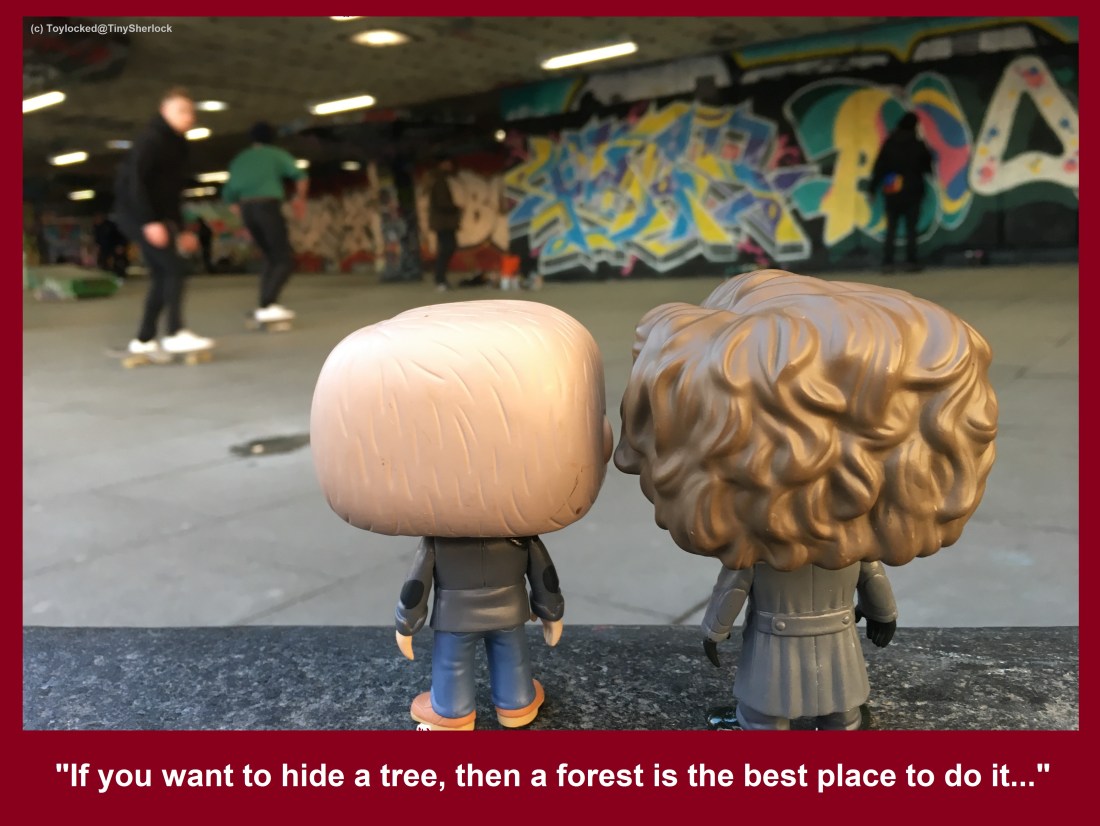
Later in the same episode, Raz takes Sherlock and John to see an example of the Michigan Yellow paint which has appeared in some graffiti in the skate park on the South Bank. Taking a photograph here aroused some interest in one or two of the skaters and one of them asked what I was doing. When I explained about my Toylocked project, he told me he thought it was “wicked”, and I carried on:

michigan yellow

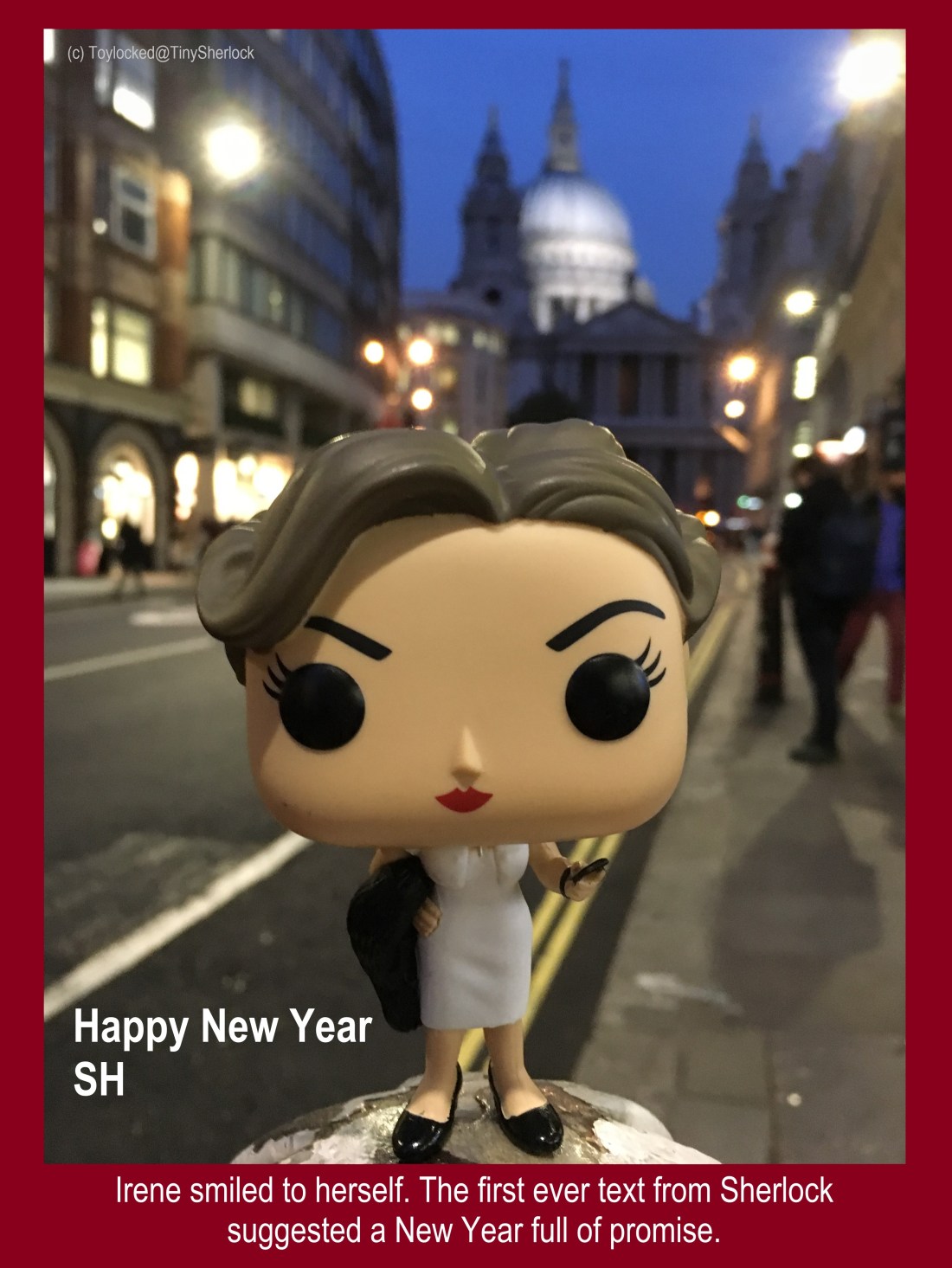
As I write today’s blog, it is New Year’s Eve. The last Toylocked photo for today is therefore Irene Adler receiving a New Year’s message from Sherlock in A Scandal in Belgravia. Here I have to make a confession: there have been two versions of this picture and the first one was wrong. I was in London one evening, with the toys in my bag, and I thought I’d take advantage of my proximity to St Paul’s Cathedral to take this photo. I didn’t check the scene exactly. I precariously balanced Irene on top of one of the black, white and red City of London bollards on Ludgate Hill and got a good shot, showing the dome of St Paul’s floodlit against an evening sky.  This shot was posted on 31 December 2017.

new year titled

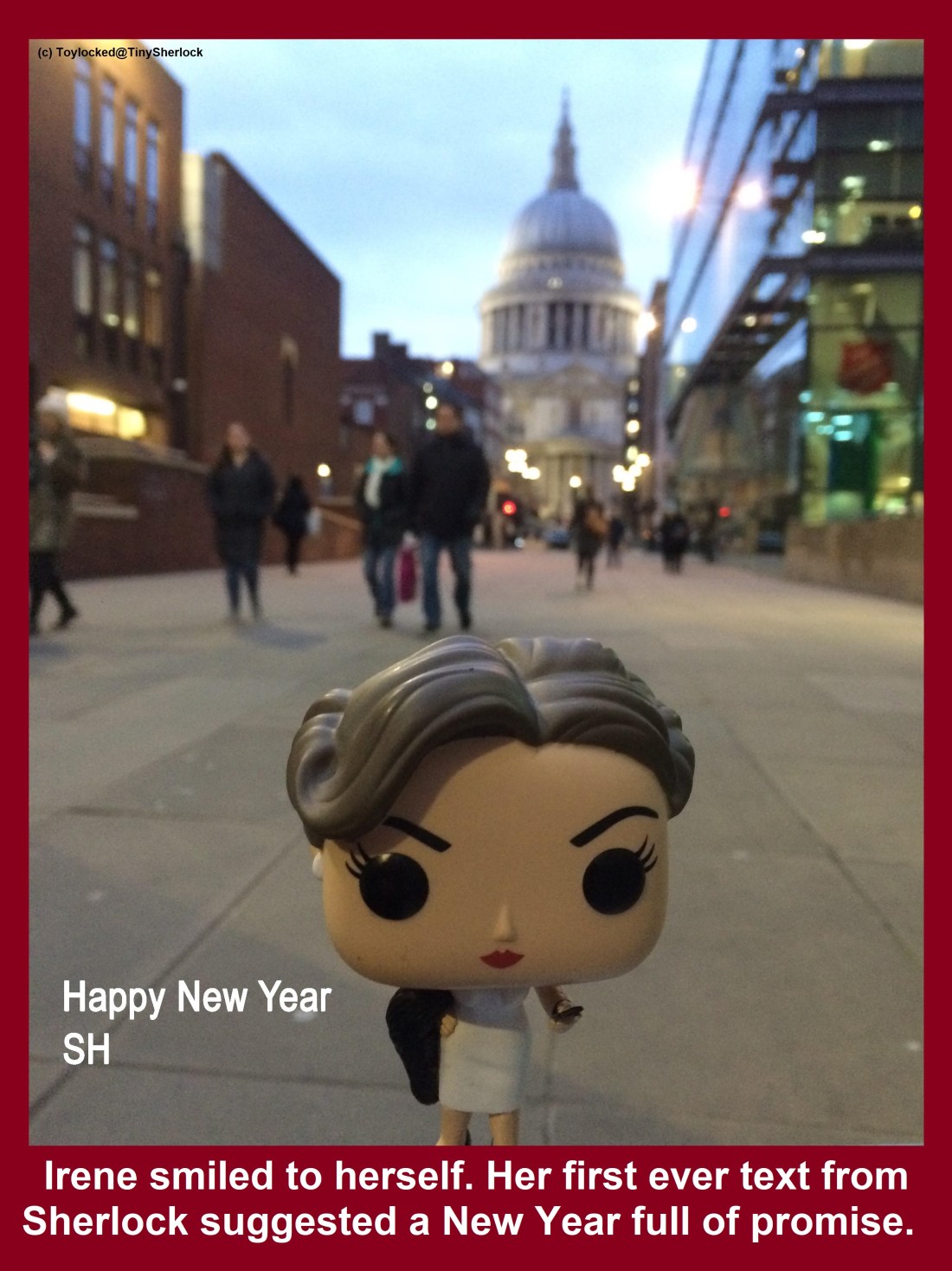
Then I watched the episode again and realised that Irene was not standing on Ludgate Hill at all, but on the pedestrian street leading to the Millennium Bridge. The modern buildings on that street provide a series of reflections which provide a dramatic backdrop:

millennium

I have of course now been to the correct location, where it is surprisingly difficult to find a surface on which to balance a rather unsteady Funkopop (Irene has tiny feet with high heels) while including the right backdrop. Here at last is the corrected version for New Year’s Eve 2018:

z new year 2

Happy New Year from Toylocked!


Christmas is coming…

I first started making pictures with toys for a Facebook advent calendar to amuse my friends. Various toys from around the house took part, including figures from Doctor Who and the Moomins, and British classics like Bagpuss and the Clangers. I wrote the captions in the body of the Facebook post, numbered down to the 24th of December.

A couple of examples:

crackers

Original caption: When Tom Smith invented Christmas crackers, he didn’t anticipate the difficulties they would pose for the creatures of Hogwarts.

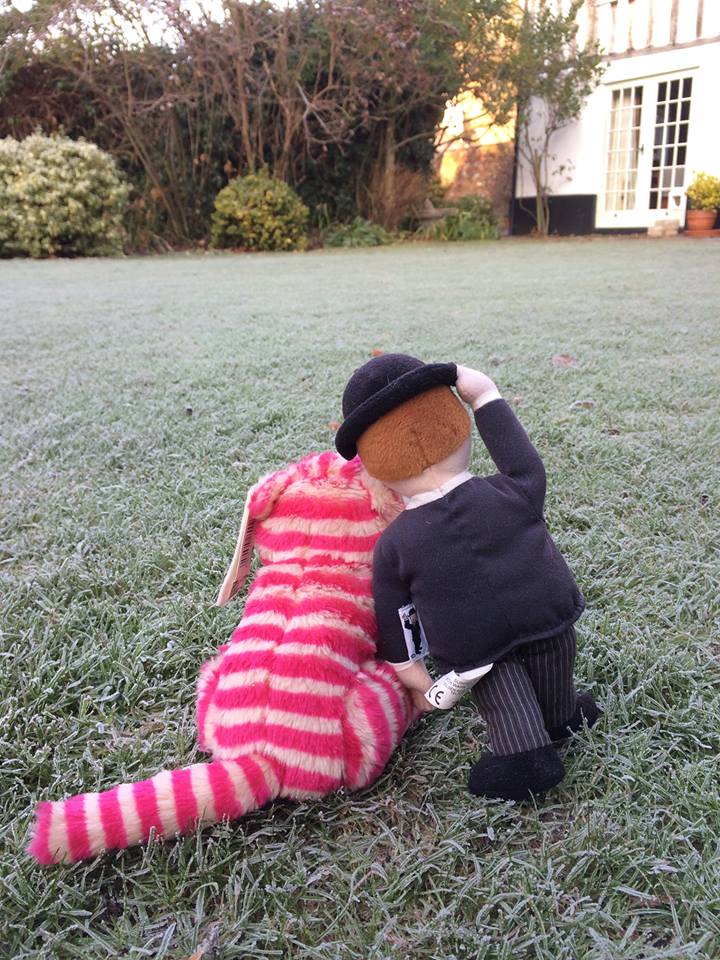
bagpuss

Original caption: Bagpuss and Mr Benn went for a bracing walk. “Isn’t the frost beautiful, Bagpuss?” “Lovely, Benn old friend, but it’s a long way back to the house. Yaaawwn.”

Eventually, of course, the Sherlock toys wanted to join in, and my first Sherlock posts were very simple:

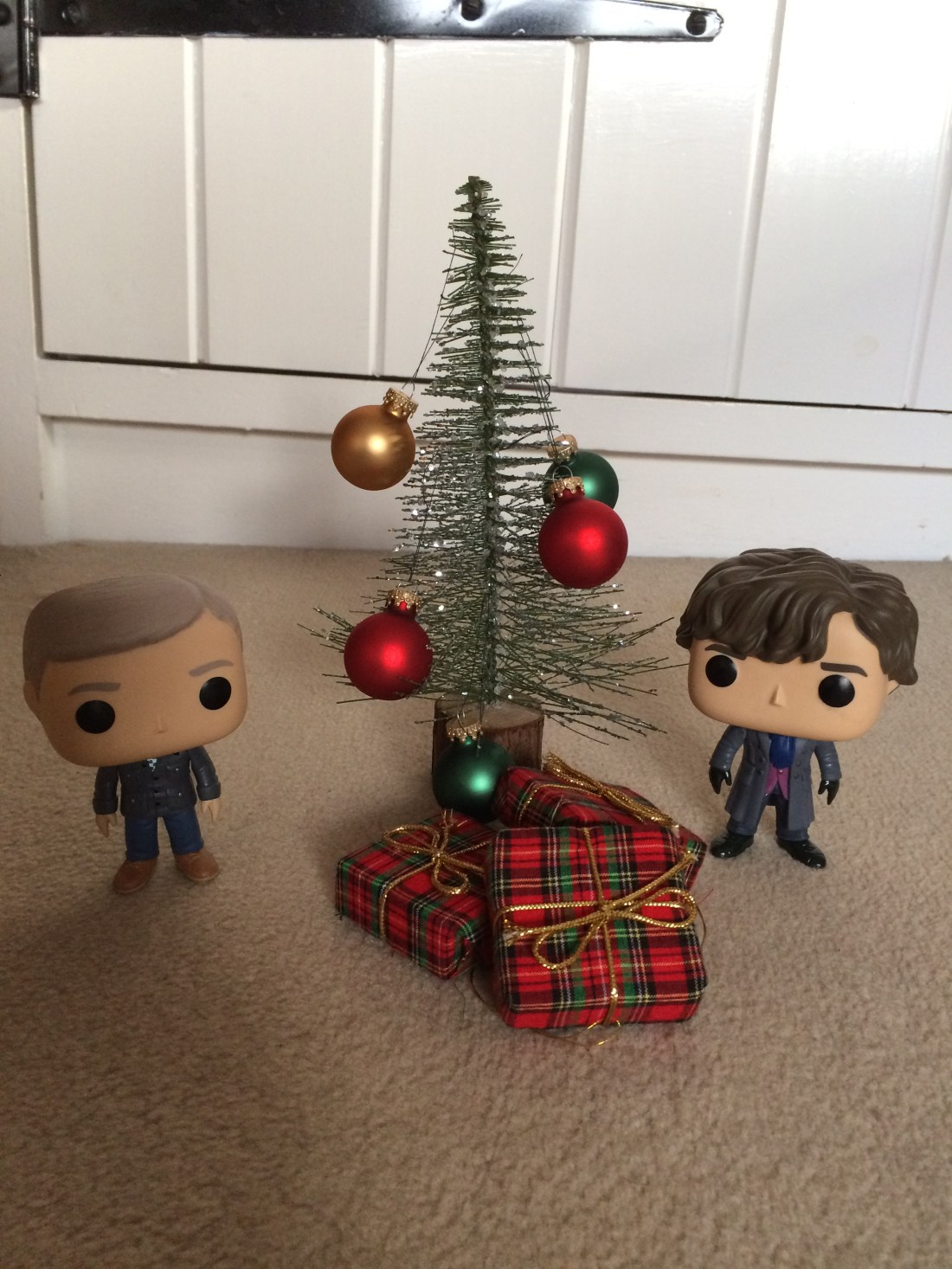
IMG_7637

Original caption: “Why has Mrs Hudson left a tree in the middle of the room, John?”
“It’s a Christmas tree, Sherlock. And frankly you’re an idiot!”
“I’m not an idiot, I’m a high-functioning sociopath”.

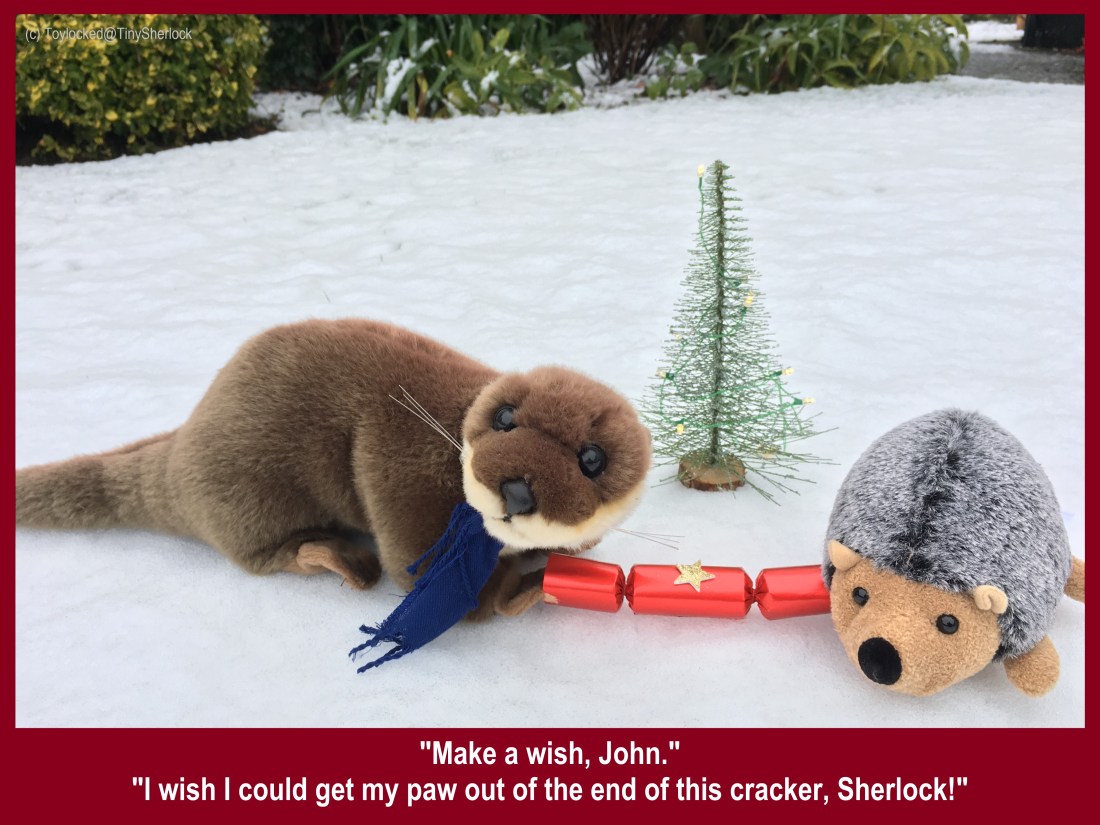
Eventually, of course, the Sherlock pictures took over and I started the Toylocked page. Christmas still provided opportunities for some enjoyable picture-making. So did the snow. Although I have used a number of different sizes of Sherlock toys for making pictures, this is the only time I have played on the memes of Benedict Cumberbatch’s resemblance to an otter and Martin Freeman’s to a hedgehog:

cracker titled

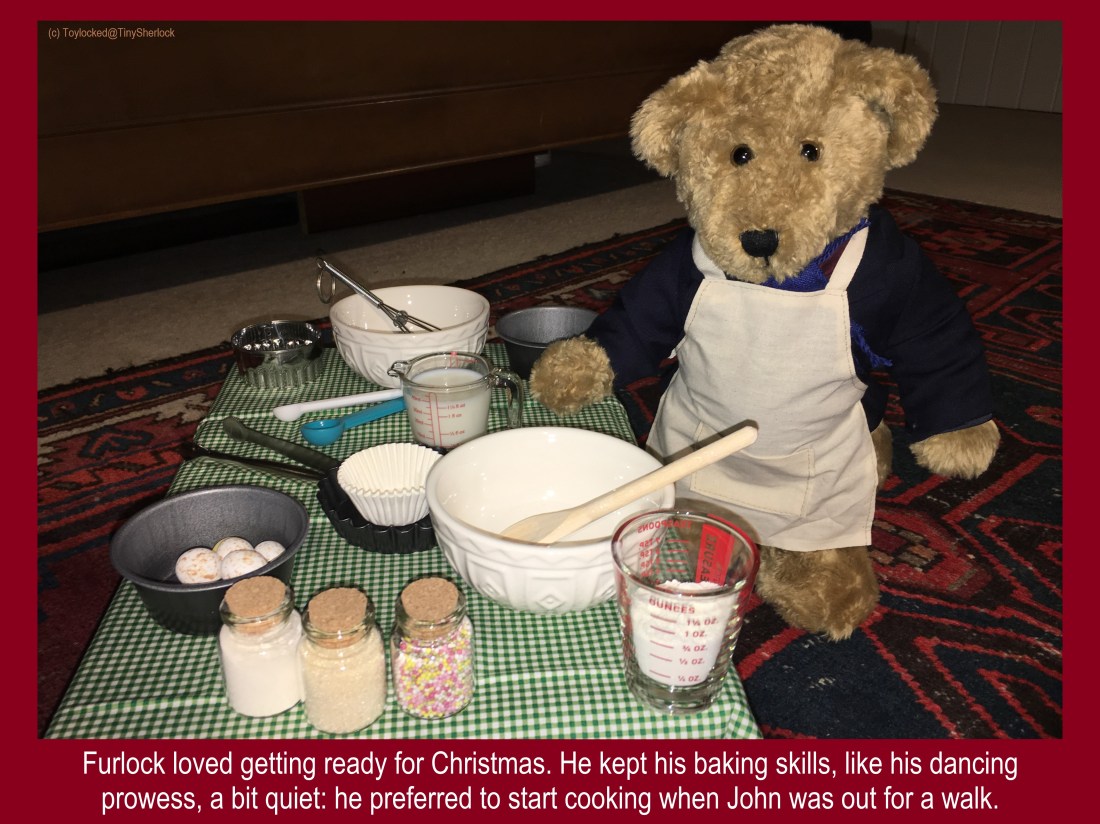
I wanted to make a Christmas picture using Furlock, the official Sherlock teddy bear (about whom there will be more in a future blog post).  This would be an imaginary scene from Sherlock’s home life. While the Funko toys are compatible with 1:12 dollshouse furniture, a stately Furlock bear requires bigger props. I took off his coat and made him an apron:

IMG_2334

I bought tiny whisks, cake tins, mixing bowls and measuring jugs in kitchen shops, I filled little jars with sugar and sprinkles. I even cut down the handle of a small wooden spoon to make it proportionate.  Furlock was ready to bake…

furlock bakes titled

Shortly afterwards, we saw Furlock and John sitting down to enjoy the results (John wearing a special teddy-sized Christmas sweater bought on eBay). All the food in this picture is real – tiny pies, iced biscuits, even real tea in the cups!

christmas tea titled

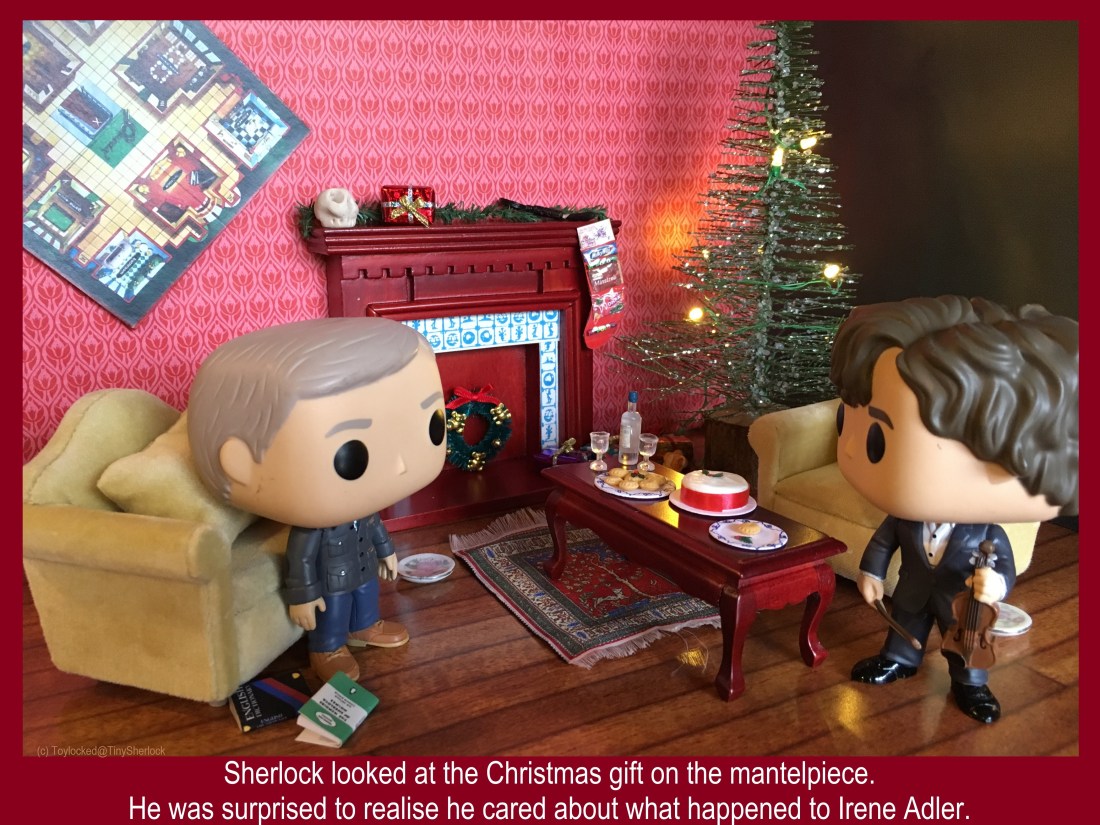
But of course, the Funko toys had to have a Christmas scene too.  In A Scandal in Belgravia, Sherlock and John’s flat looks very cosy and colourful when they host drinks for their friends. I used a large number of tiny props to create the same feel: the cake, the mince pies, the gifts, the stocking-shaped selection pack of sweets (we used to be given these when I was little!), the gift on the mantelpiece, the crockery, the bottle and glasses, the wreath in the fireplace. All were from dollshouse suppliers online, as were the tiny working fairy lights wrapped round a tree from a bargain shop in town.  The books on the floor are an English dictionary and a copy of the memoirs of Sherlock Holmes.

mantelpiece titled

My tiniest Sherlock toys (made by the talented Carolina Alkstal) included a tiny Molly figure. This meant I was able to create a scene earlier during the same drinks evening, when Sherlock upset Molly and had to apologise. I used some of the same props, but had to put them in the background because they were too big for the toys. I used a smaller tree and a tiny carrier bag full of gifts. Sadly, I haven’t managed to find a Lestrade figure to show him looking on in horror at Sherlock’s lack of tact!

horrible things titled