
The creators of Sherlock set us up for a series of dark and stylish dramas right from the start, with night-time scenes in London streets, wet pavements reflecting street lights, the glare of headlights, the gloom of ill-lit rooms. Attempting to depict these scenes in a smaller scale has presented its own challenges.
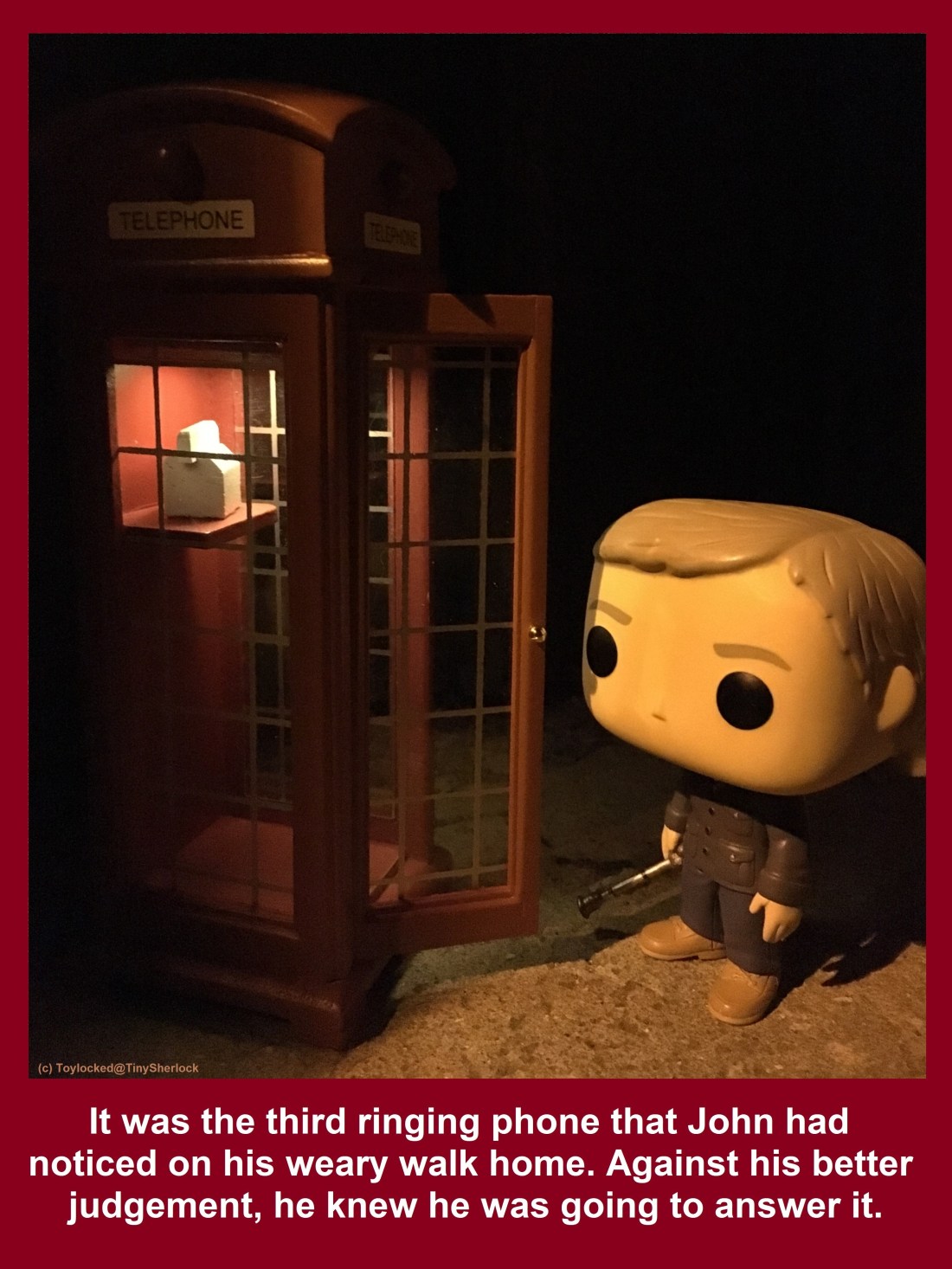
When John is first getting to know Sherlock, in A Study in Pink, he finds himself abandoned at Lauriston Gardens and having to walk (limp) back from Brixton. He passes two ringing telephones before warily deciding to pick up the third. I wanted to portray how alone he is at this point.
I found a model phone box online. It had to be lit from inside to be authentic: I stuck an LED light fitting from a dollshouse supplier onto the “ceiling” of the phone box. Then it was a question of location, near enough to street lights to show John’s face but without extraneous background.

This one works well for lighting, but my garden fence does not look like a Brixton street!
Eventually, I took the photo on a neighbour’s front doorstep (the houses face straight onto the street). It was quite late and nobody spotted me! The doorway created shadows which blacked out the background. The slightly orange glow is from a street lamp almost above me as I took the photo.
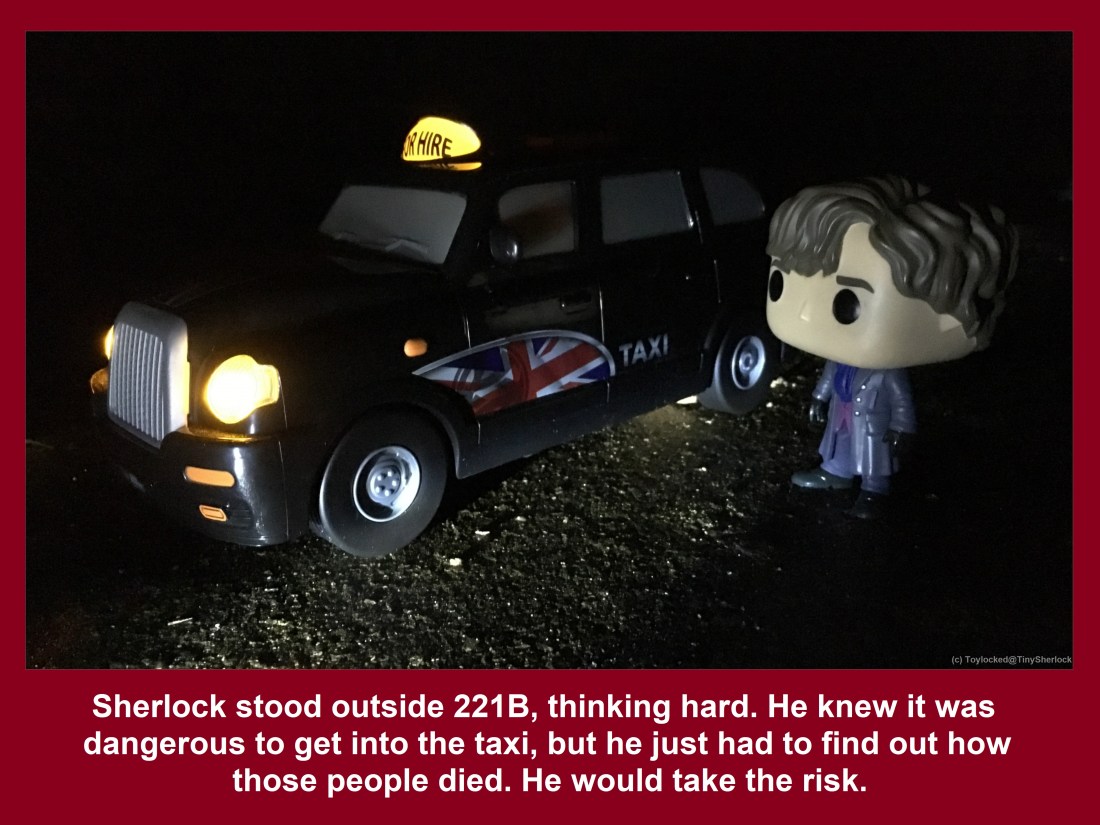
Later in that episode, Sherlock follows the taxi driver to his cab and eventually agrees to go with him to find out more (just say no, kids!). I was very pleased to find a well-known department store selling toy taxis with functioning headlights and a light-up “For Hire” sign. The only problem was that the button one had to press to make the lights work also made the wheels turn, driving the cab forward while it emitted the noise of an engine. To set up the photo in my back garden, I balanced the taxi with its axle on a small block of wood to prevent it from driving away. Then I arranged Sherlock with a torch shining on him from several feet away, so that his face could be seen. Finally, I pressed the button on the cab and took a number of pictures in the few seconds when all the lights were working. This took several attempts, and I hope I didn’t disturb the neighbours with the roar of the taxi engine!
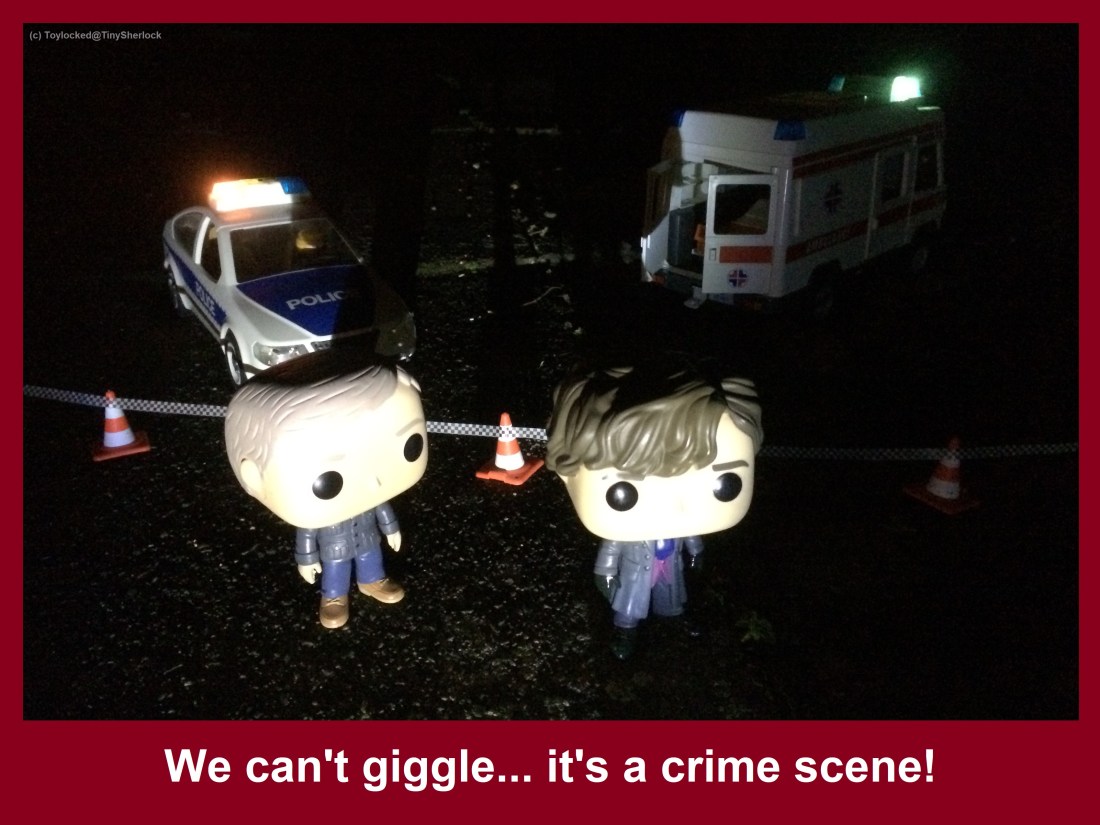
This episode famously ends with a scene outside Roland Kerr Further Education College. The scene at the top of today’s blog, and the scene below, were photographed at the same time. The figures were lit with torches, as usual. The picture was given depth with the Playmobil emergency vehicles, which are conveniently fitted with flashing lights. The traffic cones are also Playmobil, and the chequered tape is Japanese washi tape. Once the picture was set up, I had to press the buttons on the toy vehicles to make the lights flash, and take lots of shots in the hope of getting them all showing at the same time.
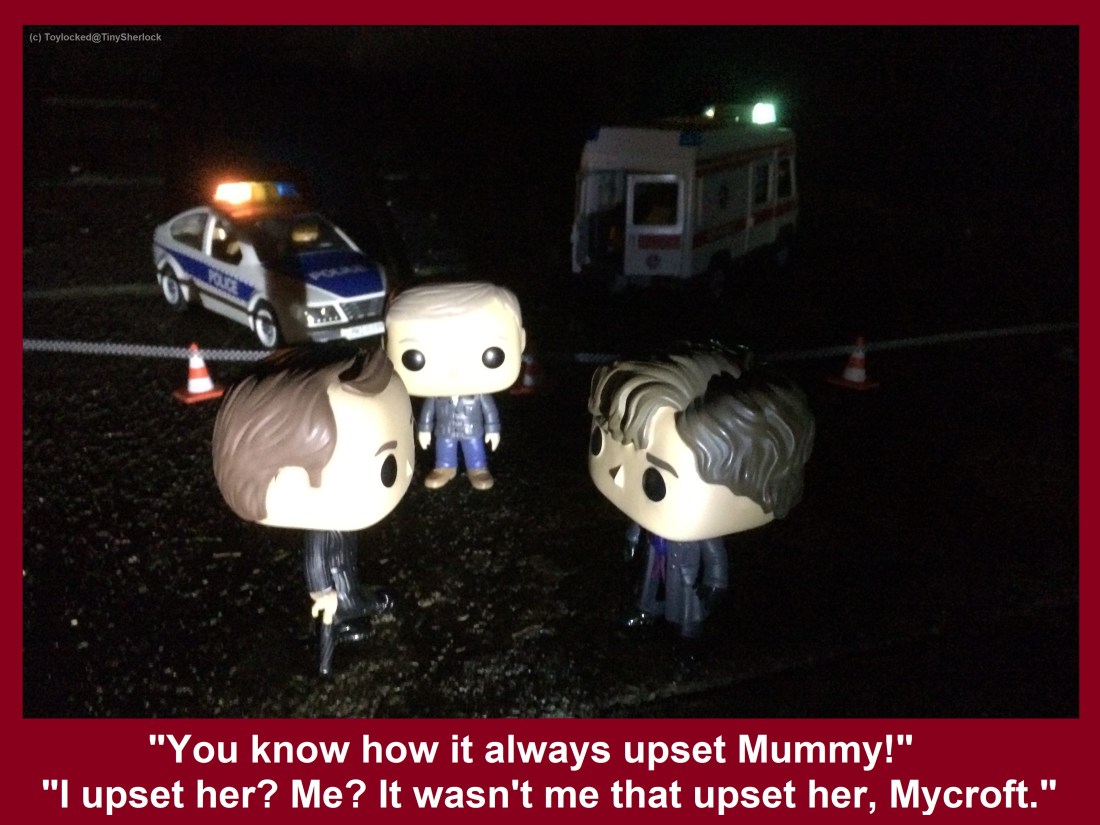
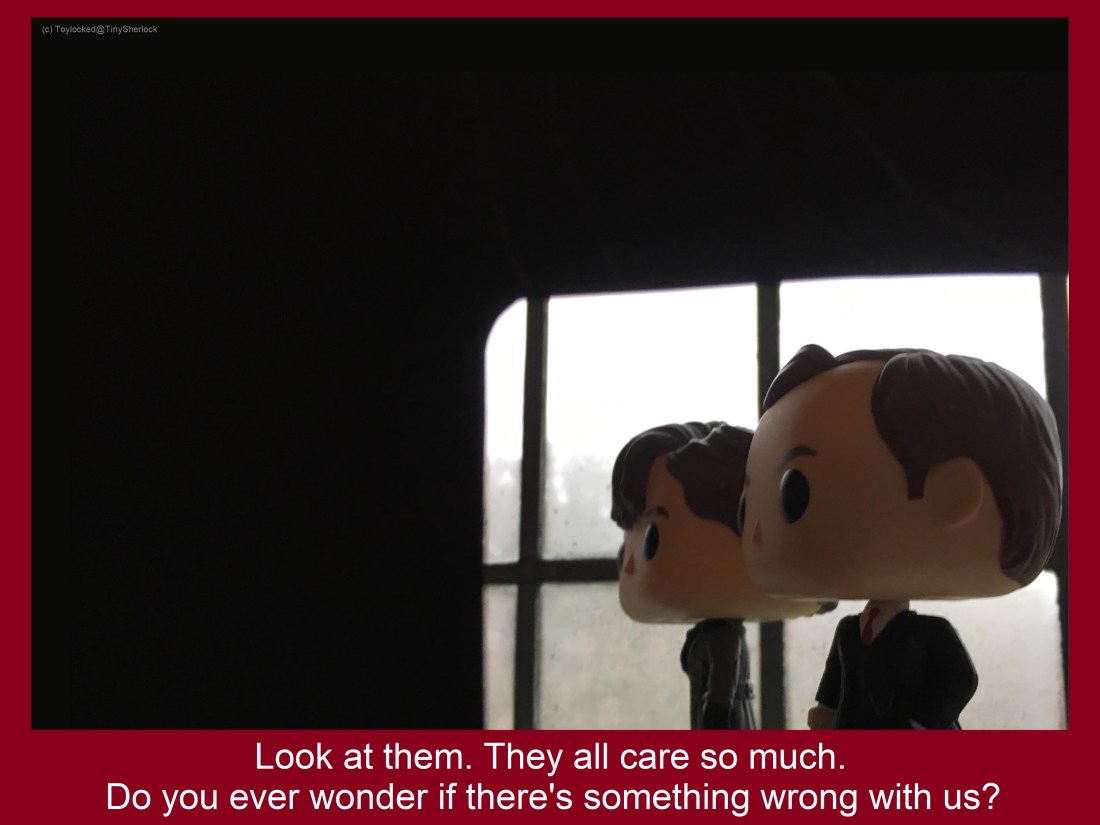
In A Scandal in Belgravia, light and dark are used in a very different way to set a mood. One particular shot I have always admired is in a scene at St Bartholomew’s Hospital, where Sherlock and Mycroft ponder on the grief of bereaved relatives outside the morgue. For this conversation, over half the screen is dark, with only the heads and upper bodies of the brothers in view as they talk.

I cut a square out of a piece of black card and held it between the phone and the toys. This was surprisingly hard to get right – I had to re-focus several times, especially as the light was behind the toys. They were in fact standing on my bathroom windowsill. And I created the effect of frosted glass by… you guessed it… taking the photo shortly after having a hot bath!
Right at the end of this episode, there is a scene set in darkness apart from the light of flaming torches – Sherlock’s memory of rescuing Irene Adler from execution. Again, I positioned the toys in the back garden, by torchlight. Their clothes were made from black cotton, pinned round them so their heads were covered. Sherlock is carrying a 1:12 sized sabre (there seems to be quite a market in miniature weapons, presumably for war gamers). As usual, tiny-footed Irene kept falling over in the slightest breeze. The darkness once again hid any extraneous background (like my rubbish bins) and I think the end result is suitably simple but dramatic.
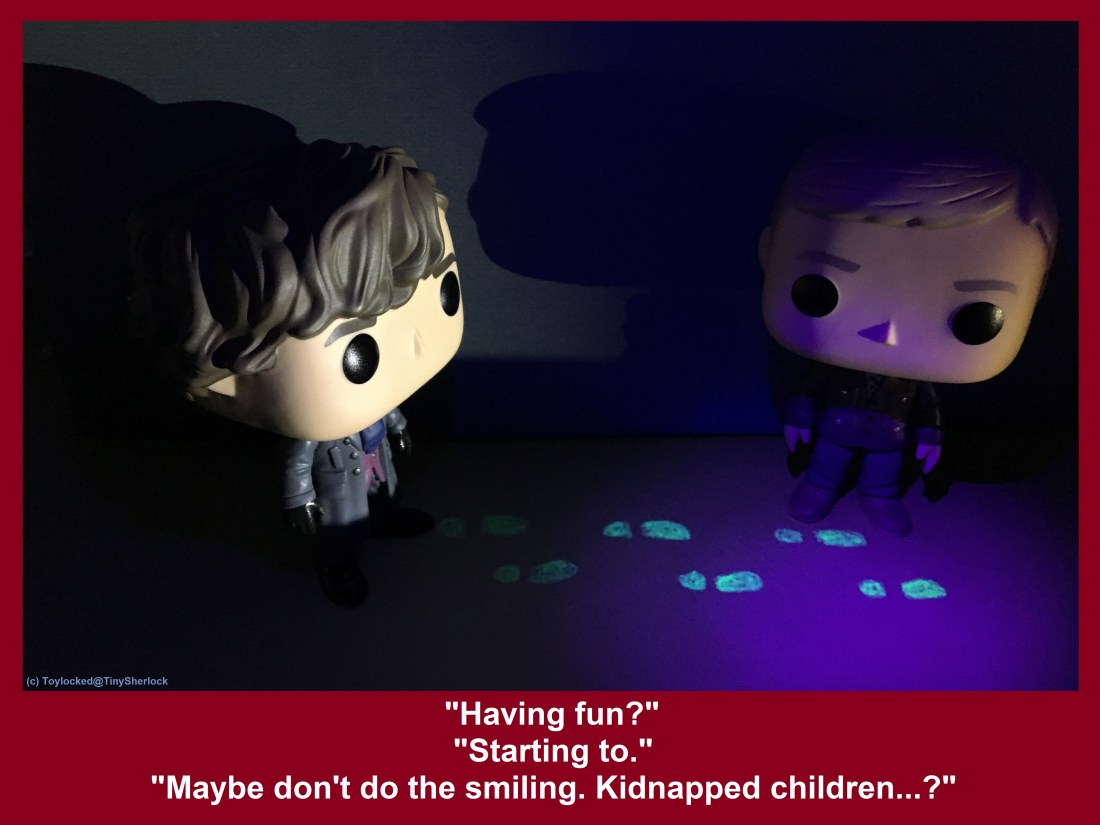
In the Reichenbach Fall, Sherlock uses light to solve the puzzle of the kidnapped children of the amabassador to the US. He realises that Max Bruhl has left a trail using the linseed oil with which he polishes his cricket bat. Using an ultra-violet light, Sherlock traces the footprints and is also then able to analyse residue from the soles of the kidnapper’s shoes. It’s a very typical Sherlock moment, where he demonstrates happiness quite inappropriate to the circumstances. The floor and background were very simple, but the trick was in the footprints. I was very happy when I discovered glow-in-the-dark felt pens! I drew the footprints, positioned the toys, lowered the lights in the room and balanced a torch on a pile of books so that it highlighted the footprints on the floor.
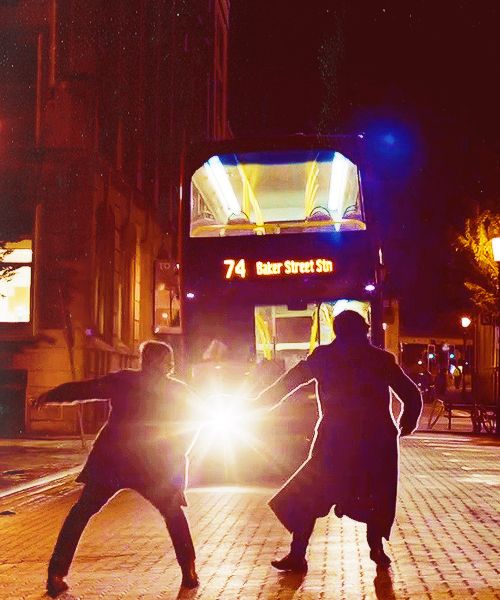
Later in the same episode. Sherlock drags John in front of a double-decker bus in an attempt to draw out one of the assassins who have been trailing him. It’s another beautiful shot in the series, with our heroes silhouetted against the glare of the bus’s headlights.
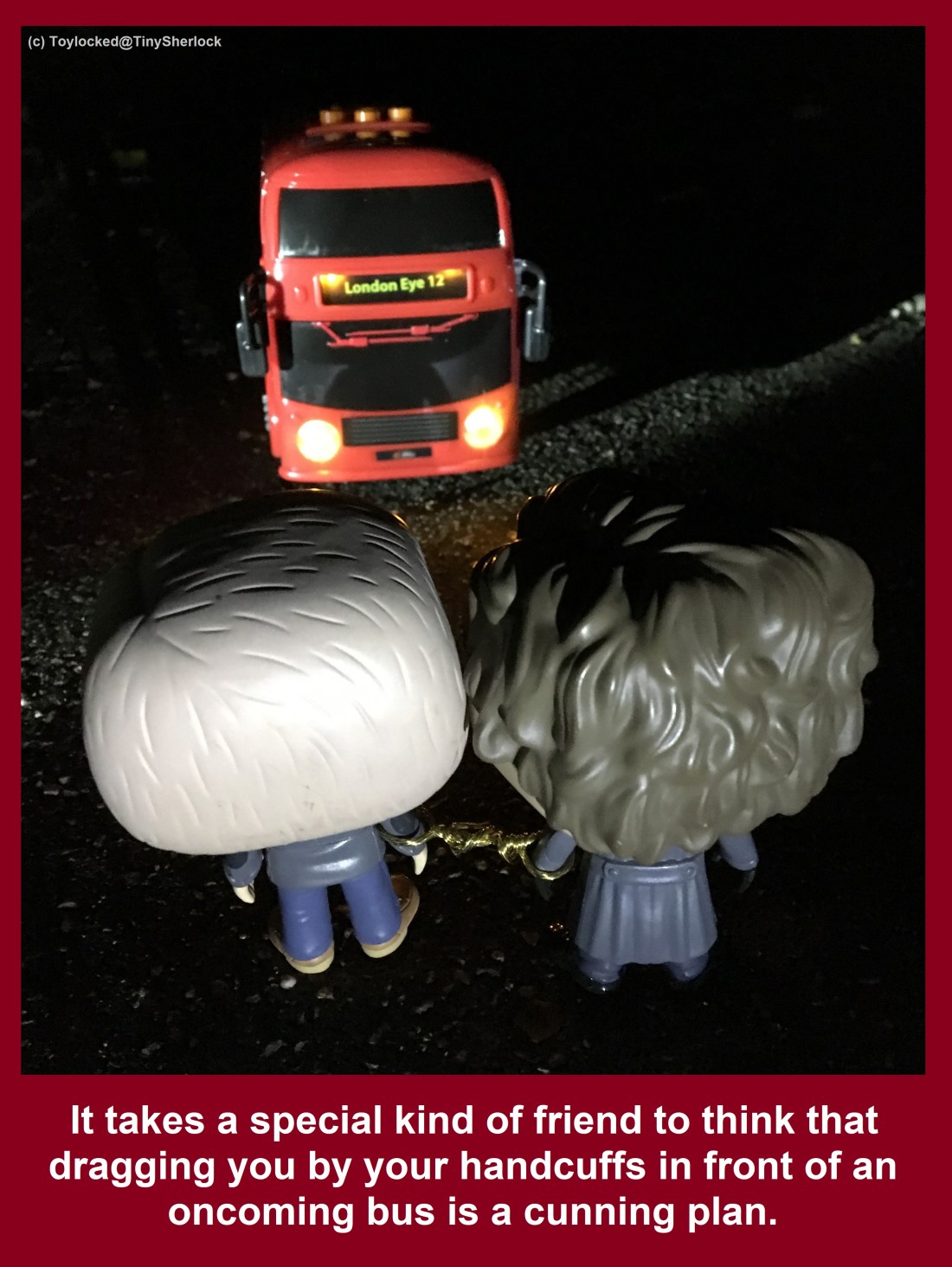
The same department store which sold the taxis also sold buses with working headlights. I had the same problem as with the taxi, in that the button which made the lights work also made the wheels turn and the engine roar (in this case with added music!). I had to balance the back axle on some wood to prevent the boys from being run over. Cue more engine noises and inappropriate musical accompaniment as I took multiple shots to get the lighting right (yes, my poor neighbours!). The “handcuffs” are simply some wire – I couldn’t find toy handcuffs which fitted round their little Funko arms! Obviously the bus destination is wrong, but I have a basic rule to try not to use Photoshop or similar and to show the toys as they really are. I had to settle with a bus going to the London Eye instead of Baker Street.
Mycroft’s office in the later episodes has very distinct lighting, because its windows are all in the ceiling. This means that rectangles of light are projected onto the walls, floor and furniture.
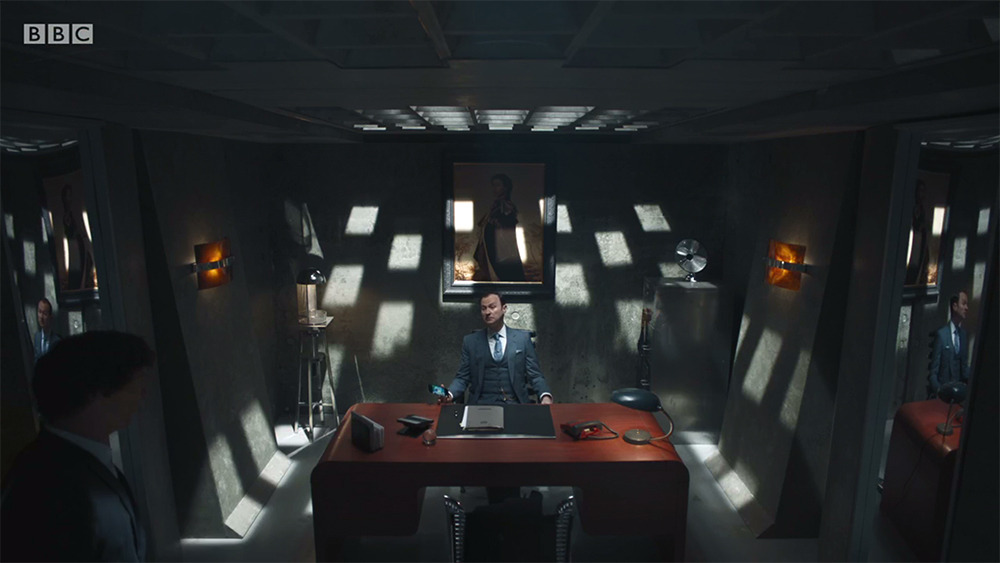
In recreating the scene from The Six Thatchers where Sherlock asks Mycroft what he knows about AGRA (the freelance assassins) and Mycroft replies with information about Agra (the city in India), I wanted to replicate this effect. The room itself is fairly simple: I bought a desk from an online supplier, and also a tiny working desk lamp. The globe is a novelty pencil sharpener. The newspaper is actually a miniature version of The Daily Telegraph with a picture of the Duchess of Cambridge on it (I think Mycroft is a staunch royalist). The portrait of the Queen is available all over the place (it is in the same picture frame as I used for The Lost Vermeer). It was the lighting which was tricky. I cut square holes in a piece of black card and shone a bright torch through it.

The angle of the torch had to be just right to get the shapes right on the walls, and if the torch was too near, or the room too dark, the contrast was too great and the picture was spoiled. Eventually, by half closing the curtains, balancing a torch on a pile of books, and holding the card with the holes in with my left hand while taking the photo with my right, I got it more or less right. Ladies and gentlemen, I present the heart of the British Government!

 Toylocked
Fantastic as usual 😊😊👍👍👌👌
LikeLike
Thank you, Mariana – you are very kind 🙂
LikeLike